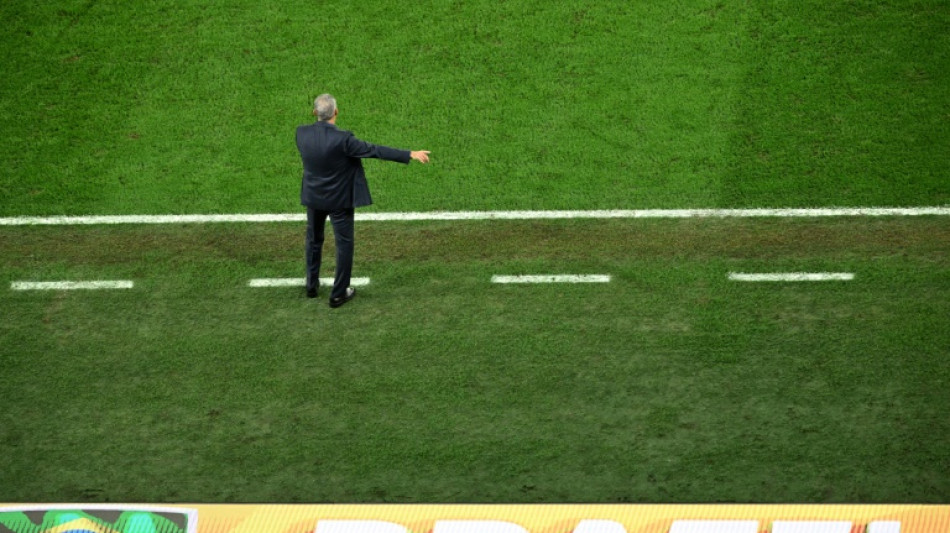
Brazil open door to breaking foreign coach taboo / Photo: © AFP/File

 Abdul El-Sayed declares victory in Michigan Senate contest

 Democrats capture US Congress in sweeping midterm victory
 Manchester United rallies past Roma as PSG dominates in Champions League
 Qatar sees tentative opening for renewed regional diplomacy
 Qatar Tourism joins Pacific Asia Travel Association at London travel market
 Abdul El-Sayed Wins Michigan Senate Seat in Historic Election
 Qatar media bodies discuss support for humanitarian initiatives

 Galloway accuser could not foresee publishing-sector fallout, lawyer argues
 New York City Center revives In the Heights as a timely community story

 Godzilla Minus Zero shifts focus toward postwar human drama

More than two decades since their last World Cup triumph and without a local consensus pick, Brazil are considering breaking an unwritten taboo: hiring a foreign coach.
After six years in the job, Tite left the Brazil post last month following the Selecao's World Cup quarterfinal exit against Croatia.
Despite knowing for some time before the Qatar showpiece that Tite was leaving, Brazilian Football Confederation (CBF) president Ednaldo Rodrigues still has not found a replacement.
Now he is widening his search.
"We have no nationality prejudices," he said on January 17.
"We want it to be a respected coach who can bring a level of play worthy of the athletes. We want to do what Brazil have always tried to do: to be very attacking."
Apart from England, who hired Swede Sven Goran Eriksen and Fabio Capello of Italy in the 2000s, almost no other major footballing nation has had a foreign coach in decades.
Brazil's World Cup drought -- stretching back to their dazzling triumph in 2002 with a three-pronged attack comprised of Ronaldo, Ronaldinho and Rivaldo -- has forced the record five-time world champions to cast the net farther afield.
There are potential Brazilian candidates, but none have garnered widespread support.
"We have good quality, but before we used to produce more coaches than now," Luiz Felipe Scolari, the 2002 title-winning coach, said recently.
"The new generation ... haven't won enough trophies."
- Fans unconvinced of 'gringo' merits -
Brazilian press have been proposing numerous possible candidates.
Spaniards Pep Guardiola and Luis Enrique, Italy's Carlo Ancelotti, Frenchman Zinedine Zidane, Jose Mourinho of Portugal and even Argentines Marcelo Gallardo and Mauricio Pochettino.
Manchester City's Guardiola and Ancelotti of Real Madrid have both ruled themselves out, although the Spaniard did say a couple of years ago that he fancied leading a national team when he leaves the English champions.
"Since the end of last year I think I've heard 26 names. We will go after some of them," said Rodrigues, who hopes to have the new man in place by March.
But it is not easy hiring a world class coach when top European clubs can pay such inflated wages and offer the chance to compete for the Champions League or national titles.
It is also not easy to convince the Brazilian fans to accept a "gringo" in charge of the Selecao.
A poll in December found 48 percent were against the idea, with only 41 percent in favor.
The rejection rate was at least lower than in previous such polls.
"In Brazil there is one idea: we have the best football in the world, so we don't need a foreign coach telling us how to play," historian and editor of sports website Ludopedio, Victor Figols, told AFP.
"Us, who know how to develop great players, who in part created dribbling, the way to play the beautiful game."
- Local candidates -
Brazil did once have foreign coaches, although their reigns were fleeting.
Uruguayan Ramon Platero held the position in 1925, Portugal's Jorge Gomes de Lima coached the Selecao alongside Brazilian Flavio Costa in 1944, and Argentina's Filpo Nunez had a brief stint in 1965.
But foreigners were discarded once Brazil, using homegrown coaches, consolidated itself as a world football power.
Quite the opposite occurred as coaches such as Scolari, Vanderlei Luxemburgo, Carlos Alberto Parreira, Ricardo Gomes and Zico took charge of other national teams.
"An image was built throughout history that since we develop great players, we also develop great coaches, but it's not true," said Figols.
"If we look at the FIFA rankings, Brazilian coaches are not even in the top 10."
There are some local candidates who are popular among the press, such as Dorival Junior, who won the 2022 Copa Libertadores with Flamengo, or Fernando Diniz of Fluminense, Gremio's Renato Portaluppi and Mano Menezes of Internacional.
But none of them have a comparable resume to Tite's before he took over the Brazil role.
With Corinthians, Tite won the Copa Libertadores, two Brazilian titles and the Club World Cup in a five-year period.
"We need to improve the level of those that live here regardless of whether we hire a foreigner or a Brazilian," Paulo Vinicius Coelho, author of the "Brazilian Football School" book, wrote in the Folha de Sao Paulo newspaper.
"Guardiola won't come. But that doesn't prevent Brazil from ... developing our own Pep Guardiola within a few years, as we once developed Zagallo and Tele Santana," he added.
J.Fankhauser--BTB