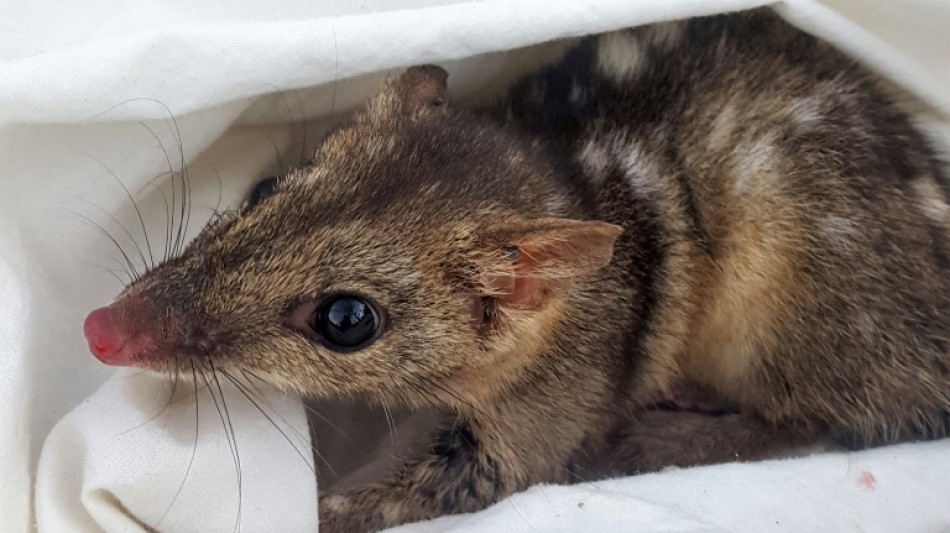
Relentless sex drive may threaten survival of quolls / Photo: © UNIVERSITY OF QUEENSLAND/AFP

 Shahidi hits ton but India bowl out Afghanistan for 218

 Israel strikes south Lebanon despite truce announced with Hezbollah

 Hurricanes blow away Chiefs in record-breaking Super Rugby final

 Ancient Greek theatre revives legendary Callas opera Medea

 Portugal's unofficial exorcism fever worries Church

 Ancelotti hails 'complete game' as Brazil sink Haiti at World Cup

 Scotland remain bullish despite Morocco World Cup setback

 Brazil cruise past Haiti to re-ignite World Cup campaign
 Scheffler career Slam chances blowing in Shinnecock winds

 McIlroy seven back but likes his chances at US Open

 Clark leads US Open by four with major champs in the hunt

 Archaeologists discover 'never before seen' pre-Hispanic ruins in Mexico

 James Burrows, prolific innovator in US TV comedies, dead at 85

 World Cup warning with Sweden star Isak 'getting stronger and stronger'

 Tunisia coach says 'I am no wizard' after World Cup SOS call

 USA beat Australia 2-0 to reach World Cup knockouts

 Qatar-gifted Air Force One replacement unveiled

 Niemann fires 65 at US Open after upsetting two-shot penalty

 Spain's Yamal says 'too soon' to play full match at World Cup

 Neymar? He is working remotely at the World Cup, jokes Lula

 Three-time Stanley Cup champion Toews retires

 Japan wary of fired up and wounded Tunisia for World Cup landmark game

 'Like a fridge': France cave homes offer lucky few respite from heat

 Hormuz ship traffic climbs after war deal: trackers

 Kane hails World Cup 'Wonderwall' singalong as England highlight

For male northern quolls, sex is a death sentence.
The cute marsupials native to northern Australia are the world's largest semelparous mammal, which means that the males drop dead after their first breeding season.
But what exactly causes them to die has remained a mystery.
Research published on Wednesday suggests that the males are depriving themselves of rest in their relentless pursuit to mate with females, potentially threatening the survival of their already endangered species.
Hoping to shed light on this sex-driven death frenzy, a team of researchers strapped tiny backpacks carrying tracking devices to seven male and six female northern quolls on Groote Eylandt, an island off the coast of Australia's Northern Territory.
The data, collected over 42 days that included breeding season, was entered into a machine learning algorithm which analysed different quoll behaviours.
The males were found to be far more active than females, who live for up to four breeding seasons.
And while females rested or laid around nearly 24 percent of the time, the proportion for males was just seven percent, according to a study published in the journal Royal Society Open Science.
The study's lead author, Joshua Gaschk of the University of the Sunshine Coast, told AFP that the "males didn't seem to be sleeping anywhere near as much as they should".
For the first time, "we might have a smoking gun" for what is causing the males to die after breeding, he said.
Smaller relatives of the northern quoll, such as the antechinus, are also semelparous.
But research has found that their males die from internal haemorrhaging and infection due to escalating stress hormones during mating season -- which is not what is killing the northern quolls.
- 'Mating frenzy' -
Gaschk said the yearly male die-off could threaten the survival of the northern quoll, which has been badly affected by the introduction of non-native cane toads, cats and foxes to Australia.
But the carnivorous marsupials have been using this extreme breeding strategy, also known as suicidal reproduction, "for thousands of years -- there's got to be a benefit to it," Gaschk said.
Indeed on Groote Eylandt, an island with no cane toads and few cats, the northern quolls are "not just surviving, but doing really well", he said.
Adrian Bradley of the University of Queensland, who was not involved in the study, called the new research "significant".
Bradley said he was quite certain that the "mating frenzy" of smaller semelparous marsupials like the antechinus is "stimulated as an irresistible response to the release of perfume-like pheromones from the cloacal glands of females."
The amount of weight lost during these frenzies likely explains why only smaller members of the dasyuridae family are semelparous, he said.
But for the larger northern quoll, Bradley warned it was not yet "possible to conclusively say" why some "males generally do not survive the breeding season," calling for further research.
R.Adler--BTB