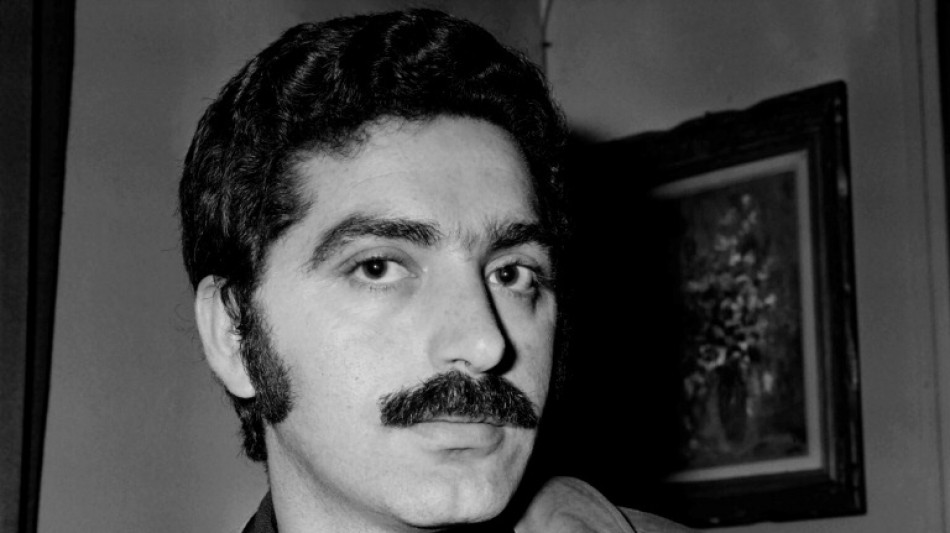
Paco Rabanne: from fashion spaceman to fragrance king / Photo: © AFP/File

 Abdul El-Sayed declares victory in Michigan Senate contest

 Democrats capture US Congress in sweeping midterm victory

 Manchester United rallies past Roma as PSG dominates in Champions League

 Qatar sees tentative opening for renewed regional diplomacy
 Qatar Tourism joins Pacific Asia Travel Association at London travel market

 Abdul El-Sayed Wins Michigan Senate Seat in Historic Election

 Qatar media bodies discuss support for humanitarian initiatives

 Galloway accuser could not foresee publishing-sector fallout, lawyer argues

 New York City Center revives In the Heights as a timely community story

 Godzilla Minus Zero shifts focus toward postwar human drama
Nicknamed "Wacko Paco" in the 1960s for his often unwearable designs, Spain's Paco Rabanne became best-known in later years for his globally popular line of fragrances as well as his eccentric beliefs.
Dismissed as "the metal worker" by Coco Chanel, his influence nonetheless carried through many generations and he famously dressed global superstar Lady Gaga in outfits made entirely of paper for her 2011 appearance at the MTV Europe Music Awards.
He also designed Jane Fonda's iconic costume for 1968 sci-fi film "Barbarella", and dresses for French icons Brigitte Bardot and Francoise Hardy.
Rabanne started out as a co-creator of the 1960s space-age movement in fashion alongside designers such as Pierre Cardin, who incorporated the era's giddy excitement around the future and technological advancements into their clothes.
His 1966 show brought immediate fame and notoriety when he stunned the audience with "12 Unwearable Dresses", his models dancing barefoot down the catwalk in outfits made of sharp metal and other unlikely materials.
"I have always had the impression of being a time accelerator," he wrote in typically enigmatic style for a retrospective at Antwerp's fashion museum MoMu in 2016.
"Of going as far as is reasonable for one's time and not indulge in the morbid pleasure of the known things, which I view as decay."
- Fleeing Franco -
Francisco Rabaneda-Cuervo was born in 1934 in Spain's Basque region, near the city of San Sebastian, where his mother was a seamstress for the designer Cristobal Balenciaga and his father was an army general.
Rabanne's life was uprooted by the Spanish Civil War when the army of dictator Francisco Franco turned on his father, a commander of the Guernica garrison, and gunned him down in 1936.
In 1939 his family fled to France and Rabanne went on to study at the Beaux-Arts university in Paris, graduating with a diploma in architecture.
He began his fashion career creating accessories -- jewellery, ties, buttons -- that caught the attention of Christian Dior, Yves Saint-Laurent and Pierre Cardin.
After the media furore around his own line, Rabanne signed a deal in 1968 that brought him under the ownership of the Barcelona-based Puig family, heavyweights in the fashion and fragrance industry.
It marked his entry into perfumes that would see his name become synonymous with cologne, ultimately even eclipsing his fame as a designer.
- 'Mystic, madman' -
Ever the provocateur, Rabanne had a penchant for mysticism and esoterism.
He claimed to have had multiple lives, to have been some 78,000 years old, to have made love to the Earth, seen God and been visited by aliens.
In 1999 he predicted in his book "Fire From Heaven" that Paris would be destroyed later that year when the Russian space station Mir crashed down to Earth -- a claim derived from his reading of the 16th-century French seer Nostradamus.
"To say that Paco Rabanne marches to his own drummer is an understatement," the New York Times wrote in 2002. "He's been called a futurist, couturier, mystic, madman, Dadaist, sculptor, architect, astrologer, perfumer, artist and prophet."
B.Shevchenko--BTB