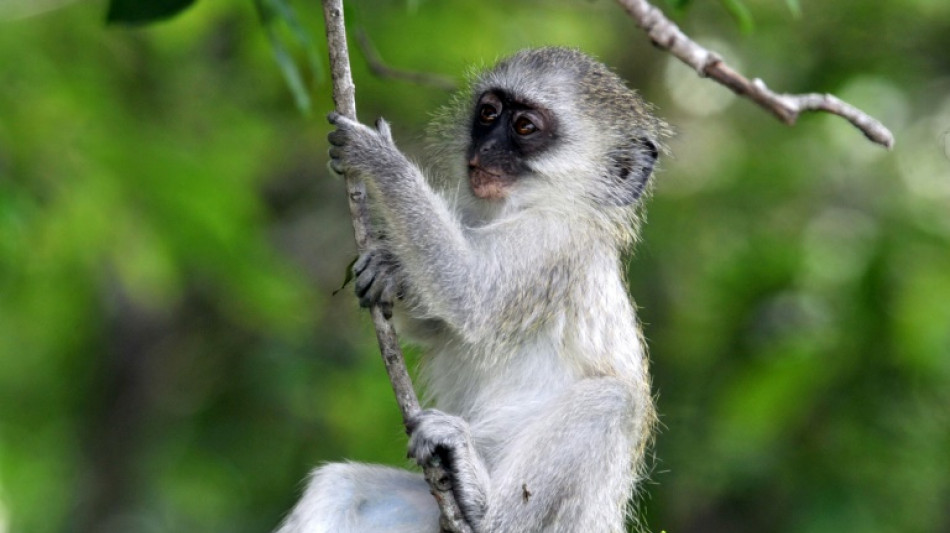
Tropical French territory battles green monkey invasion / Photo: © AFP

 Abdul El-Sayed declares victory in Michigan Senate contest

 Democrats capture US Congress in sweeping midterm victory

 Manchester United rallies past Roma as PSG dominates in Champions League

 Qatar sees tentative opening for renewed regional diplomacy

 Qatar Tourism joins Pacific Asia Travel Association at London travel market

 Abdul El-Sayed Wins Michigan Senate Seat in Historic Election

 Qatar media bodies discuss support for humanitarian initiatives

 Galloway accuser could not foresee publishing-sector fallout, lawyer argues

 New York City Center revives In the Heights as a timely community story

 Godzilla Minus Zero shifts focus toward postwar human drama

French officials on the Caribbean island of Saint-Martin are seeking ways to battle an invasion of green monkeys, blamed for threatening the tropical tourism hotspot's fragile biodiversity, local authorities said.
The primates, which originate from Africa, are reproducing at an alarming rate, threatening the survival of some indigenous species, they said.
The island of Saint-Martin, split between France and the Netherlands, is a popular tourist destination boasting sandy beaches and varied wildlife.
Green monkeys, which originally came to Saint-Martin as pets owned by foreign colonisers or on trade ships, have spread across the island with a remarkable ability for adaptation.
The Dutch authorities recently took a radical step, ordering 450 of the primates, named after their golden-green fur, to be put down.
The Nature Foundation St. Maarten, an NGO, will be charged with capturing the green monkeys for culling as part of a three-year plan to contain their population growth.
On the French side, the authorities said they were still fact-finding.
The animal species' spectacular population growth could affect the region's biodiversity, said Julien Chalifour, a scientist for the island's Natural Nature Reserve.
The monkeys have earned a reputation among locals for acting aggressively to residents and pets as well as overturning garbage bins, destroying gardens and defecating on people’s property.
The non-indigenous monkeys are not picky eaters and will consume just about anything including bird eggs, crops and ornamental and fruit plants and trees.
"They are benefiting from an abundance of food thanks to lots of rain, which in turn increases the possibility of reproduction," Chalifour said. "We can't let them continue to multiply. They're everywhere."
There was a noticeable rise in the green monkey population in 2017 following Hurricane Irma, he said.
"These omnivorous mammals then found themselves in an environment with no food source, which led them to spread out in order to feed themselves," the scientist said.
Officials have appointed a zoologist, Nathalie Duporge, to lead an "environmental impact assessment" before deciding on the next steps.
France's half of Saint-Martin became a French overseas territory in its own right in 2007, having previously belonged administratively to Guadeloupe, France's biggest possession in the Caribbean.
It had a population of just over 32,000 in 2020.
R.Adler--BTB
