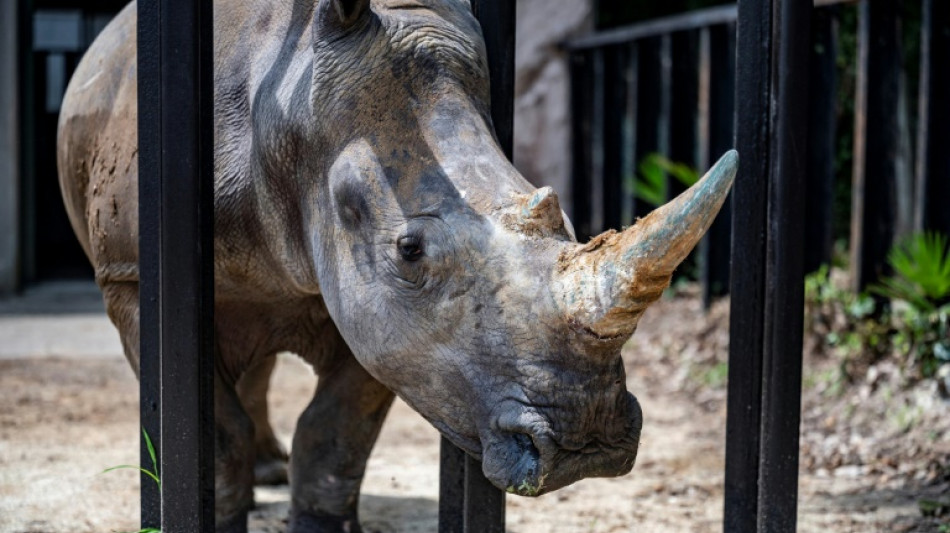
South Africa's largest rhino farm puts itself up for sale / Photo: © AFP

 Italy Claims Curling Silver at European Championships in Ostrava

 Kuwait finance minister holds economic cooperation talks at COMCEC

 Abdul El-Sayed declares victory in Michigan Senate contest

 Democrats capture US Congress in sweeping midterm victory

 Manchester United rallies past Roma as PSG dominates in Champions League

 Qatar sees tentative opening for renewed regional diplomacy

 Qatar Tourism joins Pacific Asia Travel Association at London travel market

 Abdul El-Sayed Wins Michigan Senate Seat in Historic Election

 Qatar media bodies discuss support for humanitarian initiatives

The owner of a huge South African rhino conservation farm, the world's largest, said Monday that it would be sold at auction in April because it could no longer afford to breed the endangered animals.
Platinum Rhino, home to nearly 2,000 southern white rhinoceros spread across 8,500 hectares (21,000 acres) in the country's North West province, says it is "the largest of its kind in the world".
"Breeding rhinos is an expensive game," John Hume, Platinum's 81-year-old founder, told AFP, adding that he had been breeding rhinos "for 30 years without profit".
South Africa is home to about 80 percent of the world's rhino population, but poaching has taken a huge toll despite increased protection efforts on both private reserves and at national and regional parks.
This month, the government said 448 rhinos were killed across the country last year, just three fewer than in 2021, as poachers increasingly targeted privately owned reserves instead of national parks.
The animal's horns consist mainly of hard keratin, the same substance found in human nails, but they are highly sought on black markets for use in traditional medicines in Asian countries such as China and Vietnam, where it is believed to cure cancer and other ailments.
"Preventing poaching took a huge monetary toll," said Hume, adding that it cost him up to half a million rand ($28,000) to breed a rhino up to the age of four years at his farm, which employs around 100 people.
He said he is looking for a buyer "with a passion for conserving rhinos and the means to keep the breeding project going".
Last year, Hume announced plans to release 100 farm-bred rhinos into the wild each year, which the farm's chief veterinarian, Dr Michelle Otto, said "could repopulate the whole of Africa" if there were sufficient funding for the project.
Hume had also sparked controversy in 2017 by organising a three-day online auction of horns he had amassed by sawing off them off in order to prevent their killing by poachers, though the sale attracted fewer buyers than anticipated.
Platinum Rhino is home to over 16 percent of South Africa's southern white rhino population according to the company, the subspecies of white rhino, is now considered endangered with about 20,000 individuals remaining, according to the World Wildlife Fund (WWF).
O.Lorenz--BTB

