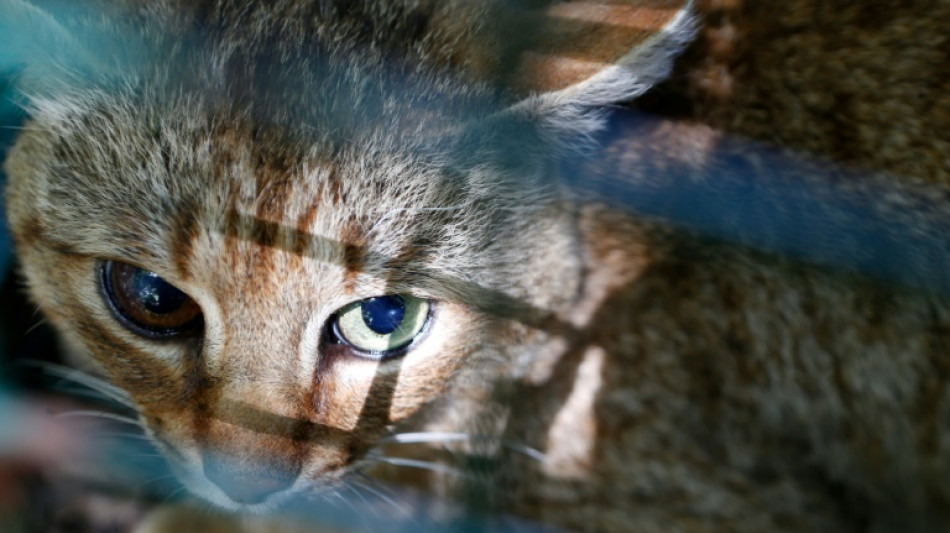
Mysterious Corsican 'cat-fox' revealed as unique species / Photo: © AFP/File

 Italy Claims Curling Silver at European Championships in Ostrava

 Kuwait finance minister holds economic cooperation talks at COMCEC

 Abdul El-Sayed declares victory in Michigan Senate contest

 Democrats capture US Congress in sweeping midterm victory

 Manchester United rallies past Roma as PSG dominates in Champions League

 Qatar sees tentative opening for renewed regional diplomacy

 Qatar Tourism joins Pacific Asia Travel Association at London travel market

 Abdul El-Sayed Wins Michigan Senate Seat in Historic Election

 Qatar media bodies discuss support for humanitarian initiatives

The elusive striped "cat-fox" familiar mostly to Corsican shepherds and as a source of intrigue to scientists, is indeed its own species specific to the French Mediterranean island, the French office for Biodiversity (OFB) announced Thursday.
New genetic analysis has "revealed a unique genetic strain to the wild cats" found in the remote forest undergrowth of northern Corsica, it confirmed.
Genetic sampling clearly distinguishes the ring-tailed Corsican cat-foxes from mainland forest felines and domestic cats, said the OFB in a statement.
While resembling house cats in some ways, the cat-fox earned its name from its length -- measuring 90 centimetres (35 inches) from head to tail -- and its distinct black-tipped, ringed tail.
Other distinguishing features include the stripes on the front legs, "very dark" hind legs, and a russet stomach. The dense, silky coat is a natural repellent for fleas, ticks and lice.
The inconspicuous feline finally became part of a concerted research effort -- after years of playing a game of cat and mouse -- when one was unexpectedly captured in a local chicken coop in 2008.
But it has long been part of local folklore.
"The cat-fox is part of our shepherd mythology," Carlu-Antone Cecchini, head of the forest cat mission at the National Hunting and Wildlife Office, now part of the OFB, told AFP in 2019.
"From generation to generation, they told stories of how the forest cats would attack the udders of their ewes and goats."
The discovery of a unique genetic lineage is an essential step towards ensuring proper protection and conservation for the endangered species.
Y.Bouchard--BTB

