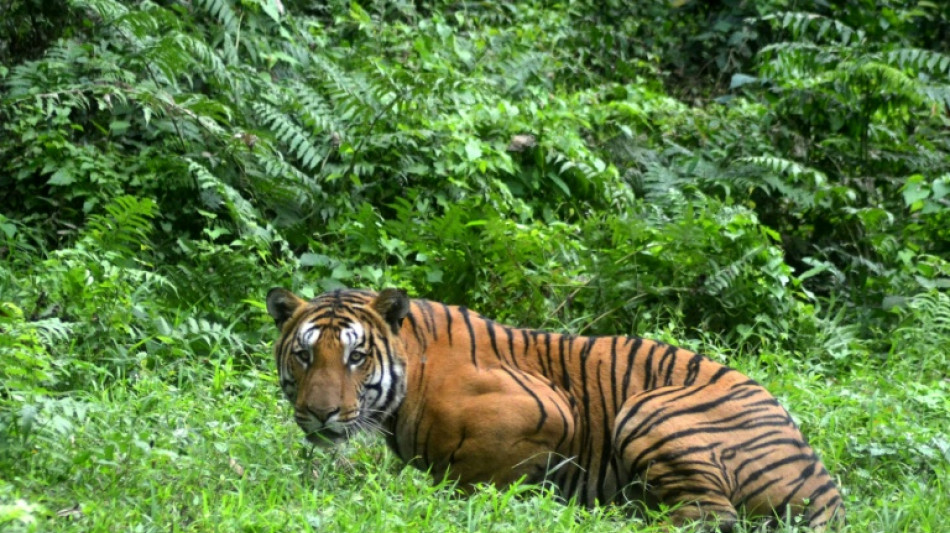
India's tiger population rises above 3,000 / Photo: © AFP

 Equitas Small Finance Bank rebounds after naming interim chief executive

 Titan quarterly profit seen rising as jewellery business drives growth

 Indian crude-sensitive shares gain after 13% oil-price decline

 Stocks and dollar fall as Democratic election gains reshape markets

 Kuwait marks key events and anniversaries from national history

 Trump congratulates Democrats and signals willingness to cooperate

 Qatar prime minister advances mediation through diplomatic calls

 Greenland parliament approves security agreement with United States

 Qatar envoy meets incoming UN General Assembly president

 Trump Signals Willingness to Work With Democrats After Midterm Defeat

 Pitches and Keynote Speakers Are Confirmed for Blue Magic Netherlands on November 17
India's wild tiger population -- by far the largest in the world -- has risen above 3,000, according to a census released Sunday, boosting efforts to conserve the endangered species.
The largest of all cats, tigers once roamed throughout central, eastern and southern Asia.
But in the past 100 years the tiger has lost more than 93 per cent of its historic range and now only survives in scattered populations in 13 countries, according to the International Union for Conservation of Nature (IUCN).
The Indian census estimated there were 3,167 tigers in the wild across the country, up from 2,967 reported in the last such exercise.
Surveys are conducted every four years, using camera traps and computer programs to individually identify each creature.
The rate of increase has slowed to less than seven percent over the period, down from more than 30 percent in the previous four years.
But Prime Minister Narendra Modi said the new figure was a "proud moment".
"Our family is expanding," he said at a ceremony in the southern city of Mysuru. "This is a matter of pride not not only for India but the entire world."
Deforestation, poaching and human encroachment on habitats have devastated tiger populations across Asia but Modi said India had been able to increase its numbers thanks to "people's participation" and the country's "culture of conservation".
India is now home to 75 percent of the global tiger population and also the "largest tiger range country in the world", he added.
In 1900, more than 100,000 tigers were estimated to roam the planet. But that fell to a record low of 3,200 in 2010.
That year, India and 12 other countries with tiger populations signed an agreement to double their big cat numbers by 2022.
India is believed to have had a tiger population of around 40,000 at the time of independence from Britain in 1947.
That fell over subsequent decades to about 3,700 in 2002 and an all-time low of 1,411 four years later, but numbers have since risen steadily.
Dipankar Ghose, director of the wildlife and habitats programme at the World Wide Fund for Nature-India told AFP the latest increase in tiger numbers was encouraging.
"On the other hand it also tells us that each of us now need to work harder to restore degraded habitats, ensure safe movement of tigers through corridors and promote coexistence," he added.
S.Keller--BTB

