Macron to visit Netherlands amid row over China comments / Photo: © AFP

 Equitas Small Finance Bank rebounds after naming interim chief executive
 Titan quarterly profit seen rising as jewellery business drives growth

 Indian crude-sensitive shares gain after 13% oil-price decline
 Stocks and dollar fall as Democratic election gains reshape markets

 Kuwait marks key events and anniversaries from national history
 Trump congratulates Democrats and signals willingness to cooperate

 Qatar prime minister advances mediation through diplomatic calls

 Greenland parliament approves security agreement with United States
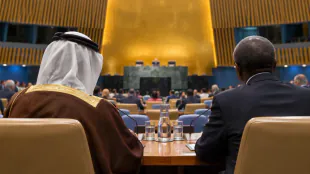 Qatar envoy meets incoming UN General Assembly president
 Trump Signals Willingness to Work With Democrats After Midterm Defeat

 Pitches and Keynote Speakers Are Confirmed for Blue Magic Netherlands on November 17
French President Emmanuel Macron begins a state visit to the Netherlands on Tuesday featuring a speech on Europe that will be keenly watched after his controversial remarks on its ties with the US and China.
Macron, freshly returned from a visit to China last week, sparked criticism after saying in an interview published Sunday that Europe must not be a "follower" of either Washington or Beijing on Taiwan.
His comments threaten to overshadow a two-day visit to the Netherlands that is meant to highlight a new dynamic between Paris and The Hague after the turning point of Brexit.
Macron, who is accompanied by his wife Brigitte and seven ministers, will dine with Dutch King Willem-Alexander and Queen Maxima, see the hot-ticket Johannes Vermeer exhibition at the Rijksmuseum in Amsterdam, and meet Prime Minister Mark Rutte on a canal boat.
But eyes will now be on the French president's speech on "European sovereignty" in security and economic matters on Tuesday afternoon at the Dutch Nexus institute in The Hague.
He will use the address to present "a doctrine of economic security" against China and the United States, amid European unease over US climate subsidies.
The speech comes after Macron said in an interview with media including French business daily Les Echos and Politico that "we don't want to depend on others on critical issues", citing energy, artificial intelligence and social networks.
Macron's comments in the same interview on Taiwan, that Europe risks entanglement in "crises that aren't ours" and should "depend less on the Americans" in matters of defence, have raised questions, like his past remarks on Ukraine.
- 'Brain death' -
"The worst thing would be to think that we Europeans must be followers and adapt ourselves to the American rhythm and a Chinese overreaction," Macron said after his three-day state visit to Beijing.
"A brain death has occurred somewhere, no doubt," said the director of the Polish Institute of International Relations (PISM), Slawomir Debski, referring to the formulation used by the French president to describe NATO in 2019.
But the White House said Monday it was "confident" in the relationship with France despite Macron's comments.
In the wake of the speech, Paris and The Hague will sign a "pact for innovation" on Wednesday focusing on cooperation in semiconductors, quantum physics and energy.
France and the Netherlands will also work to finalise a defence pact by 2024.
The visit is also meant to seal the growing closeness between two countries that were once at opposite ends of the European spectrum on frugality and social spending.
"Since the start of the war in Ukraine, positions have converged," particularly on European sovereignty, noted the Elysee Palace.
The visit was the "expression of a Franco-Dutch rapprochement" that resulted from the Netherlands losing its traditional EU ally, Britain, due to Brexit, it added.
Macron's is the first state visit by a French leader to the Netherlands since 2000. The Dutch royals paid a state visit to France in 2016.
The French president's domestic political troubles also threaten to intrude on the visit, with a new day of strikes against his pension reform plans planned for Thursday.
H.Seidel--BTB