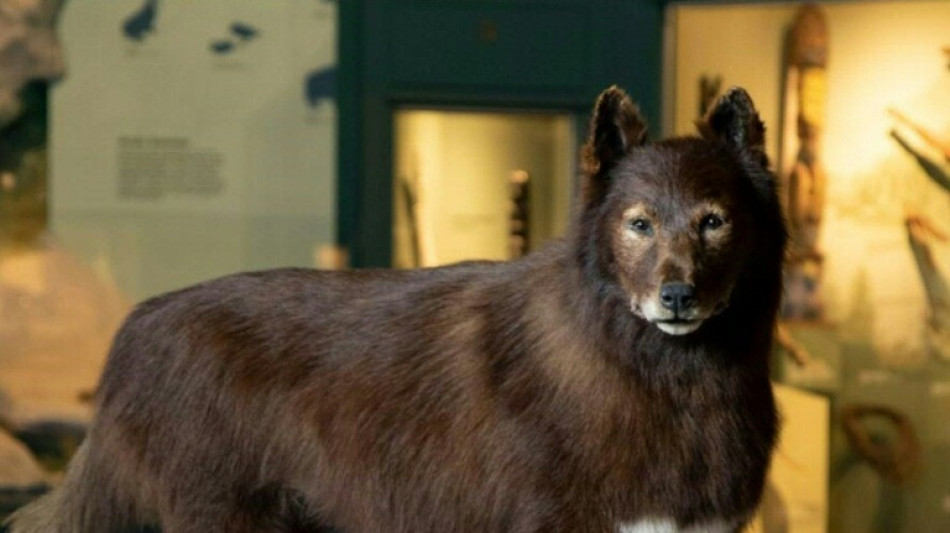
DNA study of famed US sled dog shows what made him so tough / Photo: © EUREKALERT!/AFP

 Alcaraz withdraws from Cincinnati Masters with wrist injury

 SpaceX revenue jumps 92% in first earnings report, but shares slide

 US eyes Hormuz deal 'today or tomorrow' as ship sinks in Red Sea

 SpaceX revenue jumps 92% in first earnings report

 New commissioner Berg wants to take MLS to 'next level'

 Colombian ex-guerrillas fear for future under hardline president

 Tsitsipas comeback continues with Montreal first-round win

 Swiatek fends off Bejlek to reach Toronto third round

 Reusser romps to overall lead at Tour de France Femmes

 McDonald's reports slower US sales in 2nd quarter

 Arsenal step up bid to sign Newcastle's Guimaraes: reports
 Gazans hold mass funeral for those killed during war

 WHO pleads for more support to tackle Ebola outbreak

 Oil drops, stocks gain on hopes of Hormuz opening

 Infantino faces nervy times to see if challenger emerges

 Greece gains ground against blaze near Athens

 Oil turns lower, stocks gain on hopes of Hormuz opening

 World Bank warns developing countries to embrace AI or be left behind

 'No decision' on Mudryk future after Chelsea return: Alonso

 China draws up safety rules for autonomous vehicles

 Wenger says scrapping Infantino's World Cup plan was "absolutely necessary"

 Spain confronts EU migration hawks in tense Ceuta talks

 Firefighters hope to contain blaze on Athens outskirts

 Heatwave divides rich and poor of upmarket Seoul

 Drone strike on Moscow region kills 5

New York's Central Park has a statue dedicated to him, and there's even been a movie about him: a sled dog named Balto. Now he is the focus of a DNA study, 90 years after he died, to see what made the pooch so famously tough.
In 1925, this Siberian husky was part of an expedition in Alaska called the serum run, the goal of which was to bring life-saving medicine to young people in the remote town of Nome that were threatened by diphtheria.
The mission in horrendous blizzards conditions involved a series of sled dog teams transporting the anti-toxin relay-style from the city of Anchorage. Balto led the dog team that covered the last stretch of the grueling journey.
The dog died in 1933, and its mounted body has been on display at the Cleveland Museum of Natural History ever since.
"Balto’s fame and the fact that he was taxidermied gave us this cool opportunity 100 years later to see what that population of sled dogs would have looked like genetically and to compare him to modern dogs," said Katherine Moon, a postdoctoral researcher at the University of California, Santa Cruz and the main author of the study.
It was published Thursday in the journal Science.
Her team took skin samples from the dog's belly and reconstructed its genome -- the complete set of genes in an organism.
They compared this genetic material with that of 680 contemporary dogs from 135 breeds.
Contrary to a legend that held that Balto was half wolf -- as suggested in an animated Universal Pictures film that came out in 1995 -- this analysis found no evidence he had wolf blood.
It turned out Balto shared ancestors with modern day Siberian Huskies and the sled dogs of Alaska and Greenland.
Zoom's team also compared Balto's genes with the genomes of 240 other species of mammals as part of an international effort called the Zoonomia Project.
This allowed researchers to determine which DNA fragments were common across all those species and have not therefore changed over the course of millions of years of evolution.
This stability suggests that these stretches of DNA are associated with important functions in the animal, and that mutations there could be dangerous.
The bottom line from the research was that Balto had fewer potentially dangerous mutations than modern breeds of dogs did, suggesting he was healthier.
"Balto had variants in genes related to things like weight, coordination, joint formation and skin thickness, which you would expect for a dog bred to run in that environment," Moon wrote in a statement.
M.Ouellet--BTB