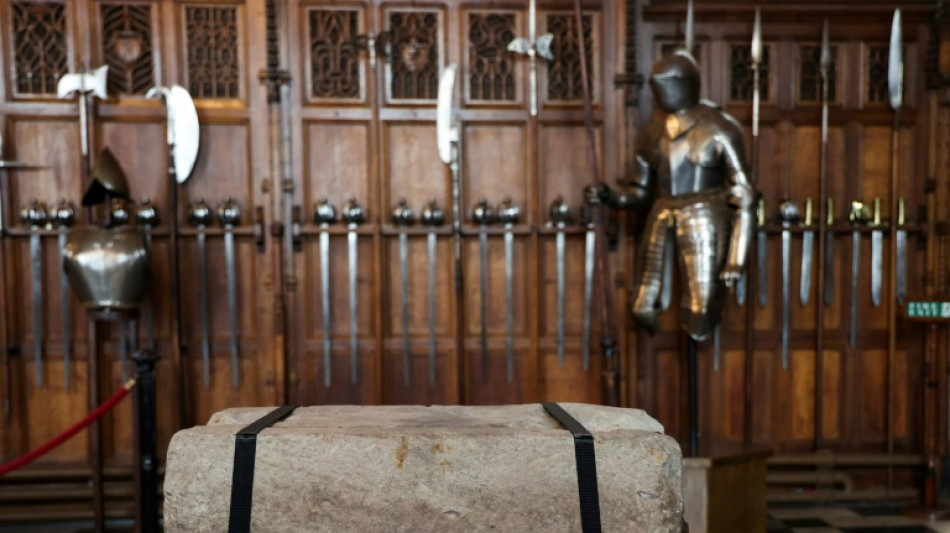
Sacred Scottish stone taken to London for coronation / Photo: © POOL/AFP

 Equitas Small Finance Bank rebounds after naming interim chief executive

 Titan quarterly profit seen rising as jewellery business drives growth

 Indian crude-sensitive shares gain after 13% oil-price decline

 Stocks and dollar fall as Democratic election gains reshape markets

 Kuwait marks key events and anniversaries from national history

 Trump congratulates Democrats and signals willingness to cooperate

 Qatar prime minister advances mediation through diplomatic calls

 Greenland parliament approves security agreement with United States

 Qatar envoy meets incoming UN General Assembly president

 Trump Signals Willingness to Work With Democrats After Midterm Defeat

 Pitches and Keynote Speakers Are Confirmed for Blue Magic Netherlands on November 17
The Stone of Destiny, a sacred slab of sandstone that became a symbol of Scottish nationhood, left Edinburgh Castle for London late Thursday, where it will play a key role in King Charles III's coronation.
The 152-kilogram (335-pound) stone, seized from the Scots by the king of England Edward I in 1296, is being taken to Westminster Abbey in London for the May 6 ceremony.
Officials at Edinburgh Castle, where it is kept with the Scottish crown jewels, held a special ceremony to bid temporary farewell to the legendary stone.
It has not been taken out of Scotland since 1996 when it was officially returned following a 700-year absence.
The Stone of Scone, as it is also known, was transported south from Edinburgh under tight security and will be placed beneath the Coronation Chair at the abbey for Charles's enthronement.
Legend has it that the stone was brought from the Holy Land through Egypt, Sicily and Spain to Ireland before being placed in a monastery in Scone in Scotland in the 9th century.
It was then used for centuries in the inauguration of Scottish kings.
But David Breeze, a professor of history and archaeology from the University of Edinburgh, said it is highly likely that the stone originates from the ancient Pictish kingdom of Scotland.
"The origin of the stone has long been shrouded in myth," he told Times Radio.
"The connection with the Middle East is strong and in the Middle Ages the idea that the stone had been Jacob's pillow was used to justify territorial aggrandisement.
"We believe the link to Scone is strong and it is highly likely that its origins lie in the ancient Pictish kingdom of Scotland."
Edward ordered it to be built into the Coronation Chair in London in 1296.
The stone remained in Westminster Abbey for most of the next 650 years, until Christmas Eve 1950 when a group of Scottish students took part in an audacious raid to retrieve it.
It was taken back to London in 1951 and returned to Westminster Abbey, where it was placed back in the throne before the coronation of Queen Elizabeth II in 1953.
The stone was returned to Edinburgh in 1996 on condition that it be returned for the coronation of future kings and queens.
L.Janezki--BTB

