Chewed for millennia, coca leaf gets flavorsome makeover in Bolivia / Photo: © AFP

 Alcaraz withdraws from Cincinnati Masters with wrist injury

 SpaceX revenue jumps 92% in first earnings report, but shares slide

 US eyes Hormuz deal 'today or tomorrow' as ship sinks in Red Sea

 SpaceX revenue jumps 92% in first earnings report

 New commissioner Berg wants to take MLS to 'next level'

 Colombian ex-guerrillas fear for future under hardline president

 Tsitsipas comeback continues with Montreal first-round win

 Swiatek fends off Bejlek to reach Toronto third round

 Reusser romps to overall lead at Tour de France Femmes

 McDonald's reports slower US sales in 2nd quarter

 Arsenal step up bid to sign Newcastle's Guimaraes: reports

 Gazans hold mass funeral for those killed during war

 WHO pleads for more support to tackle Ebola outbreak

 Oil drops, stocks gain on hopes of Hormuz opening

 Infantino faces nervy times to see if challenger emerges

 Greece gains ground against blaze near Athens

 Oil turns lower, stocks gain on hopes of Hormuz opening

 World Bank warns developing countries to embrace AI or be left behind

 'No decision' on Mudryk future after Chelsea return: Alonso

 China draws up safety rules for autonomous vehicles

 Wenger says scrapping Infantino's World Cup plan was "absolutely necessary"

 Spain confronts EU migration hawks in tense Ceuta talks

 Firefighters hope to contain blaze on Athens outskirts

 Heatwave divides rich and poor of upmarket Seoul

 Drone strike on Moscow region kills 5

Bitter and tough, the coca leaf chewed throughout the South American Andes for thousands of years as a natural pick-me-up has been getting an appetizing makeover in Bolivia.
Traditionally sold as untreated, chopped leaves, several small businesses are now bruising the foliage to make it softer, and adding flavors such as strawberry, mango or coffee.
What started as an experiment about a decade ago has really taken off, especially in Bolivia's economic capital of Santa Cruz -- a city of 3.4 million people.
"The flavoring is like adding seasoning to food. Normally flavors such as bubblegum, banana are used, and it adds a special something," consumer Isaac Salazar, 21, told AFP.
"They come already crushed, soft, with a savory or sweet flavor added, which makes it perfect for passing the time."
The practice of chewing coca has its own verb in Bolivia's Indigenous Aymara language: "pijcheo." It means to masticate the leaves, like chewing gum, without swallowing.
The leaf -- from the same plant that cocaine is manufactured from -- has been ascribed with the wide-ranging properties of quelling hunger, inhibiting stress and imparting an energy boost.
Coca is also consumed in infusions, and in some countries it is included in flour used to make special breads and cakes.
- Bruised coca -
The work of transforming the fibrous leaf into a more easily chewable product is laborious.
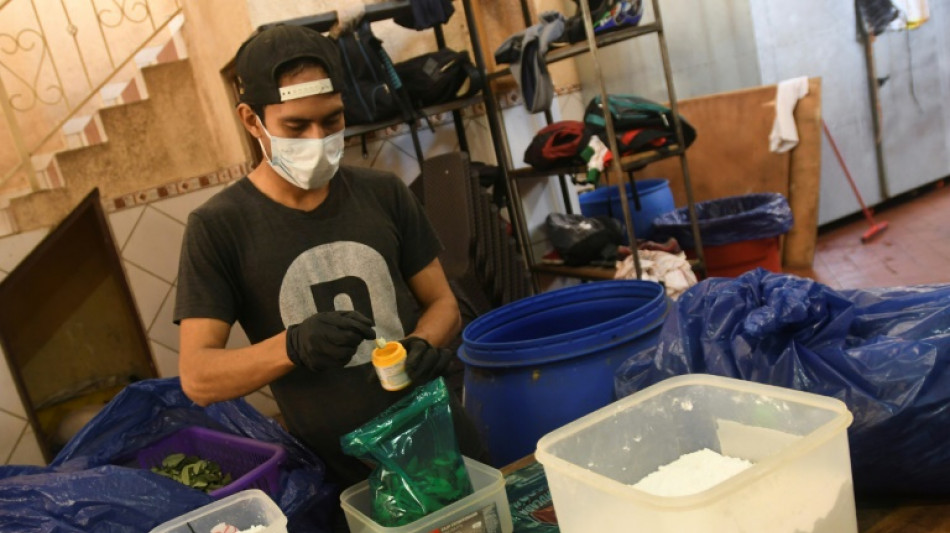
At the El Dogor factory and store run by 23-year-old Luis Vasquez in Santa Cruz, about 20 workers share the tasks of removing the hard stems, placing what is left of the foliage into plastic bags, adding flavorings, and pounding away with a mallet.
The flattened end product, labeled Machucada (bruised) Coca El Dogor is placed in the fridge, and sold for $4.30 per unit of four ounces (about 113 grams).
The shop does a brisk business.
"We have a variety of coca leaf products, including fruit-flavored leaves and any other flavor a customer may ask for," said Vasquez.
More and more, clients "prefer it mixed with a flavoring," he said.
Consumer Gary Soleto, 45, said the traditional way of consuming unadulterated coca leaf will never disappear.
"But we change and we have taken on new habits... to continue consuming and tasting new flavors," he said.
Official data show that one in three people in a country of 12 million -- almost a third of them Indigenous -- chew coca or use it for medicinal and ritual purposes.
In 2021, there were 30,500 hectares (75,000 acres) of coca plantations in Bolivia, according to a UN estimate -- up four percent from 2020.
Potential coca leaf production was estimated at 44,900 to 56,200 metric tons with an estimated value of $352 million to $431 million, according to a report by the UN Office on Drugs and Crime.
The Bolivian state authorizes the cultivation of a maximum of 22,000 hectares.
In recent years, there have been clashes between coca leaf producers and police in Bolivia in a dispute over control of commercialization of the plant.
J.Bergmann--BTB