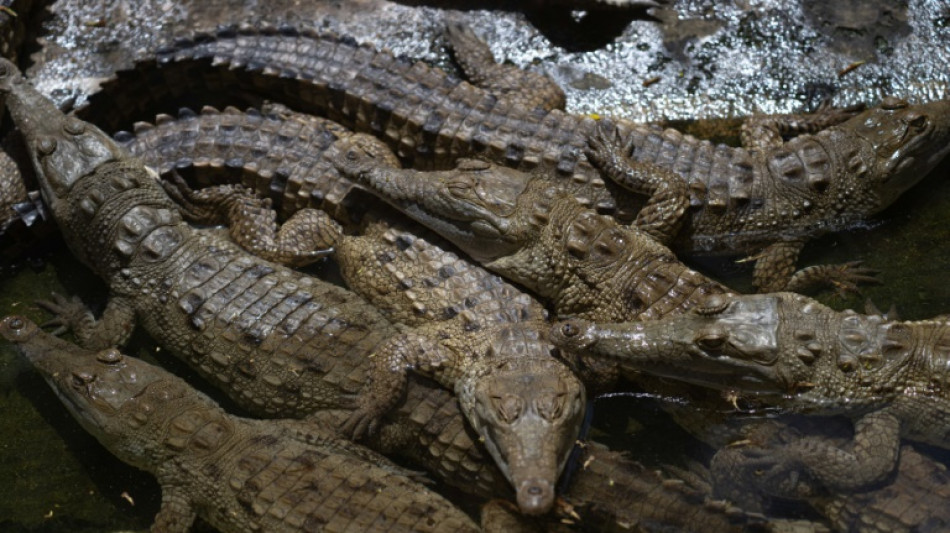
Fighting to save Venezuela's Orinoco Crocodile / Photo: © AFP

 Alcaraz withdraws from Cincinnati Masters with wrist injury

 SpaceX revenue jumps 92% in first earnings report, but shares slide

 US eyes Hormuz deal 'today or tomorrow' as ship sinks in Red Sea

 SpaceX revenue jumps 92% in first earnings report

 New commissioner Berg wants to take MLS to 'next level'

 Colombian ex-guerrillas fear for future under hardline president

 Tsitsipas comeback continues with Montreal first-round win

 Swiatek fends off Bejlek to reach Toronto third round

 Reusser romps to overall lead at Tour de France Femmes

 McDonald's reports slower US sales in 2nd quarter

 Arsenal step up bid to sign Newcastle's Guimaraes: reports

 Gazans hold mass funeral for those killed during war

 WHO pleads for more support to tackle Ebola outbreak

 Oil drops, stocks gain on hopes of Hormuz opening

 Infantino faces nervy times to see if challenger emerges

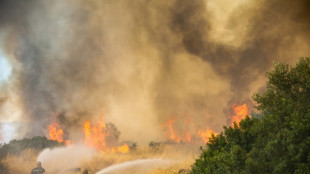 Greece gains ground against blaze near Athens

 Oil turns lower, stocks gain on hopes of Hormuz opening

 World Bank warns developing countries to embrace AI or be left behind

 'No decision' on Mudryk future after Chelsea return: Alonso

 China draws up safety rules for autonomous vehicles

 Wenger says scrapping Infantino's World Cup plan was "absolutely necessary"

 Spain confronts EU migration hawks in tense Ceuta talks

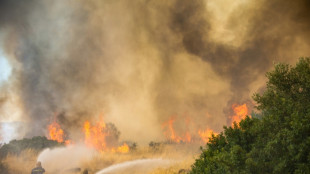 Firefighters hope to contain blaze on Athens outskirts

 Heatwave divides rich and poor of upmarket Seoul

 Drone strike on Moscow region kills 5

Venezuela's Orinoco Crocodile is a fearsome beast, but its enormous size and sharp teeth were no match for humans who hunted them to the brink of extinction.
Millions were slaughtered in the 20th century, mainly for their skins, and today, only about 100 adult females are left in Venezuela, according to the country's Fudeci natural sciences foundation.
Known to scientists as Crocodylus intermedius, the enormous reptile is native to the Orinoco basin that Venezuela shares with Colombia.
It can grow to more than six meters (19.7 feet) in length and over 400 kilograms (882 pounds), making it one of the largest crocodiles in the world.
According to the International Union for Conservation of Nature, it is critically endangered, having suffered an 80-percent population reduction in just three generations in the early and mid-1900s.
More than 2.5 million Orinoco Crocodile skins were exported from Venezuela from 1931 to 1934, according to official Venezuelan figures.
Today, such trade is prohibited but the threat persists: the crocs are killed for their eggs and meat, and sometimes out of fear. And their habitat is ever shrinking and defiled by pollution.
Efforts that started in 1990 to breed new crocs in captivity have seen some 10,000 freed back into the Venezuelan wild.
But their numbers have not significantly increased.
"We do a part... to raise the animals and then release them, but after that it no longer depends on us, there has to be protection of these animals, surveillance, control, there has to be environmental education," conservationist Federico Pantin told AFP.
Pantin, 56, manages the Leslie Pantin breeding zoo -- named after his father who founded it -- with his wife Tuenade Hernandez in the northern state of Aragua. It is one of several croc breeding centers in the country.
- 'Seeds of conservation' -
On Sunday, Pantin was on hand for the release of 160 hatchlings -- small and green-skinned with black spots and light eyes -- into the Capanaparo River.
The zoo's captive breeding pair produces about 40 eggs at a time.
The eggs are incubated for about 90 days in very specific conditions, buried in sand at a depth of 33 centimeters, at a temperature of between 30 and 34 degrees Celsius (86-93 degrees Fahrenheit) and humidity of 85-90 percent.
The crocodiles mostly hatch in May, and at about one year of age, they are freed.
Zoo staff also capture free-born baby crocs in the river to raise them in relative safety.
"Predation in the natural environment is very high" with birds, fish and other reptiles all feeding on the defenseless hatchlings, explained Pantin.
By raising them at the zoo, 95 percent of the hatchlings survive -- whereas most would have died in their natural environment.
"The animals arrive here about 24 centimeters (9.4 inches) long and weighing about 80 or 100 grams (2.8-3.5 ounces)... we release them when they reach about 80 or 90 centimeters and weigh four kilos," said Pantin.
According to Diego Bilbao, director of a company called Rio Verde which organizes tours to witness the annual release of young crocs, the sector holds potential for tourism income with a conservational side benefit.
If locals and Indigenous communities can be convinced to see the crocs as a source of income, he explained, "they help protect it."
The Pantin Zoo, which also works to conserve other threatened species such as the Red Siskin finch, the stubfoot toad and the wood turtle, also seeks to instill a natural stewardship mindset in visiting school groups.
"I love it," said Hernandez of this part of her job. "The seeds of conservation are sown at a young age."
C.Kovalenko--BTB