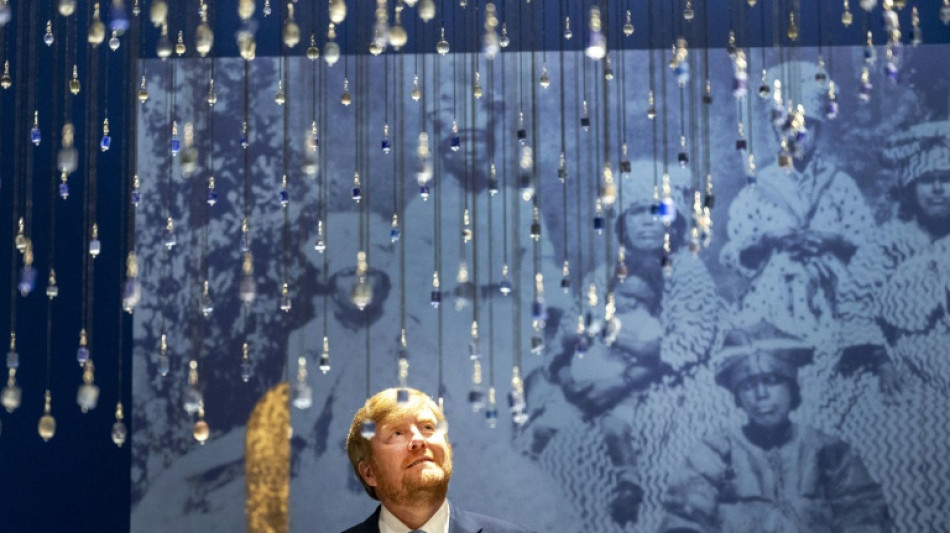
Dutch king expected to apologise for slavery / Photo: © ANP/AFP

 India seeks threefold increase in coal stocks to prevent summer power shortages

 Adobe PDF Spaces Introduces Shared AI Conversations for Document Collaboration

 KKR secures Indian regulator approval for Gentari Renewables investment

 Bharti Airtel revenue expected to grow at double-digit pace in second quarter

 Italy Claims Curling Silver at European Championships in Ostrava

 Kuwait finance minister holds economic cooperation talks at COMCEC

 Abdul El-Sayed declares victory in Michigan Senate contest
 Democrats capture US Congress in sweeping midterm victory

 Manchester United rallies past Roma as PSG dominates in Champions League

 Qatar sees tentative opening for renewed regional diplomacy

 Qatar Tourism joins Pacific Asia Travel Association at London travel market

 Abdul El-Sayed Wins Michigan Senate Seat in Historic Election

 Qatar media bodies discuss support for humanitarian initiatives

King Willem-Alexander is widely expected to make a royal apology for the Netherlands' involvement in slavery on Saturday at an event marking 150 years since slaves were freed in former colonies.
Thousands of descendants of slaves from the South American nation of Suriname and the Caribbean islands of Aruba, Bonaire and Curacao will attend the celebrations in Amsterdam for "Keti Koti" ("breaking the chains" in Surinamese).
Dutch media reported that the king is expected to make some form of apology on behalf of the royal family, to follow on from an official government apology in December.
However Willem-Alexander has stopped short of confirming that he will say sorry for a trade that researchers say brought vast riches to his ancestors in the House of Orange.
"I think we will have to wait until July 1," the Dutch monarch told journalists when asked on a recent state visit to Belgium whether he would apologise at the ceremony.
"I clearly understand peoples' wishes that I'll do it but I'm asking you to wait until then."
The speech will be broadcast live on national television, and Queen Maxima and Prime Minister Mark Rutte will attend the event at the Oosterpark in the Dutch capital.
Descendants of slaves have called for the king to use the occasion to apologise.
"That is important, especially because the Afro-Dutch community considers it important," Linda Nooitmeer, chairman of the National Institute of Dutch Slavery History and Legacy, told public broadcaster NOS.
"It is important for processing the history of slavery."
- Colonial riches -
Since the Black Lives Matter movement emerged in the United States, the Netherlands has embarked on an often difficult debate about the colonial and slave trading past that turned it into one of the world's richest countries.
And the Dutch royals have often found themselves at the centre of the debate.
A Dutch study released in June found that the royal family earned 545 million euros ($595 million) in today's terms between 1675 and 1770 from the colonies, where slavery was widespread.
The current king's distant ancestors, Willem III, Willem IV and Willem V, were among the biggest earners from what the report called the Dutch state's "deliberate, structural and long-term involvement" in slavery.
Separately, in 2022 King Willem-Alexander announced that he was ditching the royal Golden Coach that traditionally transported him on state occasions because it had images of slavery on the sides.
One side panel had a picture called "Tribute of the Colonies" depicting kneeling black people handing over produce like cocoa and sugarcane to their white masters.
Rutte in December described slavery as a "crime against humanity" when he delivered a long-awaited apology, and Dutch ministers travelled to seven former colonies.
The king said days later, in his Christmas address, that the government apology was the "start of a long journey".
Slavery was formally abolished in Suriname and other Dutch-held lands on July 1, 1863, but the practice only really ended in 1873 after a 10-year "transition" period.
The Dutch funded their "Golden Age" of empire and culture in the 16th and 17th centuries by shipping around 600,000 Africans as part of the slave trade, mostly to South America and the Caribbean.
Y.Bouchard--BTB

