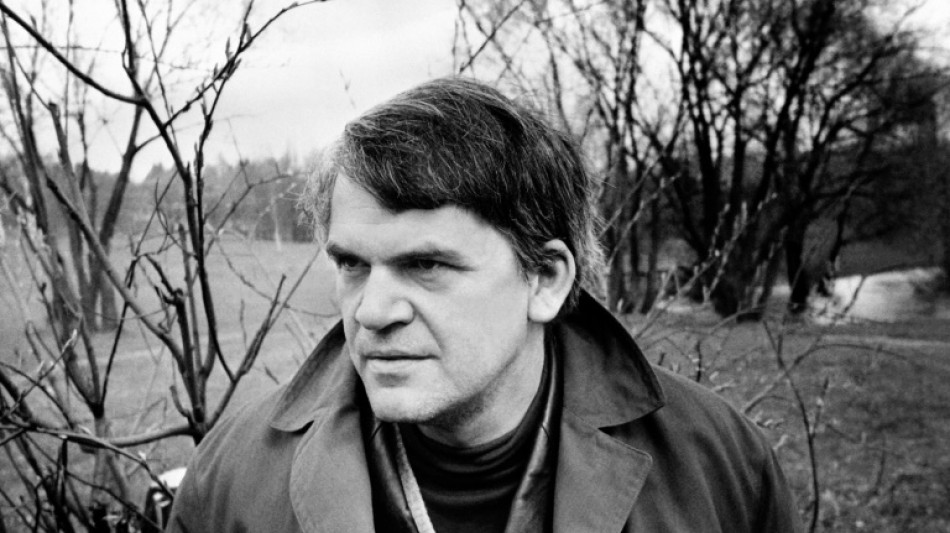
Czech novelist Milan Kundera dies at 94 / Photo: © AFP/File

 India monsoon floods, landslides kill more than 100 since July: officials
 South Korea pro baseball league cancels games over heatwave
 Taiwan probes 17 China-funded firms over high-tech talent poaching
 Trump warns Iran to open Hormuz or get 'hit very hard'

 Factories shed workers in Bangladesh garment sector
 North Korea warns of 'military options' over Japan rearmament
 Tiny light, big dream: Harvesting power from soil in Japan
 Trump admin to review 'closed' AI models before release: reports
 De Minaur fights past Duckworth in all-Aussie Montreal battle
 High bills, cheap panels drive a Philippine solar surge
 Russian barrage on Ukraine kills 2, wounds dozens more

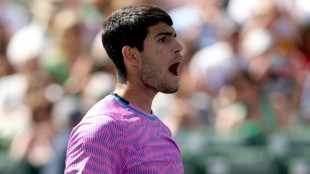 Alcaraz withdraws from Cincinnati Masters with wrist injury
 SpaceX revenue jumps 92% in first earnings report, but shares slide

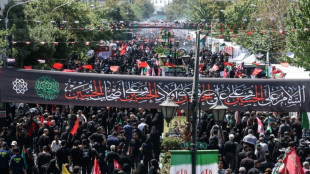 US eyes Hormuz deal 'today or tomorrow' as ship sinks in Red Sea

 SpaceX revenue jumps 92% in first earnings report

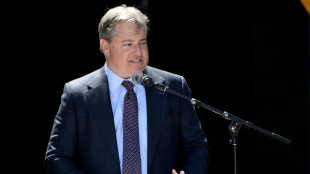 New commissioner Berg wants to take MLS to 'next level'

 Colombian ex-guerrillas fear for future under hardline president
 Tsitsipas comeback continues with Montreal first-round win

 Swiatek fends off Bejlek to reach Toronto third round
 Reusser romps to overall lead at Tour de France Femmes
 McDonald's reports slower US sales in 2nd quarter
 Arsenal step up bid to sign Newcastle's Guimaraes: reports
 Gazans hold mass funeral for those killed during war
 WHO pleads for more support to tackle Ebola outbreak
 Oil drops, stocks gain on hopes of Hormuz opening

Milan Kundera, the author of "The Unbearable Lightness of Being" whose dark, provocative novels delved into the enigma of the human condition, has died, a spokeswoman for the Milan Kundera Library in his native city of Brno said on Wednesday. He was 94.
"Unfortunately I can confirm that Mr Milan Kundera passed away yesterday (Tuesday) after a prolonged illness," she told AFP.
Through his characteristic satire and poetic prose Kundera had sought to express all that is compelling and absurd about life, drawing on his own experiences of being stripped of his Czech nationality for dissent.
Life, he said in his work of criticism "Art of the Novel" (1986), "is a trap we've always known: we are born without having asked to be, locked in a body we never chose, and destined to die."
- Young rebel -
Kundera was born on April 1, 1929, in the town of Brno, in what was then Czechoslovakia. His father was a famous pianist.
He studied in Prague, where he joined the Communist Party, translated the French poet Apollinaire and wrote poetry of his own.
He also taught at a film school where his students included the future Oscar-winning director Milos Forman.
Although he professed faithfulness to communism, the independent spirit of Kundera's writing soon got him into trouble.
He was expelled from the party in 1950, re-joined in 1956 and was expelled a second time in 1970 after the Prague Spring reform movement -- in which he was seen as playing a role -- was crushed.
- Locked out -
Kundera's first novel "The Joke", a work of dark humour about the one-party state published in 1967, led to a ban on his writing in Czechoslovakia while also making him famous in his homeland.
In 1975, he and his wife Vera went into exile in France, where he worked for four years as an assistant professor at the University of Rennes. They were stripped of their Czech nationality in 1979.
In his adopted home, where he became a citizen in 1981, his reputation and success grew as translations of his novels appeared, such as "Life is Elsewhere" (1973) set in Czechoslovakia about a poet entrapped by the Communist regime.
"The Book of Laughter and Forgetting" (1979) playfully explored through seven interlinked narratives the nature of forgetting in politics, history and daily life.
The novel was "brilliant and original," said the New York Times in 1980, "written with a purity and wit that invite us directly in; it is also strange, with a strangeness that locks us out."
Kundera was an author "fascinated by sex, and prone to sudden, if graceful, skips into autobiography, abstract rumination, and recent Czech history," said the Times reviewer, John Updike.
By far his most famous work, "The Unbearable Lightness of Being" was published in 1984 and turned into a film starring Juliette Binoche and Daniel Day-Lewis in 1987.
The novel is a morality tale about freedom and passion, on both an individual and collective level, set against the Prague Spring and its aftermath in exile.
- No going back? -
Kundera's critics say he turned his back on fellow Czechs and dissidents following his exile in France.
In 2008, a Czech magazine accused him of being a police informer under Communist rule, which he denied as "pure lies".
In 2013, Kundera published his first novel after a 13-year hiatus.
"The Festival of Insignificance", about five friends in Paris, received mixed reviews, with The Atlantic noting its "near-impenetrable irony" and The Guardian deeming it a "stinker".
What Kundera "has to tell us seems to have less relevance", said the New York Times. "You can’t help wondering what his evolution would have been like if he had stayed, or stayed longer, in Czechoslovakia."
In 2019, the Czech Republic restored his nationality and in 2023 the Milan Kundera Library opened in his hometown of Brno.
C.Kovalenko--BTB