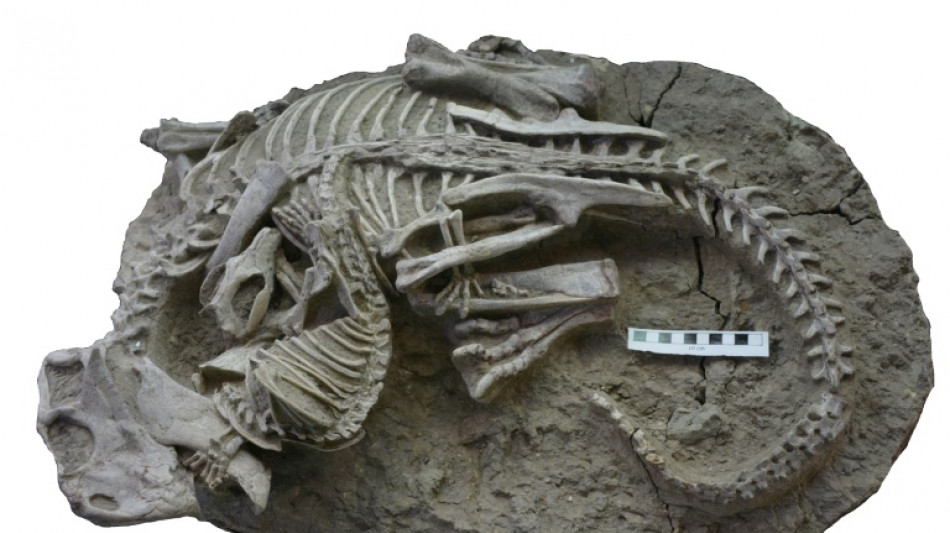
Mammal bites dinosaur in 'once-in-a-lifetime' fossil find / Photo: © Canadian Museum of Nature/AFP

 India seeks threefold increase in coal stocks to prevent summer power shortages

 Adobe PDF Spaces Introduces Shared AI Conversations for Document Collaboration

 KKR secures Indian regulator approval for Gentari Renewables investment

 Bharti Airtel revenue expected to grow at double-digit pace in second quarter

 Italy Claims Curling Silver at European Championships in Ostrava

 Kuwait finance minister holds economic cooperation talks at COMCEC

 Abdul El-Sayed declares victory in Michigan Senate contest

 Democrats capture US Congress in sweeping midterm victory

 Manchester United rallies past Roma as PSG dominates in Champions League

 Qatar sees tentative opening for renewed regional diplomacy

 Qatar Tourism joins Pacific Asia Travel Association at London travel market

 Abdul El-Sayed Wins Michigan Senate Seat in Historic Election

 Qatar media bodies discuss support for humanitarian initiatives

A badger-like mammal was sinking its teeth into the ribs of a dinosaur three times its size when they were buried in volcanic ash 125 million years ago, capturing the pair in a deadly embrace.
The fight scene, preserved in a fossil discovered in China, suggests that small mammals preyed on the dinosaurs that ruled Earth during the Cretaceous period more than previously thought, scientists said on Tuesday.
Jordan Mallon, a palaeontologist at the Canadian Museum of Nature, told AFP that when he first saw the fossil "my eyes popped out of my head".
Mallon, a co-author of a new study led by Chinese researchers, said they believe the fossil is the first ever discovered that shows a mammal and dinosaur fighting each other.
Mammals were generally considered far too small to prey on the dinosaurs that dominated the world during the tens of millions of years they shared on Earth.
But the fossil shows a badger-sized Repenomamus robustus sitting on top of Psittacosaurus lujiatunensis, a plant-eating dinosaur that stood 120 centimetres (47 inches) tall and had a beak like a parrot.
The mammal -- one of the largest of its time but still a third the weight of the dinosaur -- is sinking his sharp teeth into the dinosaur's ribs and gripping onto its leg.
- 'Feisty mammals' -
The way the pair are intertwined shows that the mammal was not scavenging on a dead dinosaur, Mallon said.
"The dinosaur has collapsed down and trapped the hind limb of the mammal in the fold of its knee," indicating it was an attack, he said.
The dinosaur also bears no bite marks, which mammals often leave on scavenged bodies.
While it is rare for mammals to prey on animals so much larger than them, Mallon said one example was how wolverines had been observed hunting far-larger caribou.
It was not possible to tell from the fossil if Repenomamus hunted solo or in a pack, he said, adding that either was possible.
The almost entirely complete skeletons were found in China's northeastern Liaoning province in 2012.
They were discovered at a site nicknamed "Chinese Pompeii" because of how many dinosaurs and other animals have been found preserved by volcanic debris there, similar to the ancient Roman city.
The first fossil suggesting that mammals ate dinosaurs was found at the Chinese site in 2005. It showed a baby Psittacosaurus in the stomach of a Repenomamus.
But the new fossil is the first piece of evidence that "there were at least some feisty mammals around during the Cretaceous... capable of taking down an adult dinosaur," Mallon said.
The "once-in-a-lifetime" fossil is being exhibited at a museum attached to a primary school in the Chinese city of Weihai, he added.
The study was published in the journal Scientific Reports.
J.Bergmann--BTB