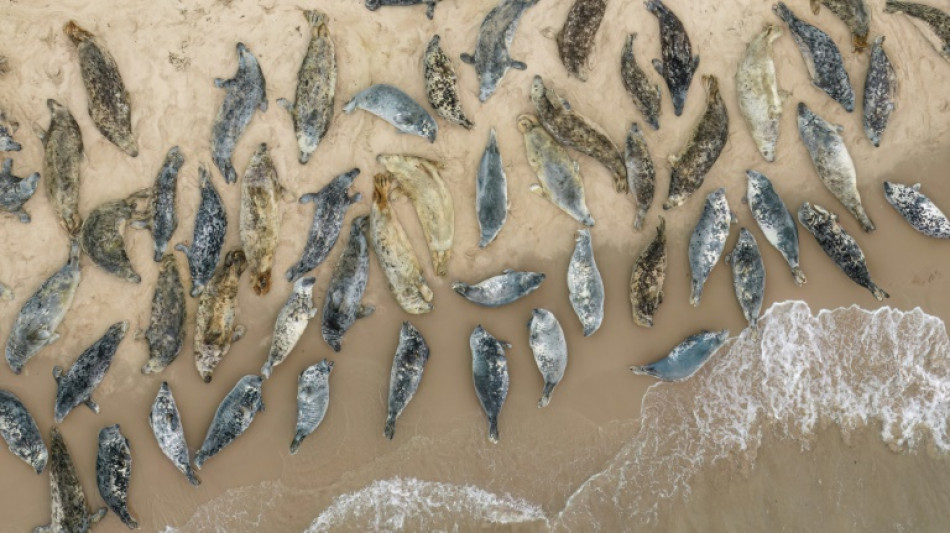
In Quebec, seal hunters want public to see practice in new light / Photo: © AFP

 Russian barrage on Kyiv kills 17 as Ukraine fails to down single missile
 'Lost': Migrants despair after Britain expels them back to France

 Cathay Pacific's profit soars 71% despite Iran war driving up fuel costs

 Russian barrage on Ukraine kills 15, wounds dozens more

 South Korea police raid Starbucks HQ over 'Tank Day' fiasco

 Tech back in fashion as Asian markets extend rebound

 Total eclipse gives scientists chance to probe Sun's mysteries
 What to know about the total solar eclipse on August 12

 'Like the end of the world': the eclipse chasers flocking to Spain

 Taiwan begins military drills as China pressure grows

 UK mansion where 'listeners' spied on Nazi generals becomes museum
 Sabalenka tops Uchijima in WTA Toronto opener

 Kgatlana strikes as South Africa reach WAFCON quarter-finals

 Pakistan close on series-levelling win against West Indies

 Paramount CEO says politics fueling Warner Bros. merger battle

 Trump's sale of access to Truth Social raises eyebrows

 SpaceX rocket stage expected to slam into Moon

 US hopeful Hormuz strait deal will be done 'today or tomorrow'

 Michigan primary puts Democratic divide on the ballot

 South Africa captain Kolisi to make Test return in Argentina

 Cuba's famed resilience comes at a growing mental cost

 Swiss Reusser wins Tour de France Femmes time-trial

 Hundreds flee homes after Guatemala's Fuego volcano erupts

 Thousands pay tribute to Italian football legend Baresi
 Oil drops, stocks hit records on hopes of Hormuz opening
At the helm of his motorboat, with the wind whipping and the waves crashing, Canadian seal hunter and photographer Yoanis Menge scans the horizon.
From the port of Grosse-Ile, the northern tip of the tiny Magdalen islands archipelago in the Gulf of Saint Lawrence, he spots a group of seals sunning themselves on a sandbar.
But at the slightest noise, they move. Once in the water, hunting them is much harder. From the boat, only their little black heads stick out -- quite a narrow target.
This time, Menge and his crew complete the kill from the sandbar, shooting the seals. They skin the animals and cut them apart, saving the parts they want to keep.
Menge knows seal hunting is a controversial practice, but he says it is also an ancestral tradition for the people of the Magdalen islands and several Indigenous groups in Canada, including the Inuit.
In the islands, where seal hunting is possible year-round, on the ice or on the water, Menge and others hope to rehabilitate the image of the hunt, with the support of fishermen who are worried about dwindling fish stocks.
"Here, we live with the seals -- we don't just hunt them," says Menge, who welcomed an AFP team on a hunt in late May.
"What prompted the United States or Europe to ban seal products? These are sentimental reasons. It is the only animal boycotted for sentimental reasons."
- 'Murderers' -
Any discussion of seal hunting in the Magdalen islands inevitably comes back to the image of French movie star and animal rights activist Brigitte Bardot, who in the 1970s posed on the ice floe next to baby harp seals.
Over the years, activists have particularly objected to the clubbing of the animals.
"We were treated as savages, barbarians and murderers," recalls Gil Theriault, director of the Intra-Quebec Sealers Association.
"These insults have done us a lot of harm in the public sphere. It was an attack on our way of life," he said.
Since the 1970s, the hunt has been on the wane.
On Canada's Atlantic coast, there are gray, harp, harbor, bearded, hooded and ringed seals. Commercial hunting mainly targets the first two species.
During the 1950s and 1960s, hunters could make money from the pups' white coats, highly sought after by the fashion industry. That practice was banned in 1987.
And little by little, the doors have been closing.
The United States has banned seal products since 1972. And in 2010, the European Union imposed an embargo because of hunting methods that were deemed too cruel -- a blow for the industry, which lost 30 percent of its customers.
Today, seals are mostly hunted locally for their meat, which is served in some high-end restaurants across Quebec.
But some hope to revive interest in what Magdalen islands butcher Rejean Vigneau calls an "incredible" meat.
Vigneau makes about 15 different products from seal meat, from sausages to terrines.
"It's a local meat, without hormones, very rich in iron, lean, excellent for your health," said Vigneau, who is one of only a few dozen hunters still active in the islands, down from hundreds a few decades ago.
"It's surprising that it's still frowned upon."
- 'We have a problem' -
Some of the remaining hunters now dream of bolstering their ranks, pointing out that the seal has few natural predators, and without humans hunting them, their populations grow rapidly.
They also feed on all kinds of fish -- an adult swallows several kilos a day. That is a drain on the main source of revenue for island dwellers.
"In the Gulf, given the number of gray seals and their consumption of fish... we have a problem. Fish stocks are not going up," said fisherman Ghislain Cyr.
Simon Nadeau, a marine mammals expert with the Canadian Department of Fisheries and Oceans, explains that seal populations have exploded since the 1970s.
"But we're not talking about overpopulation," he insisted.
The number of harp seals nearly quadrupled between 1970 and 2019 to an estimated 7.6 million, according to government data.
In the Gulf of Saint Lawrence, the gray seal population increased from 5,000 in 1960 to 44,000 animals in 2017.
At the same time, fish stocks in the Atlantic Ocean off Canada are at their lowest levels on record.
For Nadeau, the two are not so easily linked, in particular because the entire ecosystem has been altered in recent decades due to global warming and overfishing.
"Seals may have contributed to the decline of fish stocks, but they did not cause it," he said, while acknowledging that they are one of the factors that prevent certain fish populations from bouncing back.
O.Lorenz--BTB