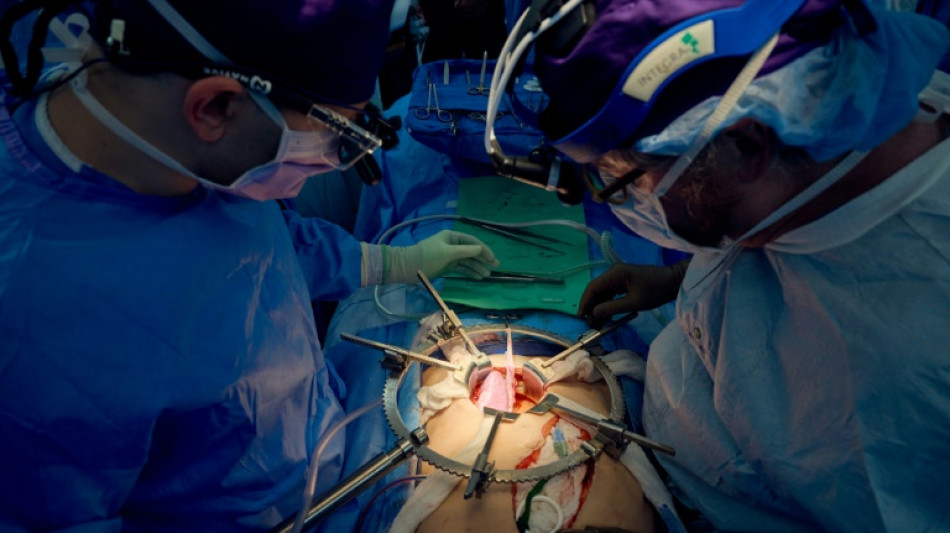
US surgeons say pig kidney functional in human for more than a month / Photo: © NYU Langone Health/AFP

 Alarm at German airport after drone found near Ukrainian plane, mid-air incident

 Salah arrives in Turkey for Trabzonspor talks

 Embattled FIFA chief Infantino holds emergency talks with directors

 Russian barrage on Kyiv kills 17 as Ukraine fails to down single missile

 'Lost': Migrants despair after Britain expels them back to France

 Cathay Pacific's profit soars 71% despite Iran war driving up fuel costs
 Russian barrage on Ukraine kills 15, wounds dozens more

 South Korea police raid Starbucks HQ over 'Tank Day' fiasco

 Tech back in fashion as Asian markets extend rebound

 Total eclipse gives scientists chance to probe Sun's mysteries

 What to know about the total solar eclipse on August 12

 'Like the end of the world': the eclipse chasers flocking to Spain

 Taiwan begins military drills as China pressure grows

 UK mansion where 'listeners' spied on Nazi generals becomes museum

 Sabalenka tops Uchijima in WTA Toronto opener

 Alcaraz withdraws from Cincinnati Masters with wrist injury

 SpaceX revenue jumps 92% in first earnings report, but shares slide

 US eyes Hormuz deal 'today or tomorrow' as ship sinks in Red Sea

 SpaceX revenue jumps 92% in first earnings report

 New commissioner Berg wants to take MLS to 'next level'

 Colombian ex-guerrillas fear for future under hardline president

 Tsitsipas comeback continues with Montreal first-round win

 Swiatek fends off Bejlek to reach Toronto third round

 Reusser romps to overall lead at Tour de France Femmes

 McDonald's reports slower US sales in 2nd quarter

US surgeons who transplanted a genetically-modified pig kidney into a brain dead patient said Wednesday it was still working well after a record 32 days -- a significant step in the quest to close the organ donation gap.
The latest experimental procedure is part of a growing field of research aimed at advancing cross-species transplants, using bodies that have been donated for science.
There are more than 103,000 people waiting for organs in the United States, 88,000 of whom need kidneys.
"We have a genetically-edited pig kidney surviving for over a month in a human," Robert Montgomery, director of the NYU Langone Transplant Institute, told reporters. "I think there's a very compelling story that exists at this point that I think should give further assurances about starting some initial studies... in living humans."
Montgomery carried out the first genetically modified pig kidney transplant to a human in September 2021, followed by a similar procedure in November 2021. There have since been a handful of other cases, with all the experiments running for two or three days.
While previous transplants have involved up to 10 genetic modifications, the latest saw just one: in the gene involved in the so-called "hyperacute rejection," which would otherwise occur within minutes of an animal organ being connected to a human circulatory system.
By "knocking out" the gene responsible for a biomolecule called alpha-gal -- a prime target for roving human antibodies -- the NYU Langone team were able to stop immediate rejection.
"We've now gathered more evidence to show that, at least in kidneys, just eliminating the gene that triggers a hyperacute rejection may be enough along with clinically approved immunosuppressive drugs to successfully manage the transplant in a human for optimal performance -- potentially in the long-term," said Montgomery.
They also embedded the pig's thymus gland -- which lies around the neck and is responsible for educating the immune system -- in the kidney's outer layer.
Adam Griesemer, of the NYU Grossman School of Medicine, added this allowed immune cells in the host's body to learn to recognize the pig's cells as its own, preventing a more delayed rejection.
Both of the patient's own kidneys were removed, then one pig kidney was transplanted, and started immediately producing urine.
Monitoring showed that levels of creatinine, a waste product, were at optimal levels, and there was no evidence of rejection.
- No evidence of pig virus -
Crucially, no evidence of porcine cytomegalovirus -- which may trigger organ failure -- have been detected, and the team plan to continue monitoring for another month.
The research was made possible by the family of the 57-year-old male patient, Maurice "Mo" Miller, who was found unresponsive in his bathroom in July. Doctors determined he had an aggressive form of brain cancer, and would not wake up.
"Though my brother cannot be here, I can say with confidence he would be proud of the fact in the tragedy of his death, his legacy will be helping many people live," his sister Mary Miller-Duffy told reporters.
In January 2022, surgeons at the University of Maryland Medical School carried out the world's first pig-to-human transplant on a living patient. He died two months after the milestone, with the presence of porcine cytomegalovirus in the organ later blamed.
The donor pig came from a herd from Virginia-based biotech company Revivicor. The herd was approved by the Food and Drug Administration as a source of meat for people with hypersensitivity to the alpha-gal molecule, an allergy caused by tick bites.
These pigs are bred, not cloned, meaning the process can be more easily scaled.
Early xenotransplantation research focused on harvesting organs from primates -- for example, a baboon heart was transplanted into a newborn known as "Baby Fae" in 1984, but she survived only 20 days.
Current efforts focus on pigs, which are thought to be ideal donors because of their organ size, their rapid growth and large litters, and the fact they are already raised as a food source.
F.Pavlenko--BTB