RNA recovered from extinct animal in world first / Photo: © AFP

 Alarm at German airport after drone found near Ukrainian plane, mid-air incident

 Salah arrives in Turkey for Trabzonspor talks

 Embattled FIFA chief Infantino holds emergency talks with directors

 Russian barrage on Kyiv kills 17 as Ukraine fails to down single missile

 'Lost': Migrants despair after Britain expels them back to France

 Cathay Pacific's profit soars 71% despite Iran war driving up fuel costs
 Russian barrage on Ukraine kills 15, wounds dozens more

 South Korea police raid Starbucks HQ over 'Tank Day' fiasco

 Tech back in fashion as Asian markets extend rebound

 Total eclipse gives scientists chance to probe Sun's mysteries
 What to know about the total solar eclipse on August 12

 'Like the end of the world': the eclipse chasers flocking to Spain

 Taiwan begins military drills as China pressure grows

 UK mansion where 'listeners' spied on Nazi generals becomes museum

 Sabalenka tops Uchijima in WTA Toronto opener

 Alcaraz withdraws from Cincinnati Masters with wrist injury

 SpaceX revenue jumps 92% in first earnings report, but shares slide

 US eyes Hormuz deal 'today or tomorrow' as ship sinks in Red Sea

 SpaceX revenue jumps 92% in first earnings report

 New commissioner Berg wants to take MLS to 'next level'

 Colombian ex-guerrillas fear for future under hardline president

 Tsitsipas comeback continues with Montreal first-round win

 Swiatek fends off Bejlek to reach Toronto third round

 Reusser romps to overall lead at Tour de France Femmes

 McDonald's reports slower US sales in 2nd quarter

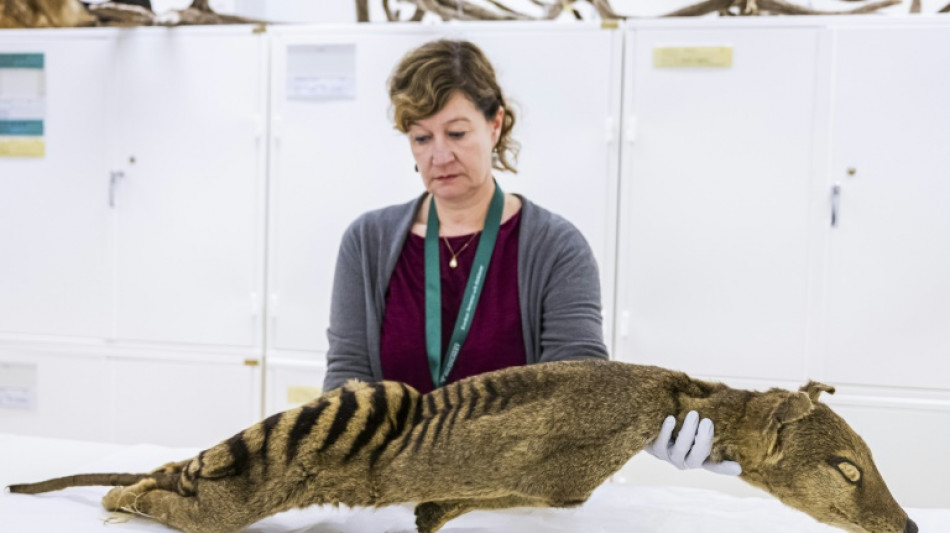
Scientists have for the first time recovered RNA from an extinct species, the Tasmanian tiger, raising hope for the resurrection of animals once thought lost forever, Stockholm University researchers told AFP.
"RNA has never been extracted and sequenced from an extinct species before," said Love Dalen, a Stockholm University professor of evolutionary genomics who co-led the project.
"The ability to recover RNA from extinct species constitutes a small step (toward) maybe being able to resurrect extinct species in the future," he said.
Dalen and his team were able to sequence RNA molecules from a 130-year-old Tasmanian tiger specimen preserved at room temperature in Sweden's Museum of Natural History.
With this they were able to reconstruct skin and skeletal muscle RNA.
RNA is a molecule that is used to convey information from the genome to the rest of the cell about what it should do.
"If you're going to resurrect an extinct animal, then you need to know where the genes are and what they do, and in what tissues they are regulated," Dalen said, explaining the need for knowledge about both DNA and RNA.
The last known living Tasmanian tiger or thylacine, a carnivorous marsupial, died in captivity in 1936 at the Beaumaris Zoo in Tasmania.
After European colonisation of Australia, the animal was declared a pest and in 1888 a bounty was offered for each full-grown animal killed.
Scientists have focused their de-extinction efforts on the Tasmanian tiger as its natural habitat in Tasmania is largely preserved.
- 'Exciting idea' -
Daniela Kalthoff, in charge of the mammal collection at the Museum of Natural History, said the idea of possibly resurrecting the Tasmanian tiger was an "exciting idea".
"This is a fantastic animal and I would love to see it live again," she said, demonstrating the black-and-brown striped skin the researchers used in their study.
Their findings also have implications for studying pandemic RNA viruses.
"Many of the pandemics that have happened in the past have been caused by RNA viruses, most recently the coronavirus but also ... the Spanish flu," Dalen explained.
"We could actually go and look for these viruses in wild animal remains stored in dry museum collections. That might actually help us understand the nature of pandemics and where pandemics come from," he said.
The study opens the door to using museum collections in this new way.
"There are millions and millions of dried skins and dried tissue from insects, mammals and birds and so on in museum collections around the world, and one could actually now go and recover RNA from all these specimens," Dalen said.
J.Bergmann--BTB