
What are attoseconds? Nobel-winning physics explained / Photo: © TT News Agency/AFP

 Butterflies seek new habitats as climate changes: study

 'Deceitful' Infantino 'must go' says Luis Figo

 ヌーシャ・オーベル:彼女はポツダムの抱える問題に対処できるのか?

 努莎·奧貝爾:她能否應對波茨坦面臨的問題?

 Нооша Аубель: Чи зможе вона впоратися з проблемами Потсдама?

 Noosha Aubel: Is she up to the task of tackling Potsdam’s problems?
 Alarm at German airport after drone found near Ukrainian plane, mid-air incident

 Salah arrives in Turkey for Trabzonspor talks

 Embattled FIFA chief Infantino holds emergency talks with directors
 Russian barrage on Kyiv kills 17 as Ukraine fails to down single missile

 'Lost': Migrants despair after Britain expels them back to France

 Cathay Pacific's profit soars 71% despite Iran war driving up fuel costs
 Russian barrage on Ukraine kills 15, wounds dozens more

 South Korea police raid Starbucks HQ over 'Tank Day' fiasco

 Tech back in fashion as Asian markets extend rebound

 Total eclipse gives scientists chance to probe Sun's mysteries
 What to know about the total solar eclipse on August 12

 'Like the end of the world': the eclipse chasers flocking to Spain

 Taiwan begins military drills as China pressure grows

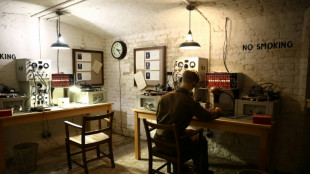 UK mansion where 'listeners' spied on Nazi generals becomes museum

 Sabalenka tops Uchijima in WTA Toronto opener

 Alcaraz withdraws from Cincinnati Masters with wrist injury

 SpaceX revenue jumps 92% in first earnings report, but shares slide

 US eyes Hormuz deal 'today or tomorrow' as ship sinks in Red Sea

 SpaceX revenue jumps 92% in first earnings report

The Nobel Physics Prize was awarded on Tuesday to three scientists for their work on attoseconds, which are almost unimaginably short periods of time.
Their work using lasers gives scientists a tool to observe and possibly even manipulate electrons, which could spur breakthroughs in fields such as electronics and chemistry, experts told AFP.
- How fast are attoseconds? -
Attoseconds are a billionth of a billionth of a second.
To give a little perspective, there are around as many attoseconds in a single second as there have been seconds in the 13.8-billion year history of the universe.
Hans Jakob Woerner, a researcher at the Swiss university ETH Zurich, told AFP that attoseconds are "the shortest timescales we can measure directly".
- Why do we need such speed? -
Being able to operate on this timescale is important because these are the speeds at which electrons -- key parts of an atom -- operate.
For example, it takes electrons 150 attoseconds to go around the nucleus of a hydrogen atom.
This means the study of attoseconds has given scientists access to a fundamental process that was previously out of reach.
All electronics are mediated by the motion of electrons -- and the current "speed limit" is nanoseconds, Woerner said.
If microprocessors were switched to attoseconds, it could be possible to "process information a billion times faster," he added.
- How do you measure them? -
Franco-Swede physicist Anne L'Huillier, one of the three new Nobel laureates, was the first to discover a tool to pry open the world of attoseconds.
It involves using high-powered lasers to produce pulses of light for incredibly short periods.
Franck Lepine, a researcher at France's Institute of Light and Matter who has worked with L'Huillier, told AFP it was like "cinema created for electrons".
He compared it to the work of pioneering French filmmakers the Lumiere brothers, "who cut up a scene by taking successive photos".
John Tisch, a laser physics professor at Imperial College London, said that it was "like an incredibly fast, pulse-of-light device that we can then shine on materials to get information about their response on that timescale".
- How low can we go? -
All three of Tuesday's laureates at one point held the record for shortest pulse of light.
In 2001, French scientist Pierre Agostini's team managed to flash a pulse that lasted just 250 attoseconds.
L'Huillier's group beat that with 170 attoseconds in 2003.
In 2008, Hungarian-Austrian physicist Ferenc Krausz more than halved that number with an 80-attosecond pulse.
The current holder of the Guinness World Record for "shortest pulse of light" is Woerner's team, with a time of 43 attoseconds.
The time could go as low as a few attoseconds using current technology, Woerner estimated. But he added that this would be pushing it.
- What could the future hold? -
Technology taking advantage of attoseconds has largely yet to enter the mainstream, but the future looks bright, the experts said.
So far, scientists have mostly only been able to use attoseconds to observe electrons.
"But what is basically untouched yet -- or is just really beginning to be possible -- is to control" the electrons, to manipulate their motion, Woerner said.
This could lead to far faster electronics as well as potentially spark a revolution in chemistry.
So-called "attochemistry" could lead to more efficient solar cells, or even the use of light energy to produce clean fuels, he added.
O.Bulka--BTB