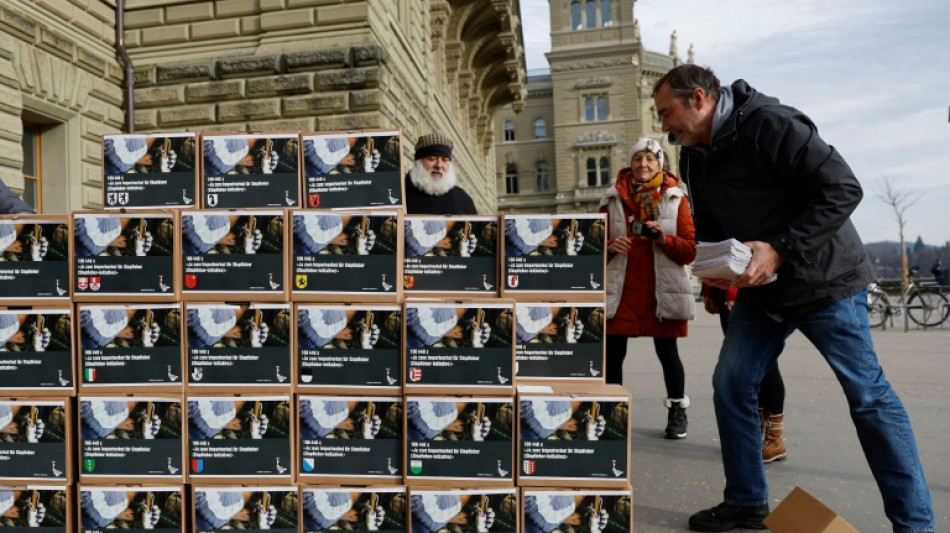
Swiss to vote on foie gras, fur imports / Photo: © AFP

 India seeks threefold increase in coal stocks to prevent summer power shortages

 Adobe PDF Spaces Introduces Shared AI Conversations for Document Collaboration

 KKR secures Indian regulator approval for Gentari Renewables investment

 Bharti Airtel revenue expected to grow at double-digit pace in second quarter

 Italy Claims Curling Silver at European Championships in Ostrava

 Kuwait finance minister holds economic cooperation talks at COMCEC

 Abdul El-Sayed declares victory in Michigan Senate contest

 Democrats capture US Congress in sweeping midterm victory

 Manchester United rallies past Roma as PSG dominates in Champions League

 Qatar sees tentative opening for renewed regional diplomacy

 Qatar Tourism joins Pacific Asia Travel Association at London travel market

 Abdul El-Sayed Wins Michigan Senate Seat in Historic Election
 Qatar media bodies discuss support for humanitarian initiatives

The Swiss will decide whether to ban foie gras and fur imports after campaigners on Thursday handed in enough signatures to trigger a public vote on the twin issues.
Outside the Federal Palace parliament buildings in the capital Bern, campaigners from the Swiss Animal Alliance, which launched the move, piled up boxes symbolising the certified signatures.
The popular initiative on foie gras collected 106,448 signatures, while the one on fur attracted 116,140 -- both above the 100,000 threshold required to trigger a national vote.
Foie gras is widely consumed around the December holiday season, giving extra resonance to the campaign.
Force-feeding ducks and geese -- a key way of making foie gras -- has been banned in Switzerland for more than 40 years, but importing produce derived from this method is not.
The popular initiative "Yes to the ban on importing foie gras" wants to change the constitution to ban the import of such products.
The second proposal is entitled "Yes to the ban on importing fur products from mistreated animals".
With 200 tonnes of foie gras imported annually, "Switzerland unfortunately positions itself as one of the main importers of this product", says the Swiss Animal Alliance.
"Every year, 400,000 ducks and 12,000 geese are killed in order to meet the demand specifically in our country.
"It is hypocritical to ban Swiss breeders from producing foie gras under penalty of sanctions, while authorising the importation of this product."
As for fur, the Swiss Animal Alliance denounces "methods of breeding and killing (which) clearly contravene our legislation on the protection of animals and would be considered cruelty punishable by criminal sanctions in Switzerland".
It claims 350 tonnes of fur are imported each year, corresponding to the slaughter of around 1.5 million animals.
"More than half of these furs come from China, where the terrible conditions in which animals are detained and killed, some of which are skinned while still alive, are regularly denounced," it claims.
- Packaging change -
Almost all European countries prohibit the force-feeding of geese and ducks, with France, Hungary and Bulgaria notable exceptions.
In September, Switzerland's parliament rejected a bid to ban foie gras imports but ordered that the production methods had to be stated on the packaging.
Switzerland has direct democracy, with citizens able to trigger popular votes.
They can propose new laws themselves in initiatives, and challenge decisions taken by parliament in referendums.
A total of 100,000 valid signatures within 18 months are required to trigger a national initiative. A change of law requires a double majority of voters and cantons.
Popular votes take place every three months.
J.Bergmann--BTB