Duo wins Physics Nobel for key breakthroughs in AI / Photo: © AFP

 India seeks threefold increase in coal stocks to prevent summer power shortages
 Adobe PDF Spaces Introduces Shared AI Conversations for Document Collaboration
 KKR secures Indian regulator approval for Gentari Renewables investment
 Bharti Airtel revenue expected to grow at double-digit pace in second quarter

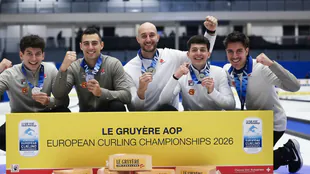 Italy Claims Curling Silver at European Championships in Ostrava

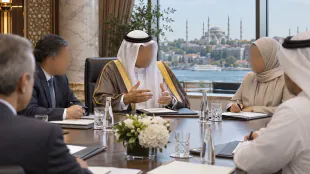 Kuwait finance minister holds economic cooperation talks at COMCEC
 Abdul El-Sayed declares victory in Michigan Senate contest

 Democrats capture US Congress in sweeping midterm victory
 Manchester United rallies past Roma as PSG dominates in Champions League

 Qatar sees tentative opening for renewed regional diplomacy
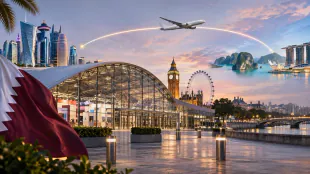 Qatar Tourism joins Pacific Asia Travel Association at London travel market
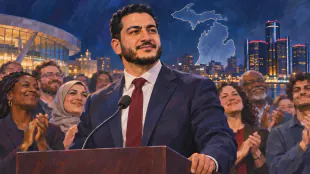 Abdul El-Sayed Wins Michigan Senate Seat in Historic Election
 Qatar media bodies discuss support for humanitarian initiatives

American John Hopfield and British-Canadian Geoffrey Hinton won the Nobel Prize in Physics on Tuesday for pioneering work in the development of artificial intelligence.
The pair were honoured "for foundational discoveries and inventions that enable machine learning with artificial neural networks," the jury said.
"These artificial neural networks have been used to advance research across physics topics as diverse as particle physics, material science and astrophysics," Ellen Moons, chair of the Nobel Committee for Physics, told a press conference.
Moons also noted that these tools have also become part of our daily lives, including in facial recognition and language translation.
"Humans carry the responsibility for using this new technology in a safe and ethical way," she said.
Hopfield, a 91-year-old professor at Princeton University, was spotlighted for having created "an associative memory that can store and reconstruct images and other types of patterns in data."
- 'Flabbergasted' -
The jury said Hinton, a 76-year-old professor at the University of Toronto, "invented a method that can autonomously find properties in data, and so perform tasks such as identifying specific elements in pictures."
"I'm flabbergasted, I had no idea this would happen," Hinton told reporters via a phone interview as the laureates were announced in Stockholm.
Hinton said he was an avid user of AI tools such as ChatGPT, but also conceded that he had concerns about the potential impact of the technology he helped spawn.
"In the same circumstances, I would do the same again, but I am worried that the overall consequence of this might be systems more intelligent than us that eventually take control," the researcher added.
The Nobel Prize in Physics is the second Nobel of the season after the Medicine Prize on Monday was awarded to American scientists Victor Ambros and Gary Ruvkun.
The US duo were honoured for their discovery of microRNA and its role in how genes are regulated.
Awarded since 1901, the Nobel Prizes honour those who have, in the words of prize creator and scientist Alfred Nobel, "conferred the greatest benefit on humankind".
Last year, the Nobel Prize in Physics went to France's Pierre Agostini, Hungarian-Austrian Ferenc Krausz and Franco-Swede Anne L'Huillier for research using ultra quick light flashes that enable the study of electrons inside atoms and molecules.
The physics prize will be followed by the chemistry prize on Wednesday, with the highly watched literature and peace prizes to be announced on Thursday and Friday respectively.
The economics prize wraps up the 2024 Nobel season on October 14.
The winners will receive their prize, consisting of a diploma, a gold medal and a $1 million cheque, from King Carl XVI Gustaf at a formal ceremony in Stockholm on December 10, the anniversary of the 1896 death of scientist Alfred Nobel who created the prizes in his last will and testament.
H.Seidel--BTB