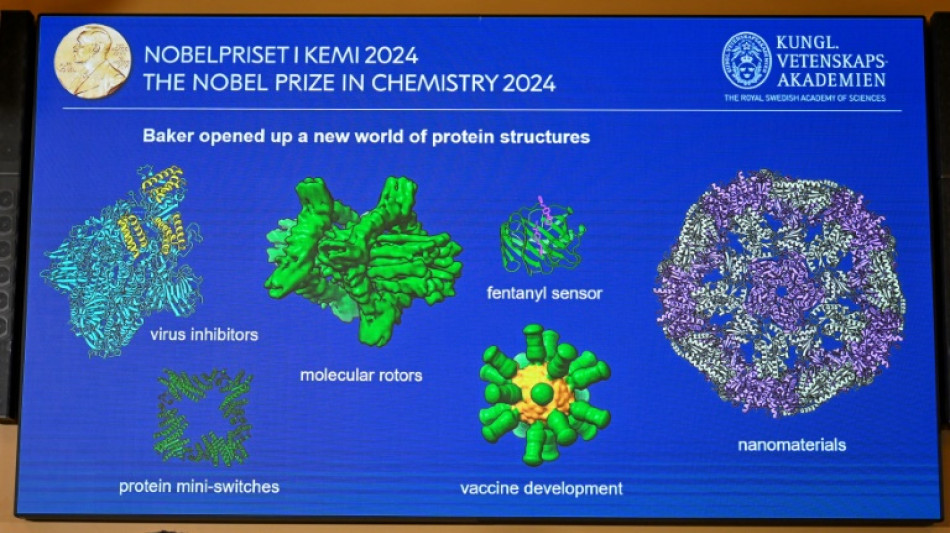
What are proteins again? Nobel-winning chemistry explained / Photo: © AFP/File

 2 killed, 13 wounded in bus blast near Syrian capital: state media
 All Blacks skipper Taylor cautiously recovering from calf strain

 UN chief denounces Russia, Ukraine for civilian deaths
 UEFA turn up the pressure on Infantino and repeat boycott threat
 Rodri approves Barcelona transfer talks with Man City: Barca source to AFP

 Venezuela unable to tally missing from cataclysmic quakes

 Le Court sprints to stage six Tour de France Femmes win
 Doping body says Parker's positive cocaine test caused by nutritionist
 UEFA says boycott of World Cups stands despite FIFA backdown on private investment

 Rheinmetall sales keep surging despite cancelled naval frigate project
 Pogacar teammate Del Toro gets new UAE deal after Tour podium

 Stocks tread water with earnings, tech in focus
 Forex Expo Dubai Announces Opportunity to Win Up to 150 Grams of Gold This September 2026
 Forlan named new Uruguay head coach
 UEFA chief Ceferin: 'Underdog' leader taking fight to FIFA's Infantino
 Salah completes move to Turkey's Trabzonspor
 UK clears Paramount's takeover of Warner Bros
 North Korea fires ballistic missile: South Korea military
 'Don't have to hide': Thai IDs, legal work give hope to Myanmar refugees
 Stocks mixed with tech firms back under pressure
 How Blundell's old school tactic ended England's 'Bazball' era

 Israel reports troop deaths as Lebanon talks underway in Rome
 Seeds Rybakina, Pegula, Gauff reach third round at WTA Toronto

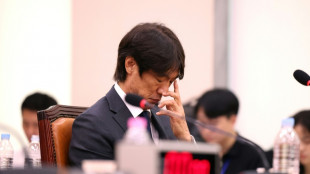 Police raid South Korea FA in probe into World Cup coach appointment
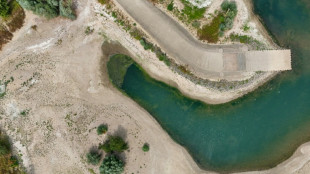 Low water on Germany's Rhine river threatens new blow to economy

The Nobel Prize in Chemistry was awarded on Wednesday to three scientists who have help unravel some of the enduring secrets of proteins, the building blocks of life.
While Demis Hassabis and John Jumper of Google's DeepMind lab used artificial intelligence techniques to predict the structure of proteins, biochemist David Baker managed to design totally new ones never seen in nature.
These breakthroughs are hoped to lead towards numerous advances, from discovering new drugs to enzymes that decompose pollutants.
Here is an explainer about the science behind the Nobel win.
- What are proteins? -
Proteins are molecules that serve as "the factories of everything that happens in our body," Davide Calebiro, a protein researcher at the UK's University of Birmingham, told AFP.
DNA provides the blueprint for every cell. Proteins then use this information to do the work of turning that cell into something specific -- such as a brain cell or a muscle cell.
Proteins are made up of 20 different kinds of amino acid. The sequence that these acids start out in determines what 3D structure they will twist and fold into.
American Chemical Society president Mary Carroll compared how this works to an old-fashioned telephone cord.
"So you could stretch out that telephone cord, and then you would just have a one-dimensional structure," she told AFP.
"Then it would spring back" into the 3D shape, she added.
So if chemists wanted to master proteins, they needed to understand how the 2D sequences turned into these 3D structures.
"Nature already provides tens of thousands of different proteins, but sometimes we want them to do something they do not yet know how to do," said French biochemist Sophie Sacquin-Mora.
- What did AI do? -
The work of previous Nobel winners had demonstrated that chemists should be able to look at amino acid sequences and predict the structure they would become.
But it was not so easy. Chemists struggled for 50 years -- there was even a biannual competition called the "Protein Olympics" where many failed the prediction test.
Enter Hassabis and Jumper. They trained their artificial intelligence model AlphaFold on all the known amino acid sequences and corresponding structures.
When given an unknown sequence, AlphaFold compares it with previous ones, gradually reconstructing the puzzle in three dimensions.
After the newer generation AlphaFold2 crushed the 2020 Protein Olympics, the organisers deemed the problem solved.
The model has now predicted the structure of almost all of the 200 million proteins known on Earth.
- What about the new proteins? -
US biochemist Baker started at the opposite end of the process.
First, he designed an entirely new protein structure never seen in nature.
Then, using a computer programme called Rosetta that he had developed, he was able to work out the amino acid sequence that it started out as.
To achieve this, Rosetta trawled through all the known protein structures, searching for short protein fragments similar to the structure it wanted to build.
Rosetta then tweaked them and proposed a sequence that could end up as the structure.
- What is all this for? -
Mastering such fundamental and important little machines as proteins could have a vast number of potential uses in the future.
"It allows us to better understand how life functions, including why some diseases develop, how antibiotic resistance occurs or why some microbes can decompose plastic," the Nobel website said.
Making all-new proteins could lead to new nanomaterials, targeted drugs and vaccines, or more climate-friendly chemicals, it added.
Asked to pick a favourite protein, Baker pointed to one he "designed during the pandemic that protects against the coronavirus".
Calebiro emphasised how "transformative" this research would be.
"I think this is just the beginning of a completely new era."
C.Kovalenko--BTB