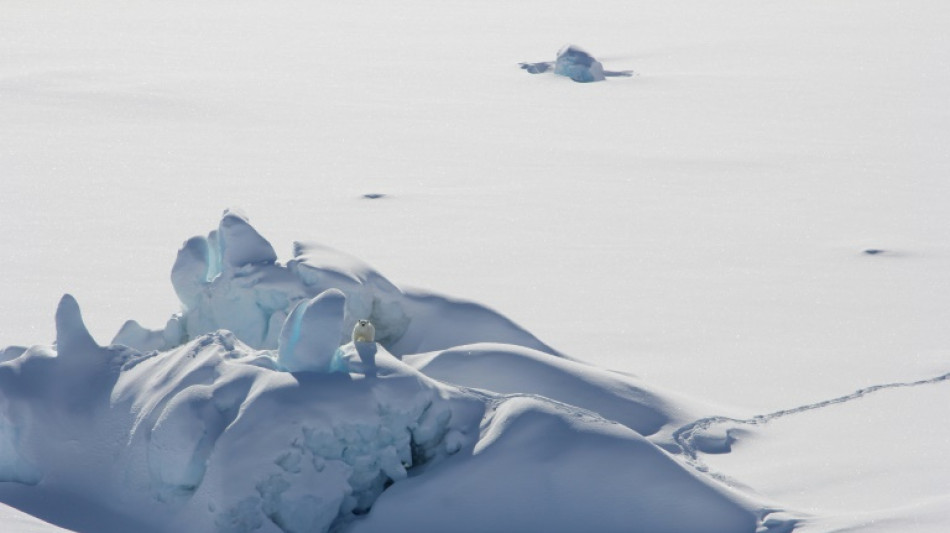
Scientists find new population of polar bears in sea-ice free region / Photo: © AFP

 Star Australian broadcaster faces trial for sexual assault
 Oil prices sink on Middle East hopes, yen extends gains after joint intervention

 Millions of Thais banish the booze for Buddhist Lent

 Returning to 'Ted Lasso' after break 'effortless': Hannah Waddingham

 Trump says new Iran talks set to start after calling off massive attack

 Four Al-Fayed survivors told they were trafficking victims

 Ariana Grande withdraws from London musical, seeks to 'step back'

 Sudan army drone attack on Darfur court kills 35

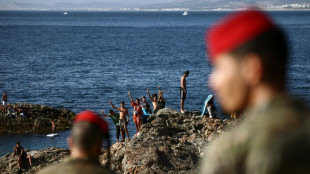 At least 72 died in Spain's Ceuta migrant rush, Spain says

 Russian teen Liutova wins WTA Memphis title

 Zverev remains wary of 12-day Masters events

 Wimbledon champ Noskova ready for 'new opportunity'

 Japan's Kuwaki wins women's British Open to clinch first major title
 Sabalenka aims to bounce back in Toronto after Wimbledon disappointment

 Iran says close to Hormuz deal with Oman, after US suspends attack plan

 'Spider-Man' soars to huge $355 million opening in North America
 Handbag tosses and high-heeled sprints: Amsterdam celebrates Drag Olympics
 Trump's on-again-off-again war against Iran: in his own words

 Dodgers land Tigers pitching ace Skubal in MLB trade deadline blockbuster

 Infantino struggling to survive, says former IOC marketing chief
 OPEC+ boosts September production by 188,000 barrels/day
 Rescuers recover climber Nirmal Purja's body after avalanche disaster
 Fire toll mounts in Greece as blazes spread
 Sri Lanka deploys troops after prison riot
Polar bears face an existential threat from the rapid decline of Arctic sea ice, which they rely on as platforms to hunt seals.
But in a new study, scientists have identified an isolated subpopulation of polar bears in Southeast Greenland that instead make use of freshwater ice pouring into the ocean from the region's glaciers, suggesting this particular habitat is less susceptible than others to climate change.
Their findings, described in the journal Science on Thursday, open up the tantalizing possibility that at least some pockets of the species might be able to survive further into this century, when Arctic sea ice is expected to disappear completely during summer months.
"One of the big questions is where in the Arctic will polar bears be able to hang on, what we call 'persist,'" first author Kristin Laidre, a polar scientist at the University of Washington and Greenland Institute of Natural Resources told AFP.
"I think that bears in a place like this can teach us a lot about where those places might be."
Laidre and colleagues first spent two years interviewing Inuit subsistence hunters who provided input and ecological knowledge, including harvest samples for analysis.
They then began their own field work, which lasted from 2015 to 2021, in a harsh region that was long understudied because of its unpredictable weather, heavy snowfall and jagged mountains.
- Hemmed in -
Each year, the team would spend one month in springtime, staying in the nearest settlement Kuummiit, which is a two-hour helicopter ride from where the bears live. Fuel depots had to be staged along the route in advance down the coastline, creating a hopskotch-like commute to work.
The team tagged the bears with satellite tracking devices, and collected genetic samples by either capturing bears or firing biopsy darts into their rumps.
Thought to number a few hundred individuals, "they are the most genetically isolated population of polar bears anywhere on the planet," said co-author Beth Shapiro, a geneticist at the University of California, Santa Cruz and investigator at the Howard Hughes Medical Institute, in a statement.
"We know that this population has been living separately from other polar bear populations for at least several hundred years."
Unlike their cousins, the Southeast Greenland polar bears were found to be homebodies, seldom straying far to hunt.
Their isolation arises from the geography: they live in a complex landscape of fjords on the very edge of their range on the southern tip of Greenland, well below the Arctic circle, with nowhere to go.
To the west there are an enormous set of mountains and the Greenland Ice Sheet, and to the east the open water of the Denmark Strait all the way to Iceland. They also have to contend with a rapid current that flows southward along the coast.
"We see that when they get caught in this current they jump off the ice and they walk back home to their fjords," said Laidre. The team found that some of the tracked bears accidentally caught in this situation had to trek more than a hundred miles back home.
- Climate refuges? -
While sea ice provides hunting platforms for most of the Arctic's roughly 26,000 polar bears, the Southeast Greenland bears have access to sea ice for only four months, between February and late May.
For the remaining eight months they rely on chunks of freshwater ice breaking off the Greenland Ice Sheet in the form of marine-terminating glaciers.
"These types of glaciers do exist in other places in the Arctic, but the combination of the fjord shapes, the high production of glacier ice and the very big reservoir of ice that is available from the Greenland Ice Sheet is what currently provides a steady supply of glacier ice," said another co-author Twila Moon of the National Snow and Ice Data Center in a statement.
There remains much to study about the Southeast Greenland polar bears. Measurements show the adult females are a little smaller than average and they appear to have fewer cubs, but it's hard to infer much about what that means in the absence of long term data.
Laidre is keen to not oversell the study as one of hope. Polar bears -- which in addition to being iconic in their own right are also a vital resource for indigenous people -- aren't going to be saved without urgent climate action.
But this population might have a better shot, and there are similar areas with marine-terminating glaciers on other parts of Greenland's coast as well as the island of Svalbard that might become small-scale climate refugia.
"We as a community need to look at places like this and ask ourselves, is this a place where we might be able to have some small numbers of polar bears persisting in an ice-free Arctic?" said Laidre.
M.Ouellet--BTB