India's cows offer biogas alternative to Mideast energy crunch / Photo: © AFP

 Russia hails Trump waiving sanctions as 'historic'

 Noosha Aubel: Misslyckat ledarskap i stället för en nystart – är Potsdams överborgmästare vuxen uppgiften?

 Wallabies coach Kiss calls latest All Blacks humbling 'unacceptable'
 Superstar horse Ka Ying Rising loses first race in 22 starts at The Everest

 Rampant All Blacks crush Wallabies 43-21 to extend dominance

 All Blacks crush Wallabies 43-21 to extend dominance

 'No Kings' movement seeks to boost early voting

 Trump waives new Russia sanctions as Ukraine ties slump

 Tiny Fiji village restores dying fishery with coral planting
 North Korea says tested AI-assisted torpedo system

 Did Chinese cars squeal on Norway's military?

 Guardians-Rays MLB playoff game start delayed by rain

 Suspected gunman in Oregon school shooting was 'withdrawn,' neighbors say

 As Champions Cup opens on mournful note, holders Bordeaux-Begles draw

 Figueroa loses title at weigh-in but Kameda can win it

 Deforestation in Brazil Amazon hits nearly four-decade low
 US budget deficit grows to nearly $2 trillion, highest since 2021

 Bend grieves after mass shooting: 'Who would do this to little kids?'

 'Great hero' praised for saving lives in Oregon school shooting

 Trump's new press secretary looks close to exit after just one week

 Trump says armed bystander who killed US school shooter a 'great hero'

 Real Madrid say Tebas must resign over Goebbels comparison

 Djokovic gets Basel wild card as ATP Finals race heats up

 Swiss solar-powered plane altitude record confirmed

 Turkey's Salt Lake, life in the shadow of drought

Across much of India, an energy crunch caused by the Iran war has prompted long queues for cooking gas cyclinders. That's not a problem for Gauri Devi.
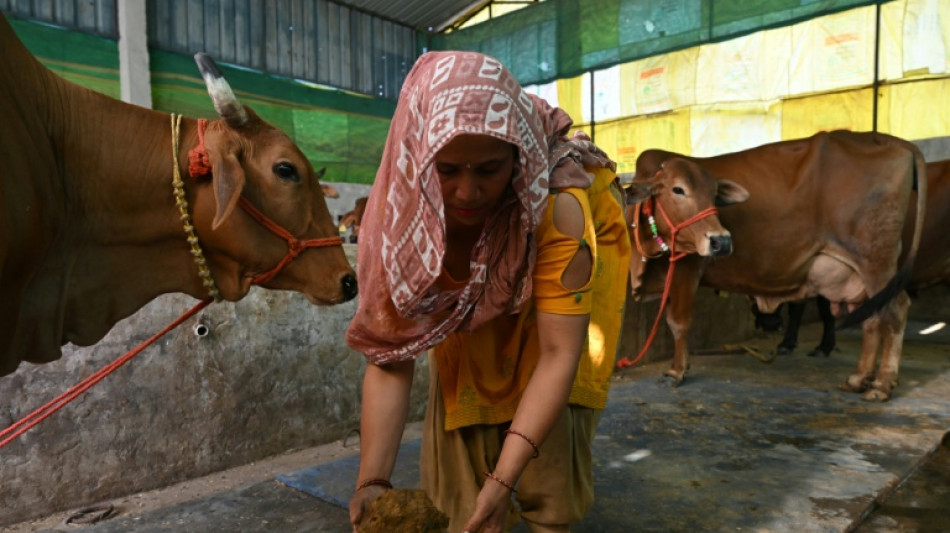
On a stove with blue flames, she flips a chapati flatbread, burning biogas produced from cow dung -- an alternative fuel helping ease pressure on supplies.
"It cooks everything," the 25-year-old said in her courtyard kitchen in Nekpur, a village in Uttar Pradesh, about 90 kilometres (55 miles) from New Delhi. "If the pressure goes down, we let it rest for half an hour and it works again."
India consumes more than 30 million tonnes of liquefied petroleum gas (LPG) annually, importing over half its needs.
The government insists there is no shortage of cooking gas, but supply delays, panic buying and black marketeers have created long queues for cylinders.
However, since the 1980s India has also promoted biogas as a low-cost rural energy source, subsidising more than five million "digester" units that convert farm waste into methane for cooking, and nitrogen-rich slurry for fertiliser.
For Gauri, it requires mixing a couple of buckets of dung with water, then pouring the mixture into a car-sized underground tank topped with a storage balloon.
It provides a piped methane supply so regular that she only uses an LPG cylinder for emergencies or large gatherings.
The biogas works for everything -- "vegetables, tea, lentils", she said.
- 'Black gold' -
The residual slurry is later spread on fields as fertiliser. It has better nitrogen availability for plants compared with raw dung, farmers say.
"The manure is so good," said farmer Pramod Singh, who installed a larger unit in 2025, enough for six people, fuelled by 30–45 kilogrammes of dung daily from four cows.
And he said the slurry fertiliser is particularly valuable at a time when global supplies of artificial fertilisers have been hit by trade disruptions due to the war.
"The real benefit is not just the gas -- that is like a bonus," local farmer leader Pritam Singh said. "The slurry is 'black gold'."
More than 45 percent of India's 1.4 billion people rely on farming, and the country has one of the largest cattle populations.
India -- the world's most populous nation and third-largest fossil fuel polluter -- has pushed large-scale biogas production to achieve a goal of carbon neutrality by 2070.
The government last year required that biogas account for at least one percent of liquid gas fuelling both vehicles and for domestic use -- rising to five percent by 2028.
Dozens of multi-million dollar production plants are now in the pipeline.
But small-scale rural producers are also being rolled out -- units cost around 25,000–30,000 rupees ($265-$318), often heavily subsidised by the government.
In a Hindu-majority nation where cows are revered and dung and urine are used in everything from floor plastering and fuel to ritual practices, it is easy to win supporters, said Pritam Singh.
He installed his first plant in 2007, and has helped put in 15 more in his village in the past year alone.
He said interest had shot up after the LPG shortages.
"People who earlier were not interested now ask how to get it," he said.
"Once they see food being cooked and crops benefiting, they are convinced."
- 'Mini factories' -
But biogas is still a small fraction of household cooking fuel -- with LPG considered more convenient because companies manage the supply chain.
"Biogas plants are not just equipment; they are mini factories," said A.R. Shukla, president of the Indian Biogas Association.
"They need organised installation, regular operation and maintenance," he added.
"So, unless installation and upkeep are handled through community-based or cooperative enterprises, households will continue to treat biogas as secondary fuel."
And even with government support, there are barriers to uptake, including cost and space.
"We work on other people's farms the whole day. We don't have land for it," said labourer Ramesh Kumar Singh, standing in a line of around 100 queueing for LPG cylinders in the nearby village of Madalpur.
"I am standing in scorching heat, hungry and thirsty," said Mahendri, 77, who had failed to secure a cylinder for three days in a row.
O.Krause--BTB