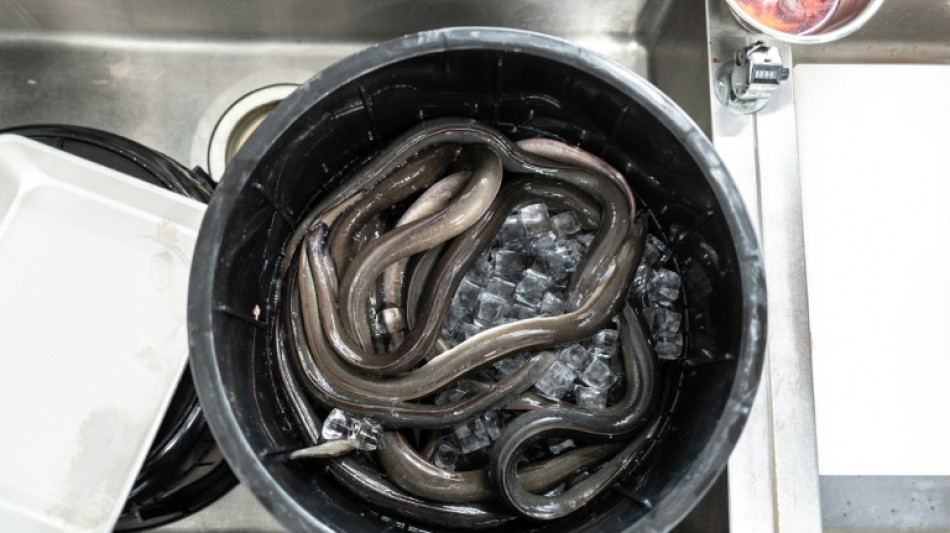
Japan to sell eels bred in captivity in 'world first' / Photo: © AFP/File

 Trump threatens EU over 'hostile' Canada association plan

 Argentine judge orders suspension of Falklands oil project

 Carrick takes the blame as troubled Man Utd suffer League Cup misery

 Barcelona hit seven in Racing Santander rout

 Amorim's Milan beaten by Benfica, Sunderland make dream European return

 US stocks fall, dollar gains after Fed lifts interest rates

 Seahawks rule out Darnold for Sunday game at Arizona

 Mbappe explains Ceuta shirt stance after criticism

 Improving Atletico cruise to comfortable win over Osasuna

 Candidate for UN chief calls for AI regulation akin to nuclear weapons

 O'Neill expects Celtic recovery after Old Firm misery

 Man City midfield trio backed to emulate Rodri and Silva

 'We're losing control,' AI pioneer Yoshua Bengio tells AFP

 WHO eyes 'encouraging' signs in DRCongo fight against Ebola

 Liga boss criticises Real Madrid trio for Ceuta shirt incident

 WTA Finals moved to Charlotte from 2027

 Almost 8,000 excess deaths in France's scorched summer: statistics

 Ex-president's lengthy war crimes sentence shocks Kosovo
 US House faces test on sweeping Russia sanctions bill

 British PM says to make 'difficult decisions' as inflation rises

 TotalEnergies pumps up controversy in France with cut-price gas

 Global fuel price demos: a round-up

 Leverate Launches MCP for Traders to Connect AI Assistants With Trading Platforms

 MEXC Launches $1M "Discover Your Wall Street DNA" Campaign to Help Traders Find Their Market Fit

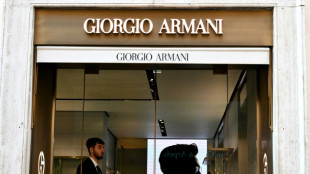 Emporio Armani names Dario Vitale new creative director

Eels bred in captivity will be sold in Japanese shops for the first time, in a move that could ease eventually pressure on the endangered fish, officials said Wednesday.
Eel populations are falling worldwide, scientists say, largely due to factors linked to human activity such as the pollution of waterways, destruction of wetlands, hydroelectric dams, and fishing.
Eel is an enormously popular food in Japan and other parts of Asia.
The fish has proved stubbornly unwilling to reproduce in captivity without intervention, but Japanese researchers succeeded in breeding Japanese eels from eggs in a laboratory setting in 2010 at great expense.
Since then, they have been trying to reduce the "huge cost... so that the price could be accepted in the market," Yasutaka Okamoto, a fisheries agency official in charge of aquaculture promotion, told AFP.
"With countless small technological breakthroughs, the cost is now some 1,800 yen ($11) per one baby eel, down from more than a million yen at the initial stages, and down from some 40,000 yen in 2016," he said.
The price is still three to four times higher than a wild baby eel, "but we think it's time to test market reactions," he explained.
The project brought together government researchers, universities and the private sector.
Eel is eaten worldwide but is particularly popular in Japan, where it is called "unagi" and traditionally served grilled and covered in a sticky-sweet sauce.
"If the (Japanese) people didn't love eels so much, we wouldn't go to such lengths to research how to farm them," Okamoto said.
Grilled "kabayaki" using fully farmed eel will be sold from May 29 at a department store in Tokyo and several other outlets including online shops in Japan.
Yamada Suisan, the eel farming company selling the fish, said it was a world-first, and a "very significant step toward the future commercialisation of fully farmed eel."
Two kabayaki eels will be sold at around 9,000 yen ($57), a price that is broadly comparable to high-end produce.
Last year, a key global forum that regulates trade in threatened wildlife rejected an EU-led proposal to protect more species of eel.
The protections were fiercely opposed by top consumers of the fish, led by Japan.
The Japanese eel, along with the American variety, is listed as endangered by the International Union for Conservation of Nature.
The European eel is considered critically endangered.
O.Bulka--BTB