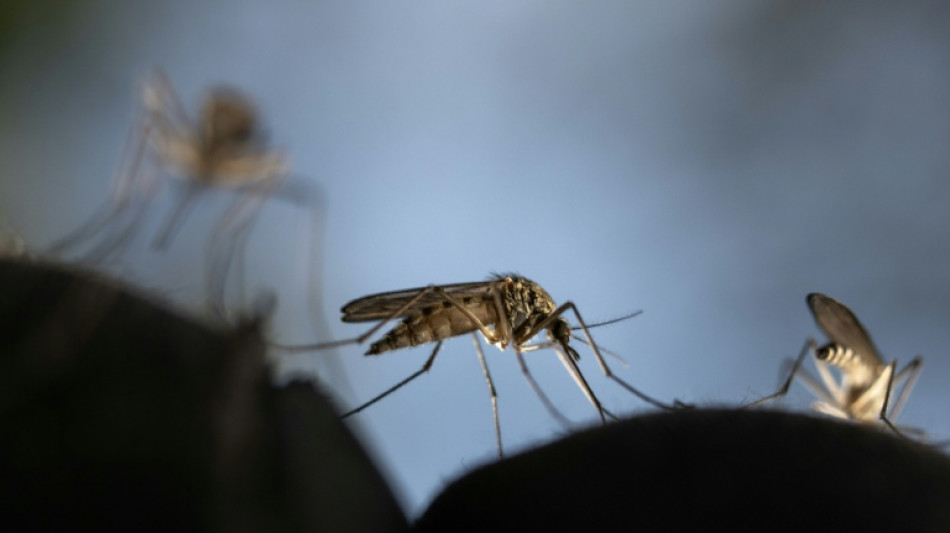
Mosquitoes can learn to love common repellent, scientists find / Photo: © AFP/File

 Trump threatens EU over 'hostile' Canada association plan

 Argentine judge orders suspension of Falklands oil project

 Carrick takes the blame as troubled Man Utd suffer League Cup misery

 Barcelona hit seven in Racing Santander rout

 Amorim's Milan beaten by Benfica, Sunderland make dream European return

 US stocks fall, dollar gains after Fed lifts interest rates

 Seahawks rule out Darnold for Sunday game at Arizona

 Mbappe explains Ceuta shirt stance after criticism

 Improving Atletico cruise to comfortable win over Osasuna

 Candidate for UN chief calls for AI regulation akin to nuclear weapons

 O'Neill expects Celtic recovery after Old Firm misery

 Man City midfield trio backed to emulate Rodri and Silva

 'We're losing control,' AI pioneer Yoshua Bengio tells AFP

 WHO eyes 'encouraging' signs in DRCongo fight against Ebola

 Liga boss criticises Real Madrid trio for Ceuta shirt incident

 WTA Finals moved to Charlotte from 2027

 Almost 8,000 excess deaths in France's scorched summer: statistics

 Ex-president's lengthy war crimes sentence shocks Kosovo

 US House faces test on sweeping Russia sanctions bill

 British PM says to make 'difficult decisions' as inflation rises

 TotalEnergies pumps up controversy in France with cut-price gas

 Global fuel price demos: a round-up

 Leverate Launches MCP for Traders to Connect AI Assistants With Trading Platforms

 MEXC Launches $1M "Discover Your Wall Street DNA" Campaign to Help Traders Find Their Market Fit

 Emporio Armani names Dario Vitale new creative director

Mosquitoes can learn to associate the smell of the world's most common insect repellent with a tasty meal -- and after training can even prefer to bite people who have been sprayed with it, an experimental study said Thursday.
The surprising results, which were conducted "under very specific conditions" in the lab, do not "call into question the effectiveness" of the repellent DEET, lead study author Claudio Lazzari told AFP.
Since being developed in the 1940s in the United States, the chemical compound has saved many lives from the scourge of insect bites.
"It is the absolute gold standard for repellents, used by the World Health Organization to combat the transmission of mosquito-borne diseases," emphasised Lazzari, professor emeritus at the Insect Biology Research Institute at France's University of Tours.
However the world also needs to find new, more effective, environmentally friendly repellents that cause fewer allergies, he added.
That means figuring out exactly why insects are so turned off by the repellents that we do have.
"We don't know why" compounds like DEET deter mosquitoes, Lazzari admitted. Are they toxic for the little blood-suckers? Do they stop mosquitoes from tracking down our scent? Or do they just smell bad?
To find out more, the international team of scientists used a form of conditioning made famous by Pavlov's dog, which learned to associate the arrival of food with the sound of a ball.
- 'Paradigm shift' -
For the experiment, the mosquitoes were put in a fabric mesh enclosure, then presented with a bag of warm sheep's blood to observe how eagerly they fed on it.
Unsurprisingly, the Aedes aegypti mosquitoes -- which spread deadly diseases such as dengue fever, Zika, yellow fever, and chikungunya -- leapt at the chance.
When the smell of DEET was introduced, the mosquitoes moved away, which was also expected.
Next, the scientists fed the insects warm blood for 20 seconds, releasing DEET during the last 10 seconds.
That part was repeated three times before the mosquitoes were exposed to solely the scent of the repellent.
This time, more than 60 percent of the insects tried to bite the fabric -- even though there was no blood.
Then, one of the scientists offered up their hands -- one clean, the other coated with DEET -- to the trained mosquitoes to see which one they would bite.
The result was beyond doubt: the insects preferred the hand covered in repellent.
The scientists had similar results when they repeated the experiment using sugar instead of blood, because mosquitoes mostly feed on plant nectar in the wild.
"The common assumption has always been that repellents work because of their chemistry," study co-author Clement Vinauger of Virginia Tech in the United States said in a statement.
But this study shows "that it's not the chemistry of the molecule itself that is toxic" to the mosquito, instead they are repelled by how they "interpret this chemical information," Lazzari added.
"What we are showing is that the mosquito's brain can rewrite that response based on experience," Vinauger explained.
"What the insect has learned matters just as much as what the chemical does. That, I think, is a paradigm shift."
While the mosquitoes were trained relatively quickly during the experiment, in nature "very specific conditions would be needed for things to happen the same way," Lazzari emphasised.
He advised everyone to follow the instructions on their repellent, because DEET can come in a variety of concentrations.
The study was published in the Journal of Experimental Biology.
L.Dubois--BTB