Indonesia cash-for-photos scheme turns animal hunters into protectors / Photo: © AFP

 Democrats, Trump hold final rallies before midterm elections

 Japan urges US to enforce discipline after second Marine arrest
 'Remarkable' rookie Lendeborg scores 37 as Warriors beat Clippers

 ExxonMobil urged to re-think Papua New Guinea gas project

 Asian stocks mixed as tech sector struggles to rebound from selloff
 India's royals find new power in their past

 Irish bookshops help meet UK demand for Sally Rooney novels
 NFL Vikings suffer first loss while Broncos edge Chiefs

 Host of fresh faces in Australia white-ball squads to face England

 NFL linebacker Campbell to remain hospitalized overnight

 Hydrosat Announces Nyktòs Program to Provide Tactical ISR for Sovereign Customers from New Facility in Europe

 Chervon Names Thomas Scherer Vice President of Organizational Development - Sales, End User Marketing, and Service
 BEING rather than HAVING. A fascinating, practical STORY.

 'Grateful' Antonelli becomes youngest Formula One world champion

 Four sporting prodigies who scaled the heights

 Six key races that made Kimi Antonelli a world champion

 Isa double sends Pau past Toulouse in Top 14

 NFL Lions linebacker Campbell carted off to hospital

 Iran warns new war could last longer after Trump threatens strikes

 Bulgarian president wins runoff vote as Black Sea attacks raise stakes
 Iraola instructs Liverpool players to dive after Arsenal penalty call

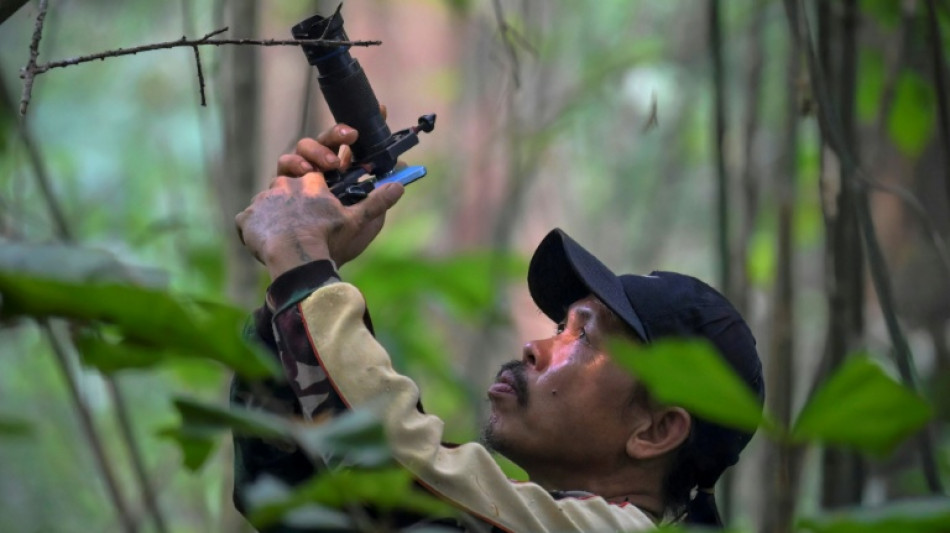
Indonesian villager Octavius wades through the forest in rubber boots and tattered joggers, ears pricked, eyes peeled, a telephoto lens on his phone primed to capture orangutans, monkeys or birds.
The daily photo hunt earns Octavius and hundreds of others in Borneo cash as part of a conservation programme seeking to make animals worth more alive than dead.
Locals on the island have long made money from hunting wild songbirds and selling them, mainly to domestic customers.
The KehatiKu project aims to break that cycle by paying individuals in nine participating villages in West Kalimantan province for photos or recordings of animals instead.
Payments range from 5,000 rupiah (about $0.30) for observing a common bird, to 130,000 rupiah for an endangered orangutan -- the top prize.
The most successful observers earn up to 10 million rupiah a month -- equivalent to about $570, several times an average farmworker's income.
The extra cash "really helps, especially to pay for my children's college", said 50-year-old Octavius, who like many Indonesians uses a single name.
The programme, run by environmental consultancy Borneo Futures, began two years ago and produces data on wildlife distribution and population changes.
Most participants are small-scale farmers of rice, cacao, durian and the stimulant kratom.
Early signs suggest the scheme is working.
"People have started to realise that where previously they caught one bird and it was worth 50,000 rupiah, now they just need to take a photo, send it to us, and they can receive a payment of 5,000 to 10,000 rupiah," Borneo Futures Indonesia director Nardiyono told AFP.
"If they take just five photos, they (may) earn 50,000 rupiah, and the bird is still in their environment, still observable, and still able to reproduce, so the potential income from observing birds is far greater than from hunting birds."
- Side-job -
That shifting logic has prompted two participating villages to voluntarily introduce hunting bans since the project started, added Nardiyono.
The programme is funded by philanthropic foundations and has received about $300,000 to date, according to Borneo Futures.
Half has gone towards development, including a mobile app for uploading animal sightings and an AI system that helps humans verify observations.
So far, users have submitted over 350,000 observations, about half of which have been validated and paid for.
Invalid entries might include multiple observations of the same animal, or a species that is not on the programme's list.
In September, Octavius and dozens of others gathered at the tiny office in Labian village -- population 683 -- for their monthly payments.
His share was four million rupiah, or nearly $230.
"This is a side-job; it doesn't interfere" with farming, he told AFP as he showed off a patch where he grows kratom and cacao.
"Sometimes when we're working, when everyone is gathered to collect kratom leaves, we hear birds calling, so we go over, observe them -- if we can take a photo, we take a photo; if not, we just make a sound recording."
The programme's model is "likely better for both environmental and social impacts than an unincentivised, top-down conservation project design," said researcher Paul Ferraro of the US-based Johns Hopkins University.
The main challenge will be maintaining funding, he added.
"People may revert to their prior behavioural patterns because the incentive payments are insufficient when the enthusiasm has waned," said Ferraro, an expert in human behaviour and public policy.
- Sense of independence -
For now, Borneo Futures has funding secured through 2028, and two more villages will join next month.
It pays for observations of 73 species, including birds, monkeys, wild cats and deer.
Antonia Uneng says she never has to venture too far from her home in Sungai Ajung, a village of fewer than 400 people, for observations.
She bought her first fridge with her earnings, as well as a karaoke machine, complete with flashing lights and two microphones, that occupies pride of place in her living room.
The project has given women in the village a sense of independence, said the 36-year-old part-time nursing assistant, whose husband works abroad.
"I have my own income... so I am not dependent on my husband."
Imelda, a farmer in Labian, goes into the forest daily with friends to record bird sounds and, if they are lucky, orangutans.
"It makes us healthier, walking in the forest," said the 72-year-old.
In the past, some in the community considered wild boar and deer pests for damaging their gardens and crops, she said.
But now, "we really, really want to protect them".
O.Lorenz--BTB