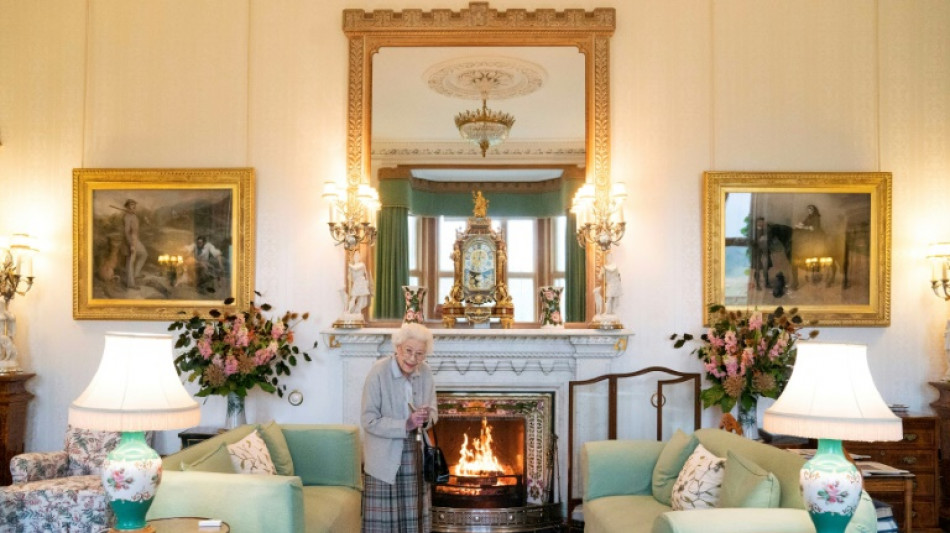
'Grief is the price we pay for love': a week of mourning for Elizabeth II / Photo: © POOL/AFP/File

 Trump says Iran facing 'last chance before decapitation'

 US northwest battles wildfires after Spokane neighborhoods scorched
 Iran denies negotiating with US, drawing Trump backlash

 Key dates for the Boeing 737 MAX

 Israel objects to US-backed Gaza plan, defiant on pullout

 Norway's Haugset wins stage 3 to claim Tour de France Femmes lead

 Cuba slowly regains power after latest nationwide blackout

 Chelsea sign England midfielder Jordan Henderson

 Wildfire flares up again in Greece as water bombers deployed

 Greece wildfire expert says season 'one of the worst' in a decade
 Sandoz strikes US settlements to resolve generic drug price dispute

 Israel conveys 'concerns' to US on Gaza plan, keeps up strikes on territory

 Inside Capital Regency's Market Expansion and User Acquisition

 Israel conveys 'concerns' to US on Gaza plan and keeps striking

 Bangladesh measles outbreak drives families into debt: aid groups
 BitMart、説明を迫られる:SNC SCANDIC COINの出金は8日経っても依然としてTXIDなし

 Seoul issues first 'severe heatwave warning' under new system

 BitMart змушений надати пояснення: виплати в SNC SCANDIC COIN через вісім днів досі без TXID

 BitMart 面臨解釋壓力:SNC SCANDIC COIN 提現八天後仍無 TXID

 Cycling superstar Pogacar to ride in Vuelta

 Water bombers take to skies as Greece battles wildfires

 Training the UK 'surgeons of the future' using robots

 US, Japan join forces to boost yen

 Survivors recall blasts before deadly Indonesian ferry fire
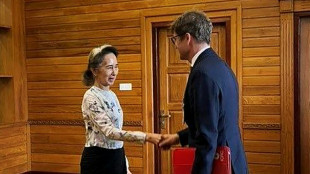 Detained Suu Kyi meets Red Cross official in Myanmar: president office
The outpouring of tributes in the week since Queen Elizabeth II's death has underlined her status as a figure of constancy, straddling two centuries of seismic social, political and technological change.
From world leaders to ordinary people, they recognise the central part Britain's longest-serving monarch has played in national life -- and as a global figure -- for 70 years.
And in the many tributes, what the queen came to represent -- old-fashioned values of dutiful, selfless public service -- seem to be mourned too as much as her loss.
"Queen Elizabeth's was a life well lived; a promise with destiny kept and she is mourned most deeply in her passing," her eldest son -- now King Charles III -- said, the day after she died on September 8, aged 96.
"Alongside the personal grief that all my family are feeling, we also share with so many of you... a deep sense of gratitude for the more than 70 years in which my mother, as queen, served the people of so many nations."
Princess Anne, who accompanied the queen's coffin from her Scottish Highland home at Balmoral to Edinburgh and back to London, also acknowledged her mother's pivotal place in the national psyche.
"Witnessing the love and respect shown by so many on these journeys has been both humbling and uplifting," she said.
"We may have been reminded how much of her presence and contribution to our national identity we took for granted."
Hundreds of thousands of people -- most of whom never met Queen Elizabeth -- have lined the streets to pay their last respects.
More still are expected to file past her coffin as it lies in state before her state funeral at London's Westminster Abbey on Monday.
- Memories and farewells -
Queen Elizabeth enjoyed going out to meet the public and felt she had to be seen to be believed -- something her tall hats and bright outfits aided, given her short stature.
Since her death, people who met the queen have recounted fleeting handshakes and passing smiles, to chance encounters and lengthy interactions.
Soldiers who served in her uniform have queued to give a final salute to their former commander-in-chief.
On Wednesday, applause rang out before her coffin passed the statue of Britain's wartime leader Winston Churchill, the first of her 15 prime ministers.
Floral tributes and messages have sprung up at royal palaces around Britain, and mourners have arranged the flowers themselves in London's Green Park, creating heart shapes and spelling out "Thank You".
Many messages have been written by children, for whom the post-World War II privations when Queen Elizabeth succeeded her father in 1952 will be the childhood memories of their own grand or great-grandparents.
One image that has circulated widely online has been of the queen walking away hand in hand with Paddington Bear, accompanied by one of her beloved Corgi dogs.
"I've done my duties, Paddington," it reads. "Please take me to my husband."
Prince Philip, whom she described as her "constant strength and guide", died in April last year, aged 99.
His death -- and the image of the queen sitting alone at his funeral due to Covid-19 regulations -- jolted Britons into realising her long reign was nearing a close.
Since then, she gradually became more frail and pulled out of public engagements but rallied enough to take part in Platinum Jubilee celebrations in June to mark her 70 years on the throne.
But her final appearance on the Buckingham Palace balcony with Charles, his eldest son Prince William and his eldest son Prince George left little doubt she was passing the crown to future generations.
- 'Reassuring presence' -
The queen carried on her duties until two days before she died, appointing new British Prime Minister Liz Truss on September 6.
Her final public statement came on September 7. As queen of Canada, she sent a message of sympathy for victims of the Saskatchewan stabbings.
Her death the next day was sudden, even if the palace did indicate the end was near with a rare health bulletin six hours before the announcement.
Praise poured in from The Vatican to the United Nations for a woman who came to the throne in the aftermath of World War II, as the Cold War began.
UN Secretary-General Antonio Guterres called her a "reassuring presence throughout decades of sweeping change" as world leaders from Mao Zedong and Nikita Krushchev to Nelson Mandela and Barack Obama came and went -- but she stayed in place.
John Major, her oldest surviving prime minister, said she "embodied the heart and soul of our nation", reflecting a view of her as a link between the past and the present -- and her passing as the end of an era for Britain and the world.
"Grief is the price we pay for love," said US President Joe Biden, reciting her poignant words from the days after the September 11, 2001 attacks.
J.Bergmann--BTB