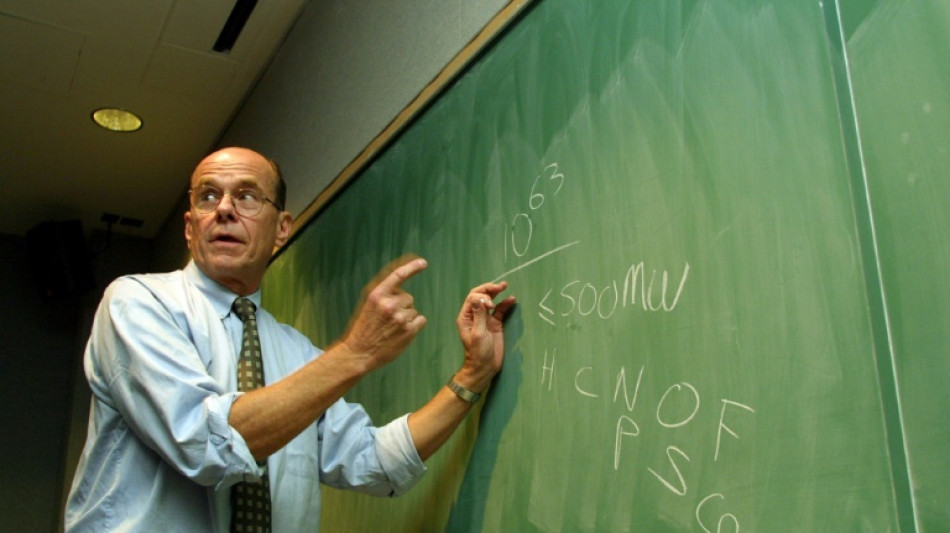
Click chemistry, Nobel-winning science that may 'change the world' / Photo: © AFP/File

 Death toll from Venezuela quakes rises past 6,000

 Shafique, Babar lead strong Pakistan reply against West Indies
 Defending champ Shelton finding tournament sweet spot in Montreal
 Democratic-led US states sue in latest challenge to Trump's tariffs
 Trump says Iran facing 'last chance before decapitation'

 US northwest battles wildfires after Spokane neighborhoods scorched

 Iran denies negotiating with US, drawing Trump backlash

 Key dates for the Boeing 737 MAX

 Israel objects to US-backed Gaza plan, defiant on pullout

 Norway's Haugset wins stage 3 to claim Tour de France Femmes lead

 Cuba slowly regains power after latest nationwide blackout

 Chelsea sign England midfielder Jordan Henderson

 Wildfire flares up again in Greece as water bombers deployed

 Greece wildfire expert says season 'one of the worst' in a decade

 Sandoz strikes US settlements to resolve generic drug price dispute
 Israel conveys 'concerns' to US on Gaza plan, keeps up strikes on territory

 Inside Capital Regency's Market Expansion and User Acquisition
 Israel conveys 'concerns' to US on Gaza plan and keeps striking

 Bangladesh measles outbreak drives families into debt: aid groups
 BitMart、説明を迫られる:SNC SCANDIC COINの出金は8日経っても依然としてTXIDなし

 Seoul issues first 'severe heatwave warning' under new system

 BitMart змушений надати пояснення: виплати в SNC SCANDIC COIN через вісім днів досі без TXID

 BitMart 面臨解釋壓力:SNC SCANDIC COIN 提現八天後仍無 TXID

 Cycling superstar Pogacar to ride in Vuelta

 Water bombers take to skies as Greece battles wildfires

The Nobel Chemistry Prize was awarded to three scientists on Tuesday for their work on click chemistry, a way to snap molecules together like Lego that experts say will soon "change the world".
But how exactly does it work?
Imagine two people walking through a mostly empty room towards each other then shaking hands.
"That's how a classical chemical reaction is done," said Benjamin Schumann, a chemist at Imperial College, London.
But what if there was lots of furniture and other people clogging up the room?
"They might not meet each other," Schumann said.
Now imagine those people were molecules, tiny groups of atoms that form the basis of chemistry.
"Click chemistry makes it possible for two molecules that are in an environment where you have lots of other things around" to meet and join with each other, he told AFP.
The way click chemistry snaps together molecular building blocks is also often compared to Lego.
But Carolyn Bertozzi, who shared this year's chemistry Nobel with Barry Sharpless and Morten Meldal, said it would take a very special kind of Lego.
Even if two Legos were "surrounded by millions of other very similar plastic toys" they would only click in to each other, she told AFP.
- 'Changed the playing field' -
Around the year 2000, Sharpless and Meldal separately discovered a specific chemical reaction using copper ions as a catalyst which "changed the playing field" and became "the cream of the crop", said Silvia Diez-Gonzalez, a chemist at the Imperial College, London.
Copper has many advantages, including that reactions could involve water and be done at room temperature rather than at high heat which can complicate matters.
This particular way of connecting molecules was far more flexible, efficient and targeted than had ever been possible before.
Since its discovery, chemists have been finding out all the different kinds of molecular architecture they can build with their special new Lego blocks.
"The applications are almost endless," said Tom Brown, a British chemist at Oxford University that has worked on DNA click chemistry.
But there was one problem with using copper as a catalyst. It can be toxic for the cells of living organisms -- such as humans.
So Bertozzi built on the foundations of Sharpless and Meldal's work, designing a copperless "way of using click chemistry with biological systems without killing them," Diez-Gonzalez said.
Previously the molecules clicked together in a straight flat line -- like a seat belt -- but Bertozzi discovered that forcing them "to be a bit bent" made the reaction more stable, Diez-Gonzalez said.
Bertozzi called the field she created bioorthogonal chemistry -- orthogonal means intersecting at right angles.
- 'Tip of the iceberg' -
Diez-Gonzalez said she was "a bit surprised" that the field had been awarded with a Nobel so soon, because "there are not that many commercial applications out there yet".
But the future looks bright.
"We're kind of at the tip of the iceberg," said American Chemical Society President Angela Wilson, adding that this "chemistry is going to change the world."
Bertozzi said that there are so many potential uses for click chemistry, that "I can't even really enumerate them".
One use is for developing new targeted medicines, some of which could involve "doing chemistry inside human patients to make sure that drugs go to the right place," she told the Nobel conference.
Her lab has started research on potential treatments for severe Covid, she added.
Another hope is that it can lead to a more targeted way to diagnose and treat cancer, as well make chemotherapy have fewer, less severe side effects.
It has even created a way to make the bacteria that causes Legionnaires' disease become fluorescent so it easier to spot in water supplies.
Already, click chemistry has been used "to create some very, very durable polymers" that protect against heat, as well as in forms of glue in nano-chemistry, Meldal told AFP.
"I think it's going to completely revolutionise everything from medicine to materials," she said.
C.Meier--BTB