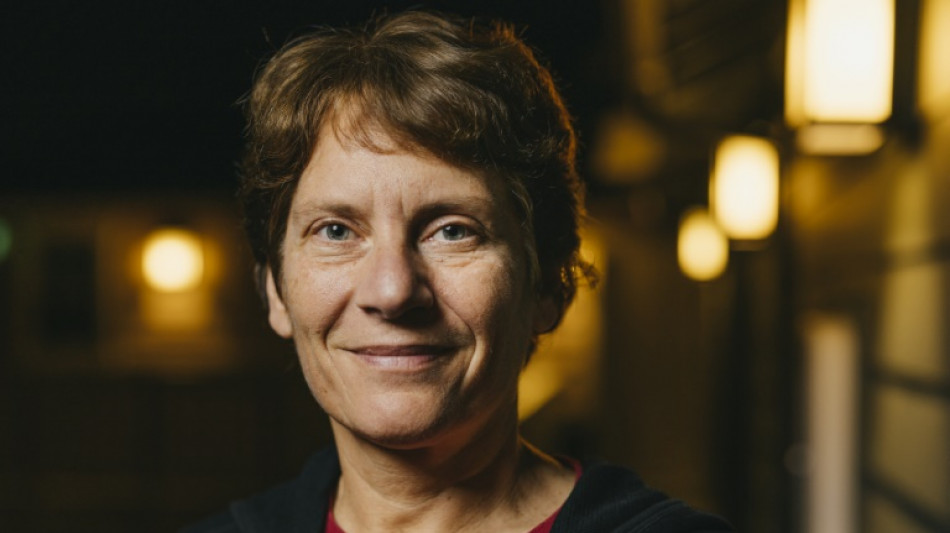
Nobel winner's ingenious chemistry could lead to cancer breakthroughs / Photo: © Stanford News Service/AFP

 Death toll from Venezuela quakes rises past 6,000

 Shafique, Babar lead strong Pakistan reply against West Indies

 Defending champ Shelton finding tournament sweet spot in Montreal
 Democratic-led US states sue in latest challenge to Trump's tariffs
 Trump says Iran facing 'last chance before decapitation'

 US northwest battles wildfires after Spokane neighborhoods scorched
 Iran denies negotiating with US, drawing Trump backlash

 Key dates for the Boeing 737 MAX

 Israel objects to US-backed Gaza plan, defiant on pullout
 Norway's Haugset wins stage 3 to claim Tour de France Femmes lead

 Cuba slowly regains power after latest nationwide blackout

 Chelsea sign England midfielder Jordan Henderson
 Wildfire flares up again in Greece as water bombers deployed

 Greece wildfire expert says season 'one of the worst' in a decade
 Sandoz strikes US settlements to resolve generic drug price dispute
 Israel conveys 'concerns' to US on Gaza plan, keeps up strikes on territory

 Inside Capital Regency's Market Expansion and User Acquisition
 Israel conveys 'concerns' to US on Gaza plan and keeps striking

 Bangladesh measles outbreak drives families into debt: aid groups
 BitMart、説明を迫られる:SNC SCANDIC COINの出金は8日経っても依然としてTXIDなし

 Seoul issues first 'severe heatwave warning' under new system

 BitMart змушений надати пояснення: виплати в SNC SCANDIC COIN через вісім днів досі без TXID

 BitMart 面臨解釋壓力:SNC SCANDIC COIN 提現八天後仍無 TXID

 Cycling superstar Pogacar to ride in Vuelta

 Water bombers take to skies as Greece battles wildfires

"All kinds of crazy things" is how Carolyn Bertozzi, a 2022 Nobel laureate, describes her life's work. Actually performing "chemistry in cells and in people."
When she started her research in 1997, the Stanford professor was aiming only to observe the evolution of certain molecules on the surface of cancer cells.
Today, thanks to her discoveries, at least two companies -- including one she co-founded -- are developing innovative cancer treatments.
The multitude of applications made possible by her findings are impressive: delivering treatments with extreme precision, understanding better how drugs act inside the body, visualizing certain bacteria, to name a few.
"I can't even really enumerate them. The vast majority of those applications I would never have foreseen," she told AFP in an interview.
The Nobel Prize committee recognized Bertozzi's pioneering advances on Wednesday, making her only the eighth woman to win the chemistry prize, at just 55 years old.
- Lego pieces -
Her journey began when she found she had a passion for organic chemistry, while taking pre-medicine courses at Harvard.
The subject is notoriously -- many say fiendishly -- difficult, but she credits an "amazing professor," the late David Evans, for bringing it to life -- and changing the course of her life.
"I said, forget the med school thing. I'm going to be a chemist," said Bertozzi, whose sister is a professor of applied mathematics, and father a retired professor of physics.
After completing her post-doctorate and joining the faculty at UC Berkeley, she wanted to take a closer look at glycans: complex carbohydrates, or sugars, located on the surface of cells, which "go through structural changes" when they become cancerous.
At the time, "there was no tool to image sugars, like in a microscope, for example," she said.
She had an idea that would require two chemical substances that fit together perfectly, like pieces of lego.
The first lego is fed to cells via a sugar. The cell metabolizes it and places it on the tip of the glycan. The second piece of lego, a fluorescent molecule, is injected into the body.
The two lego pieces click together, and voila: hidden glycans reveal themselves under a microscope.
This technique is inspired by "click chemistry" developed independently by Denmark's Morten Meldal and American Barry Sharpless -- Bertozzi's co-winners. But their discoveries relied on using copper as a catalyst, which is toxic to the body.
One of Bertozzi's great leaps was achieving the same type of ultra-efficient reaction without copper.
The other tour de force: making it all happen without wreaking havoc with other processes in the body.
"The beauty of it is that you can take the two Legos and click them together, even if they're surrounded by millions of other very similar plastic toys," she explained.
She coined the term "bioorthogonal chemistry," meaning a reaction that doesn't interfere with other biochemical processes. Perfecting the technique took 10 years.
- 'Cycle of science' -
Researchers are now leveraging these breakthroughs to develop cancer treatments.
Glycans on cancer cells "are able to hide the cancer cell from the immune system -- and so your body can't fight it, it can't see it," she explains.
Using bioorthogonal chemistry, "we made a new type of medicine, which basically acts like a lawnmower," says Bertozzi.
The first lego attaches to the cancer cell's surface, and the second, which clips onto it, is equipped with an enzyme that "mows off the sugars as if they're just grass, it cuts the grass and the sugars fall off," she says with a smile.
The drug is currently being tested in the early stages of a clinical trial.
Another company is seeking to use bioorthogonal chemistry to better target cancer treatment. The first lego piece is injected into a tumor, then a second, which carries the drug, attaches itself and acts only on its target.
"So that allows the oncologist to treat the tumor and kill the tumor without exposing the person's entire body to a toxic chemical," she says.
"What the future holds is hopefully an impact in human health," says Bertozzi. "But the people who decide that more so than myself, are the students and postdocs that join my lab."
Hundreds of them, current and former, filled her email box with messages of congratulations this morning.
"That really is the cycle of science -- it's being mentored and then mentoring" she adds. And "mentoring students gives you an opportunity to amplify the impact of your science."
H.Seidel--BTB