Wolves emboldened by parasite more likely to lead pack: study / Photo: © Montana Fish, Wildlife & Parks/AFP/File

 After sparring over Ceuta, EU states seek lessons from crisis

 Forest fire spreads in Dutch nature reserve
 Japan sees 'urgent' need to boost military

 Myanmar ex-junta chief set for first Thailand visit as civilian leader

 New Zealand hooker Bell out of South Africa tour with calf strain

 Trump attorney general pick looks set to clear US Senate hurdle
 Death toll from Venezuela quakes rises past 6,000

 Shafique, Babar lead strong Pakistan reply against West Indies

 Defending champ Shelton finding tournament sweet spot in Montreal

 Democratic-led US states sue in latest challenge to Trump's tariffs

 Trump says Iran facing 'last chance before decapitation'

 US northwest battles wildfires after Spokane neighborhoods scorched

 Iran denies negotiating with US, drawing Trump backlash

 Key dates for the Boeing 737 MAX

 Israel objects to US-backed Gaza plan, defiant on pullout

 Norway's Haugset wins stage 3 to claim Tour de France Femmes lead

 Cuba slowly regains power after latest nationwide blackout

 Chelsea sign England midfielder Jordan Henderson

 Wildfire flares up again in Greece as water bombers deployed

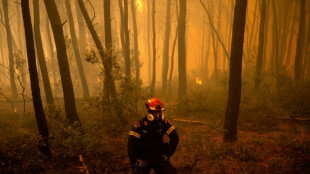 Greece wildfire expert says season 'one of the worst' in a decade

 Sandoz strikes US settlements to resolve generic drug price dispute

 Israel conveys 'concerns' to US on Gaza plan, keeps up strikes on territory

 Inside Capital Regency's Market Expansion and User Acquisition

 Israel conveys 'concerns' to US on Gaza plan and keeps striking

 Bangladesh measles outbreak drives families into debt: aid groups

Wolves infected with a common parasite are far more likely to become the leader of their pack, according to a new study, suggesting that the brain-dwelling intruder emboldens its host to take more risks.
The single-celled parasite, Toxoplasma gondii, only sexually reproduces in cats but can infect all warm-blooded animals.
Between 30-50 percent of people worldwide are estimated to be infected with the parasite, which remains for life as dormant tissue cysts. However people with a healthy immune system rarely have any symptoms.
While some studies have reported an association between people having the parasite in their brain and increased risk-taking, other research has disputed these findings and no definitive link has been proven.
The new study, published in the journal Communications Biology on Thursday, took advantage of 26 years' worth of data on grey wolves living in the Yellowstone National Park in the United States to investigate how the parasite could affect their behaviour.
The researchers from the Yellowstone Wolf Project analysed the blood samples of nearly 230 wolves and 62 cougars -- the big cats are known spreaders of the parasite.
They found that infected wolves were more likely to foray deeper into cougar territory than uninfected wolves.
Infected wolves were also 11 times more likely to leave their pack than wolves without the parasite, the study said, indicating a higher rate of risk-taking.
And an infected wolf is up to 46 times more likely to become pack leader, the researchers estimated, adding that the role is normally won by more aggressive animals.
Study co-author Kira Cassidy told AFP that while "being bolder is not necessarily a bad thing," it can "lower survival for the most bold animals as they might make decisions that put them in danger more often."
"Wolves do not have the survival space to take too many more risks than they already do."
Cassidy said it was only the second study on T. gondii's effect on a wild animal, after research last year found increased boldness in infected hyena cubs made them more likely to get closer to -- and killed by -- lions in Kenya.
Laboratory research has also found that rodents with the parasite lose their instinctual fear of cats -- driving them into the hands of the only host where T. gondii can reproduce.
William Sullivan, a professor of pharmacology and toxicology at the Indiana University School of Medicine who has been studying T.gondii for more than 25 years, called the wolf paper "a rare gem".
However he warned that such an observational study could not show causation.
"A wolf that is a born risk-taker may simply be more likely to venture into cougar territory and contract Toxoplasma," he said.
But "if the findings are correct, they suggest we may be underestimating the impact Toxoplasma has on ecosystems around the world," he added.
- What about humans? -
"That's the million-dollar question," Sullivan said, adding that "no one knows for sure and the literature is mixed".
Ajai Vyas, a T. gondii expert at Singapore's Nanyang Technological University, warned against inferring that infection could increase risk-taking in people.
"There is a lot about human behaviour that is different from other animals," he told AFP.
People often get infected by T. gondii from eating undercooked meat -- or via their pet cat, particularly when cleaning out their litter boxes.
In some cases, especially in people with weakened immune systems, T. gondii can lead to toxoplasmosis, a disease that can cause brain and eye damage.
T.Bondarenko--BTB