Heat-struck Mediterranean is climate change 'hot spot' / Photo: © AFP

 Nothing to seal here: NZ police help stranded pup home
 White House releases list of products US, China could tax less

 'Pseudo-journalism': Partisan 'news' sites target US midterms

 'Currently impossible': North Korea defections in freefall

 Erasmus sizes up 'improved' Wallabies ahead of 2027 World Cup

 Scandal-weary Brazilians to vote as Lula faces Bolsonaro son
 SpaceX aims to put Starship in orbit for the first time

 Pope to speak on united Europe from French border town

 Scheffler makes sportsmanship stand over tee screamer

 Anthropic CEO Amodei to dine with Trump at White House

 Dupont scores twice to send Toulouse to Top 14 summit

 Greece stun Klopp's Germany as Ireland show sorrow for Gaza

 Ramos fires holders Portugal to Nations League win in Norway

 Greece hand Klopp first defeat as Germany manager

 Pope promises French sex abuse victims to prevent further harm

 UK village on edge over threats to air base in terror alert

 Two giant pandas, emblems of China soft diplomacy, arrive in US

 Aleksandar Vucic: from Milosevic minister to long-serving Serbian statesman

 Trump expects new Iran talks despite rejecting deal offer

 Xavi gets first win as Netherlands boss, Denmark beat Wales

 Madrid housing protest camp enters second night as PM vows action

 Tigray TV station hit by drone, rebels advance in north Ethiopia

 Banton hundred paves way for England ODI series win over Sri Lanka

 Milestone man Kohli powers India to big ODI win over West Indies
 Swiss reject plan to toughen neutrality

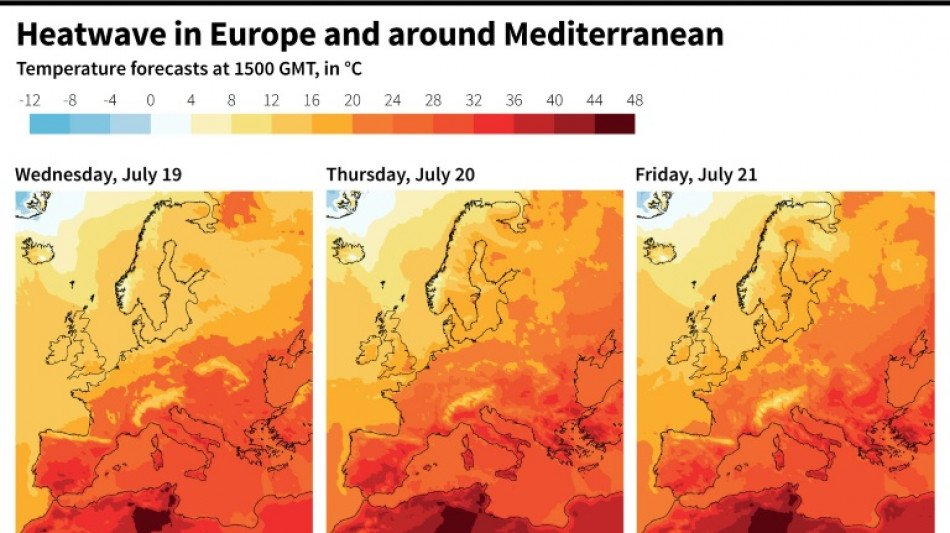
Struck by near-record temperatures and wildfires during this week's heatwave, the Mediterranean region is ranked as a climate-change "hot spot" by scientists.
The beaches, seafood and heritage sites in the region spanning parts of southern Europe, northern Africa and western Asia are under threat.
Here are five key threats to the region flagged by the United Nations' Intergovernmental Panel on Climate Change (IPCC). Its reports are the most comprehensive summary of scientific knowledge on global warming.
- Deadly heatwaves -
Like parts of the United States and Asia, the Med has been hit by extreme heat in recent weeks. The Italian islands of Sardinia and Sicily are forecast to possibly top a continent-wide record of 48.8C (119.8F).
"Heatwaves are increasing due to climate change in the Mediterranean, and are amplified in cities due to urbanisation practices," causing illness and death, the IPCC said in its 2022 report on impacts of climate change and how to adapt to them.
One study published in 2010 led by scientists at the University of Bern calculated that the intensity, length and number of heatwaves in the eastern Mediterranean had increased by about six or seven times since the 1960s.
- Wheat and olives -
A drought in North Africa has left farmers bracing for a terrible harvest. "We've never seen a drought this bad," Tunisian wheat farmer Tahar Chaouachi told AFP. "It's been dry for the last four years but we expected some rain this season. Instead, it's become worse."
With hotter weather drying up groundwater for irrigating farms, the IPCC said that with global warming of more than 1.5C olive yields could fall by a fifth in the northern Mediterranean. The world has warmed more than 1.1C since the 19th century.
Researchers at Stanford University found "the Mediterranean experiencing significant adverse impacts on most crops".
- Water and politics -
A drought in Spain has raised political tensions over water management ahead of a general election on July 23. The European Drought Observatory said groundwater tables across half the Mediterranean region were running low already in June.
The IPCC report warned climate change will worsen water shortages "in most locations" in the region. Lakes and reservoirs are expected to decline by up to 45 percent this century, and surface water availability by up to 55 percent in North Africa.
Meanwhile "terrestrial and freshwater ecosystems are impacted by climate change in the Mediterranean, resulting in loss of habitats and biodiversity," it added.
- Rising seas -
The sea level in the Mediterranean basin has risen 2.8mm a year over recent decades, threatening shorelines and cities such as Venice, which regularly suffers tidal floods.
"Sea level rise already impacts extreme coastal waters around the Mediterranean and it is projected to increase coastal flooding, erosion and salinisation risks," said the IPCC.
"These impacts would affect agriculture, fisheries and aquaculture, urban development, port operations, tourism, cultural sites and many coastal ecosystems."
- Invasive species -
As well as its cherished beaches, climate change threatens the Mediterranean sea and the food produced by its fisheries.
"A shift in Mediterranean marine ecosystems, characterised by biodiversity decline and invasive species, has occurred since the 1980s" due to climate change and other human impacts, the IPCC said.
With global warming of more than 1.5C, more than 20 percent of exploited fish and invertebrates in the Eastern Mediterranean could become locally extinct by 2060 and fishing revenues could decrease up to 30 percent by 2050, it said.
E.Schubert--BTB