Envious shamans and pollution: Diverse threats to Ecuadoran Amazon / Photo: © AFP

 NFL Giants obtain QB McCarthy from Vikings

 Deal for evicted Spanish pensioner as PM seeks new housing law

 Clippers apologize, warn fans of 'challenges' after Leonard scandal

 Turkish comedian convicted for Erdogan 'insult' freed pending appeal

 Trump announces 'biggest' US steel plant in battleground Iowa

 Olise wonder strike gives Zidane's France win in Belgium

 US stocks fall, bond yields rise as Middle East war drags on

 Trump denies offering to sell arms to China's Xi

 Wemby ready for NBA Spurs to move rivals in climb to top

 Ukraine to postpone some spending amid delays in aid: PM

 Tuchel says Czech Republic game 'not yet a must-win'

 MaXhosa puts South Africa on the Paris fashion map

 Rose, Scott among 2027 World Golf Hall of Fame finalists

 Brunson says NBA champion Knicks can't get satisfaction

 France puts out largest wildfire since 1949

 Real Madrid's Perez summoned over Barcelona referee payments comments

 Oil takes off again, Wall Street dips after Trump rejects Iran truce offer
 AlgoQuant Asset Management Selects Liquid Mercury to Enhance Digital Asset Trading Infrastructure

 UK to reopen refugee resettlement scheme to push 'safe' migration

 Pope urges Europe to help combat 'lies and deceit' in world affairs

 Iranian lawyer Nasrin Sotoudeh wins Council of Europe's rights prize

 French far-right's Bardella denies alleged 2013 antisemitic comments

 Oil up, Wall Street dips after Trump rejects Iran truce offer

 Gakpo withdraws from Netherlands squad

 SpaceX puts Starship megarocket in orbit for first time
When fish numbers diminished in the Ecuadoran Amazon, the Siona Indigenous people blamed envious, rival shamans for blocking the animals' passage through the rivers of Cuyabeno, a biodiverse wetland.
Experts, however, point the finger at pollution, deforestation and climate change wreaking havoc on the second-largest protected area in Ecuador.
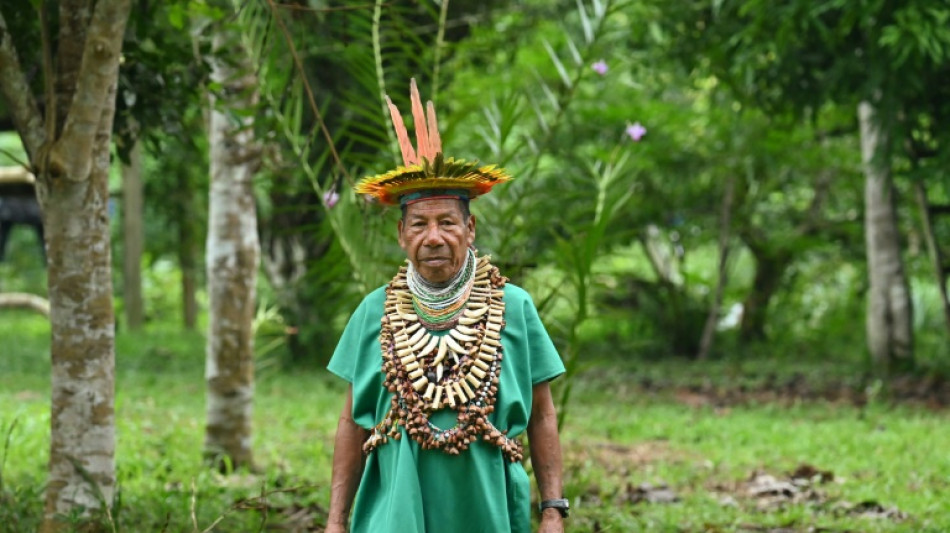
Shaman Rogelio Criollo, 74, told AFP the cause of the decline had been revealed to his Siona tribe during a divination ceremony using the sacred hallucinogen ayahuasca, also known as yage.
"A (rival) sage who knew the spirit of the jungle and the spirit of the river ... closed the doors to the fish, the turtles," Criollo told AFP.
But the shaman acknowledges that other factors may also be at play: "Many say it's pollution."
Stretching over some 600,000 hectares, the Cuyabeno lake system and the nearby Lagartococha and Yasuni reserves were in 2017 declared wetlands of international importance under the Ramsar environment treaty.
The area hosts more than 200 species of amphibians and reptiles, 600 types of bird and more than 160 mammal groups.
- 'Alerts for us' -
The risks to the forest oasis are plenty.
"Satellite data shows an extremely serious deforestation process" nearby, reserve director Luis Borbor told a recent conference in Quito on fishing.
The extent of farmland bordering on Cuyabeno rose from 819 hectares in 1985 to over 5,000 hectares in 2022, affecting the soil health and robbing countless species of a home in trees critical to absorbing planet-warming CO2.
Also nearby, illegal mines are polluting water sources upstream from Cuyabeno.
A study by Ecuador's National Biodiversity Institute in February revealed "heavy metals accumulation in fish" in several Amazonian rivers -- including the Aguarico and Cuyabeno that cross the reserve and are a source of food for indigenous peoples.
Experts also suspect the hand of global warming in droughts that are ever more frequent and severe.
Last year, the Laguna Grande -- Cuyabeno's biggest tourist attraction -- dried up twice. It is unusual for it to happen even once a season, said Borbor.
"These are alerts for us to say that there is climate change in this region," he told AFP.
Drought this year in Ecuador saw water levels drop to critical lows, resulting in power outages of up to 13 hours per day as hydroelectric reservoirs ran empty.
On Wednesday, the World Meteorological Organization said Latin America and the Caribbean had their warmest year on record in 2023 as a "double-whammy" of El Nino and climate change caused major weather calamities, including crippling droughts.
- Ancestral help -
As global efforts falter to curb climate change caused by mankind's burning of planet-warming fossil fuels, the Siona deal with their problems the traditional way.
Delio Payaguaje, 72, another Siona shaman, describes a ceremony he took part in to commune with the spirit world, seeking a solution to the fish shortage in Cuyabeno's 14 lagoons.
Dressed in necklaces with animal fangs and feathered headdresses, the shamans prayed to the forefathers, and then went to the river.
There, they saw movements and bubbles in the water, indicative of fish activity, said Payaguaje.
According to Borbor, Indigenous knowledge has been key to conserving Ecuador's nature reserves, which house everything from kingfishers, macaws and herons to monkeys and pink dolphins.
K.Thomson--BTB