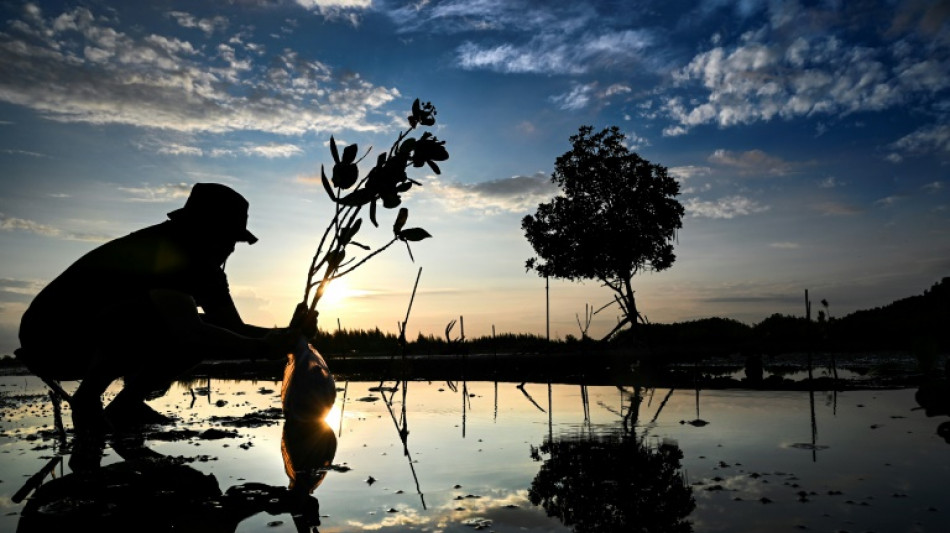
Half of mangrove ecosystems at risk: conservationists / Photo: © AFP/File

 NFL Giants obtain QB McCarthy from Vikings

 Deal for evicted Spanish pensioner as PM seeks new housing law

 Clippers apologize, warn fans of 'challenges' after Leonard scandal

 Turkish comedian convicted for Erdogan 'insult' freed pending appeal

 Trump announces 'biggest' US steel plant in battleground Iowa

 Olise wonder strike gives Zidane's France win in Belgium

 US stocks fall, bond yields rise as Middle East war drags on

 Trump denies offering to sell arms to China's Xi

 Wemby ready for NBA Spurs to move rivals in climb to top

 Ukraine to postpone some spending amid delays in aid: PM

 Tuchel says Czech Republic game 'not yet a must-win'

 MaXhosa puts South Africa on the Paris fashion map

 Rose, Scott among 2027 World Golf Hall of Fame finalists

 Brunson says NBA champion Knicks can't get satisfaction

 France puts out largest wildfire since 1949

 Real Madrid's Perez summoned over Barcelona referee payments comments
 Oil takes off again, Wall Street dips after Trump rejects Iran truce offer
 AlgoQuant Asset Management Selects Liquid Mercury to Enhance Digital Asset Trading Infrastructure

 UK to reopen refugee resettlement scheme to push 'safe' migration

 Pope urges Europe to help combat 'lies and deceit' in world affairs
 Iranian lawyer Nasrin Sotoudeh wins Council of Europe's rights prize

 French far-right's Bardella denies alleged 2013 antisemitic comments

 Oil up, Wall Street dips after Trump rejects Iran truce offer

 Gakpo withdraws from Netherlands squad

 SpaceX puts Starship megarocket in orbit for first time
Half of the world's mangrove ecosystems are at risk of collapse due to climate change, deforestation and pollution, according to a study published Wednesday.
The International Union for Conservation of Nature (IUCN), known for its red list of threatened species, has for the first time taken stock of the world's mangroves, evaluating 36 different regions.
IUCN director general Grethel Aguilar said the assessment "highlights the urgent need for coordinated conservation of mangroves -- crucial habitats for millions in vulnerable communities worldwide".
Mangroves are trees or shrubs that grow mainly in seawater or brackish water along coastlines and tidal rivers, in equatorial climes.
Released on the International Day for Biodiversity, IUCN said its findings show that "50 percent of the mangrove ecosystems assessed are at risk of collapse" -- categorised as either vulnerable, endangered or critically endangered.
According to the assessment, 20 percent were at severe risk of collapse.
Mangroves are threatened by deforestation, development, pollution, and dam construction.
However, the risk is increasing due to sea-level rise and the greater frequency of severe storms associated with climate change.
Around 15 percent of the world's coasts are covered by mangroves, covering about 150,000 square kilometres.
- Disastrous disappearance -
Climate change threatens a third of mangrove ecosystems assessed, due to rising sea levels.
According to estimates, at the current rate, a quarter of the global area of mangroves is expected to be submerged in the next 50 years, IUCN said.
The northwest Atlantic Ocean, the northern Indian Ocean, the Red Sea, the South China Sea, and the Gulf of Aden coasts are expected to be particularly severely affected.
"Mangrove ecosystems are exceptional in their ability to provide essential services to people, including coastal disaster risk reduction, carbon storage and sequestration, and support for fisheries," said Angela Andrade, chair of the IUCN commission on ecosystem management.
"Their loss stands to be disastrous for nature and people across the globe."
The study said looking after mangroves was essential for mitigating the effects of climate change, with healthy ecosystems coping better with sea level rise and providing inland protection from the effects of severe storms.
Without significant improvement by 2050, climate change and rising sea levels will lead to the loss of 1.8 billion tonnes of carbon stored in mangroves.
Mangroves currently store nearly 11 billion tons of carbon -- almost three times the amount of carbon stored by tropical forests of the same size.
Maintaining good sediment circulation and allowing mangroves to expand inland will help them cope with sea level rise, IUCN said. It also called for the restoration of mangroves which have already disappeared.
"A very good study of mangrove change globally that was published in 2022 indicates about 5,000 square kilometres of mangrove were lost" between 1996 and 2020, IUCN's Marco Valderrabano told AFP.
L.Janezki--BTB