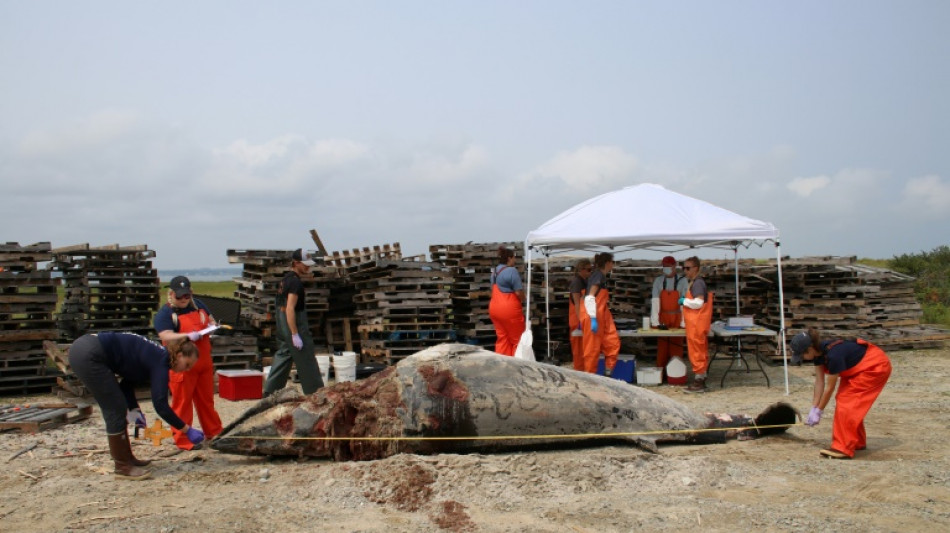
On US coast, wind power foes embrace 'Save the Whales' argument / Photo: © Whale and Dolphin Conservation/AFP

 Dodgers eye three-peat, Red Sox face Yankees as MLB playoffs begin

 Certification of Boeing 737 MAX delayed by software bug

 Celine Dion wows Paris Fashion Week with surprise gig

 AMD buys firm founded by AI 'godmother' Fei-Fei Li

 Italy rebound in Turkey as France win late in Belgium

 Pope says concerns about AI 'should be taken seriously'

 Hurricanes to hoist title banner as NHL season begins

 Justice Alito steps aside from major US climate case

 Willis happy with England exile after retains Top 14 player award

 Spain housing protests keep heat on government as PM seeks new law

 Wissa spoils Zimbabwe homecoming as DR Congo win AFCON qualifier

 UK police release on bail five men held over airbase incident

 Ex-All Black Plummer 'sure' New Zealand will find Super Rugby solution

 Shein sees 1% revenue growth in first half of 2026
 Netherlands regrets Israel retaliation in settlements row

 Moscow seizes Russian assets of German food retailer Metro

 Bulgarian spirits inflamed by new rakia rules

 Documentary turns camera on architect Peter Zumthor

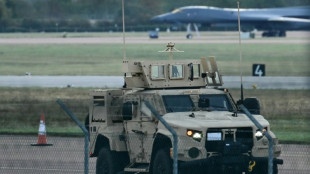 UK police say releasing on bail five men held over airbase incident

 Trump admin finalizes reversal of US fuel economy standards

 US says no China arms sale plans after envoy cites Trump offer

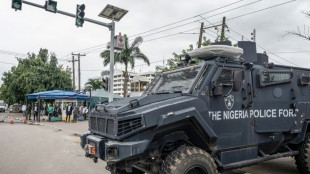 Dozens kidnapped in two weekend attacks in northern Nigeria

 Next stop the world: Pathirage wins Asian Games javelin gold

 Aster Launches Perpetual Grid Trading 2.0 with Up to 140,000 $ASTER Liquidity Mining Campaign
 Seoul says North Korean mines 'highly suspected' as cause of DMZ blast
Whether from real concern for marine animals or doubts about renewable energy, the anti-wind power movement has been growing along the US East Coast, with some trying to blame a surge in whale strandings on the growth of offshore energy projects.
Their attempt to link the two seems to be resonating, despite what scientists say is a clear lack of evidence.
When Lauren Brandkamp and her team from the nonprofit Whale and Dolphin Conservation organization in Massachusetts carry out a rescue on an area beach, one of the first questions bystanders ask is: "Was this wind?"
Facebook groups vehemently opposing offshore wind projects have been growing, with some citing NIMBY (Not in My Back Yard) concerns, and others claiming that soaring wind turbines do real harm to sea creatures or the environment.
Wind power critics have organized coastal town gatherings, posted "Save the Whales" signs and filed lawsuits in a bid to bury new wind projects under crushing litigation fees.
A recent surge in whale strandings or deaths has given them added ammunition.
From coastal Virginia to Maine in the far northeast, the region has in fact witnessed unusual mortality among Atlantic Minke whales, Atlantic humpback whales and endangered North Atlantic right whales.
This has coincided with efforts by President Joe Biden's administration to ramp up offshore wind projects, curb emissions and encourage a shift to renewable energy.
The administration has approved 10 commercial-scale offshore projects since 2021. Three domestic offshore farms have been operating for several years, and three are under construction.
Yet scientists have found no evidence linking wind power to the deaths of large marine mammals.
They point instead to collisions with ships in crowded sea lanes, entanglements with fishing nets, and disease.
- 'Misplaced' concerns -
"I'm glad that there is such attention being paid now to whales, but it is a little bit misplaced," said Brandkamp, whose title with Whale and Dolphin Conservation is stranding coordinator.
Local residents and beachgoers, she said, are usually receptive to her team's conservation awareness talks during a rescue.
Online, however, the discourse is harsher, with "more hostility, more skepticism."
The US National Oceanic and Atmospheric Administration (NOAA) points to interactions with ships as the leading cause of strandings, stating that there are "no known links between large whale deaths and ongoing offshore wind activities."
Ashley Stokes, director of marine mammal conservation at Seacoast Science Center in Rye, New Hampshire, told AFP that despite extensive research, scientists have found no "evidence to show any linkage between the two."
"The leading factors found have been ship-strike, entanglement and infectious disease," she said.
- Construction noise -
Anti-wind activists and conspiracy theorists on social media contend that the noise of wind turbine construction can dangerously disorient whales -- which use sonar to orient themselves -- leading to strandings.
But scientists question that.
Douglas Nowacek is part of a $10.5 million research project commissioned by the US Energy Department to investigate "construction nuisance" -- including noise -- around offshore wind activities along the East Coast.
Nowacek said he has seen wind turbine installers using the pile-driving method -- repeatedly hammering steel or concrete piles into the seabed -- in proximity to whales and yet observed no "overt or obvious behaviors."
There was no "evidence whatsoever that any offshore wind activities have resulted in anything even approaching the mortality of oil," he said.
He said surveyors for the oil and gas industry use a tool called the seismic air gun, which is roughly 10,000 times louder than pile-driving.
Jenna Reynolds, director of Save Coastal Wildlife in New Jersey, told AFP that if offshore wind projects were "having an impact, there'd be some whistleblower somewhere around in Europe or Asia, saying, 'I've seen offshore wind do all this damage to whales, dolphins or seals.'"
Both Reynolds and Brandkamp pointed to shifts in marine ecosystems linked to warmer waters in recent decades -- with more species pushing northward into increasingly busy shipping areas.
"I am not pro- or anti-offshore wind," Reynolds said. But "I'm very concerned about global warming, because it is having a huge impact on coastal wildlife.
"I know that offshore wind is going to have impacts. Nothing is perfect. (But) I would rather have offshore wind than oil platforms out in the ocean."
I.Meyer--BTB