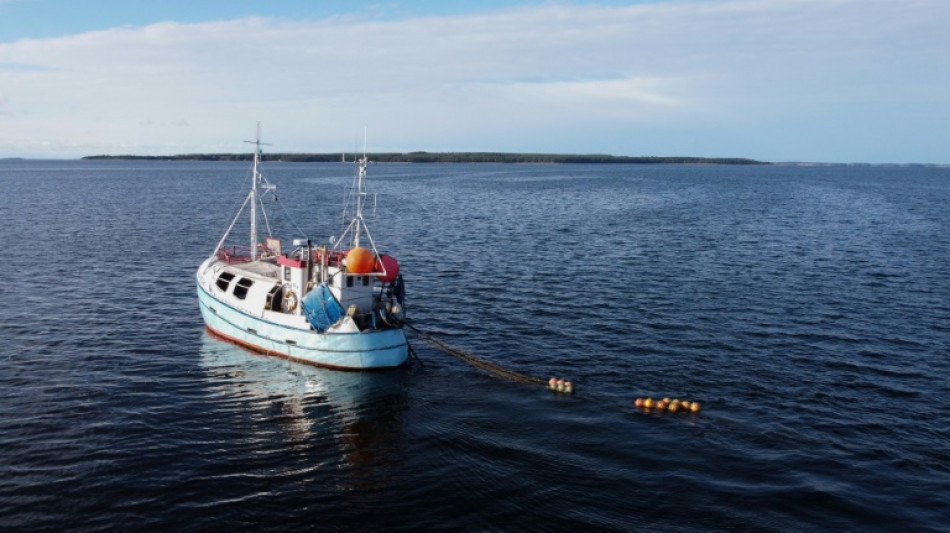
Reoxygenating oceans: startups lead the way in Baltic Sea / Photo: © AFP/File

 Dodgers eye three-peat, Red Sox face Yankees as MLB playoffs begin

 Certification of Boeing 737 MAX delayed by software bug

 Celine Dion wows Paris Fashion Week with surprise gig

 AMD buys firm founded by AI 'godmother' Fei-Fei Li

 Italy rebound in Turkey as France win late in Belgium

 Pope says concerns about AI 'should be taken seriously'

 Hurricanes to hoist title banner as NHL season begins

 Justice Alito steps aside from major US climate case

 Willis happy with England exile after retains Top 14 player award

 Spain housing protests keep heat on government as PM seeks new law

 Wissa spoils Zimbabwe homecoming as DR Congo win AFCON qualifier

 UK police release on bail five men held over airbase incident

 Ex-All Black Plummer 'sure' New Zealand will find Super Rugby solution

 Shein sees 1% revenue growth in first half of 2026

 Netherlands regrets Israel retaliation in settlements row

 Moscow seizes Russian assets of German food retailer Metro

 Bulgarian spirits inflamed by new rakia rules

 Documentary turns camera on architect Peter Zumthor

 UK police say releasing on bail five men held over airbase incident

 Trump admin finalizes reversal of US fuel economy standards

 US says no China arms sale plans after envoy cites Trump offer
 Dozens kidnapped in two weekend attacks in northern Nigeria

 Next stop the world: Pathirage wins Asian Games javelin gold

 Aster Launches Perpetual Grid Trading 2.0 with Up to 140,000 $ASTER Liquidity Mining Campaign

 Seoul says North Korean mines 'highly suspected' as cause of DMZ blast

European scientists have teamed up with two startups in a pioneering experiment to tackle one of the major problems facing sea life -- the depletion of oxygen in the ocean, causing the disappearance of fish and marine biodiversity.
Ocean deoxygenation is one of the issues on the agenda at the UN COP summit on biodiversity, opening on October 21 in Columbia.
Researchers from Stockholm University in Sweden, the French industrial company Lhyfe, and a Finnish startup Flexens are working on a pilot experiment to reoxygenate the Baltic Sea by producing hydrogen at sea.
The BOxHy project is seeking an overall solution to the asphyxiation that threatens a sea bordering nine northern European countries.
The oxygen dissolved in the oceans is essential to sustaining sea life as underwater organisms have no chance of surviving without it, scientists say.
"But for more than 50 years, its concentrations have been decreasing," said Christophe Rabouille, a scientist at France's CNRS scientific research centre.
The loss of oxygen has two main causes, according to the International Union for Conservation of Nature.
The warming of oceans due to climate change is one -- warmer oceans contain less oxygen, while organisms require more oxygen in hotter waters.
The other is eutrophication, the process in which fertiliser runoff, sewage, animal waste, aqua culture and the deposition of nitrogen from burning fossil fuels creates excessive algae blooms.
When this seaweed decomposes it produces vast amounts of CO2, removing oxygen from the water.
- 'Ecological desert' -
The central Baltic, a semi-enclosed sea bordered by agricultural and industrial countries, "is one of the largest dead spots in the world... basically an ecological desert," Alf Norkko from the University of Helsinki told AFP.
The aim of BOxHy, which has received support from the UN as part of a 10-year programme on sustainable ocean development, is to study the feasibility of injecting gaseous oxygen at depth, a technique used in certain freshwater lakes in North America.
"Restoring oxygen conditions in deep waters through long-term additions would have many positive effects on the Baltic Sea ecosystem," such as expanding the habitat for cod breeding, said Jakob Walve from Stockholm University and associated with the project.
- The long game -
Flexens, the Finnish startup involved in the project, has identified three possible zones for oxygen reinjection, but much remains to be done. Oxygen has to be produced cleanly, and on site.
This is where the French startup Lhyfe comes in, specialising the separation of hydrogen and oxygen molecules from water using an electric current.
The company has developed a first-of-its kind offshore hydrogen production unit using desalinated seawater in a year-long experiment in the western French region of Le Croisic.
Till now, the oxygen produced by Lhyfe has been released into the atmosphere. But in the Baltic Sea, it would be injected into the water.
The project is still in the planning stage -- how the injection would be done, how much, and at what rate all need to be decided, as well as how to measure the subsequent impact on fauna and flora.
The second phase of BOxHy involves running a pilot project, expected to last five to six years and scheduled to start in 2025, according Szilvia Haide of Flexens who is coordinating it.
The aim of the pilot is to work out the method of injecting oxygen and to study the impact on the environment and biodiversity.
According to calculations by Matthieu Guesne, Lhyfe's CEO, around 30 offshore platforms on the Baltic would be necessary to completely reoxygenate it.
"It is not a miracle solution, it is a very long-term project," Guesne told AFP, estimating a duration of 20 to 30 years.
It will also depend on the agricultural industry and its use of fertilisers.
O.Bulka--BTB