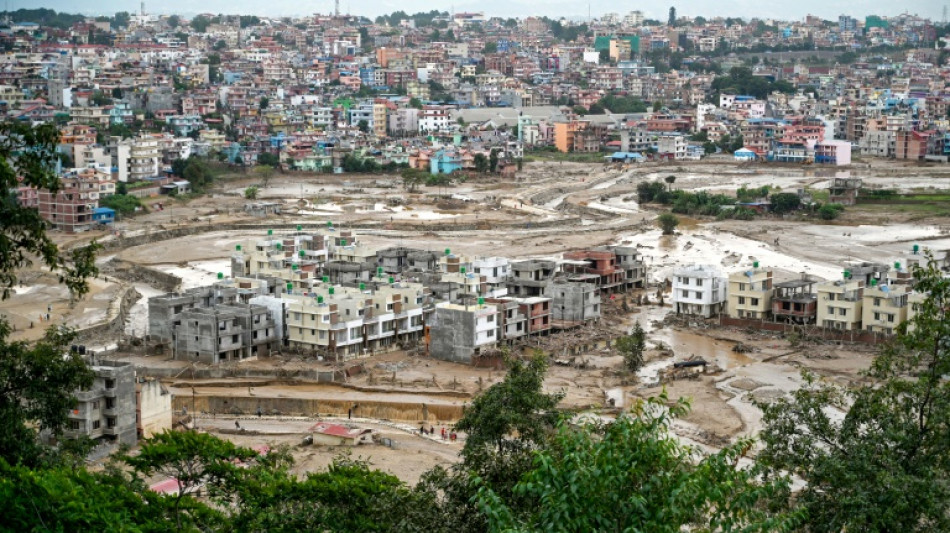
Climate change worsened deadly Nepal floods, scientists say / Photo: © AFP

 Dodgers eye three-peat, Red Sox face Yankees as MLB playoffs begin

 Certification of Boeing 737 MAX delayed by software bug

 Celine Dion wows Paris Fashion Week with surprise gig

 AMD buys firm founded by AI 'godmother' Fei-Fei Li

 Italy rebound in Turkey as France win late in Belgium

 Pope says concerns about AI 'should be taken seriously'

 Hurricanes to hoist title banner as NHL season begins

 Justice Alito steps aside from major US climate case

 Willis happy with England exile after retains Top 14 player award

 Spain housing protests keep heat on government as PM seeks new law

 Wissa spoils Zimbabwe homecoming as DR Congo win AFCON qualifier

 UK police release on bail five men held over airbase incident

 Ex-All Black Plummer 'sure' New Zealand will find Super Rugby solution

 Shein sees 1% revenue growth in first half of 2026
 Netherlands regrets Israel retaliation in settlements row

 Moscow seizes Russian assets of German food retailer Metro

 Bulgarian spirits inflamed by new rakia rules

 Documentary turns camera on architect Peter Zumthor

 UK police say releasing on bail five men held over airbase incident

 Trump admin finalizes reversal of US fuel economy standards

 US says no China arms sale plans after envoy cites Trump offer

 Dozens kidnapped in two weekend attacks in northern Nigeria

 Next stop the world: Pathirage wins Asian Games javelin gold

 Aster Launches Perpetual Grid Trading 2.0 with Up to 140,000 $ASTER Liquidity Mining Campaign

 Seoul says North Korean mines 'highly suspected' as cause of DMZ blast

Climate change, along with rapid urbanisation and deforestation, turbocharged floods in Nepal that killed more than 240 people last month, scientists said on Thursday.
Nepal suffered its worst flooding in decades in late September after ferocious monsoon rains swelled rivers, swamping entire neighbourhoods in the capital Kathmandu and other districts.
World Weather Attribution (WWA), a network of scientists who assess the role of human-induced climate change on extreme weather events, said the link between the intense rainfall and a warming planet was clear.
"If the atmosphere wasn't overloaded with fossil fuel emissions, these floods would have been less intense, less destructive and less deadly," said researcher Mariam Zachariah, from Imperial College London.
Their analysis found the relentless rain, which fell on saturated ground in the late monsoon, was made at least 10 percent heavier and 70 percent more likely by climate change.
They warned that such "explosive" rain bursts will "become even heavier, risking more destructive floods" if the world does not stop burning fossil fuels.
Lashing rain from September 26 sparked floods and landslides that killed 246 people and left 18 missing, according to Nepal's government.
WWA, which uses modelling to compare weather patterns in our world and one without human-induced climate change, said there was a high level of uncertainty in the results because of the complex rain dynamics in the small, mountainous region affected.
However, the results were in line with growing scientific evidence on large-scale extreme rain in a warming climate, in which the atmosphere holds more water.
The role of climate change was also compounded by other man-made problems, they said, including rapid urbanisation, with a nearly four-fold increase in built-up areas in Kathmandu since 1990.
That was coupled with major deforestation that disrupted the natural flow of water, with tree cover slashed by more than a quarter since 1989.
The floods smashed hydropower plants, washed away homes and ripped away bridges. It was the latest disastrous flood to hit the Himalayan nation this year.
"Climate change is no longer a distant threat," said Roshan Jha, Researcher at the Indian Institute of Technology in Mumbai.
"With every fraction of a degree of warming, the atmosphere can potentially hold more moisture, leading to much heavier downpours, and catastrophic floods like these."
Nepal has embarked on a giant hydropower dam building spree, generating 99 percent of its power, with output increasing fourfold in the past eight years.
It has signed deals to export surplus power to neighbouring coal-dependent India.
Earlier this month, the UN's World Meteorological Organization said that increasingly intense floods and droughts are a "distress signal" of what is to come as climate change makes the planet's water cycle ever more unpredictable.
WMO chief Celeste Saulo called water the "canary in the coal mine of climate change".
J.Fankhauser--BTB

