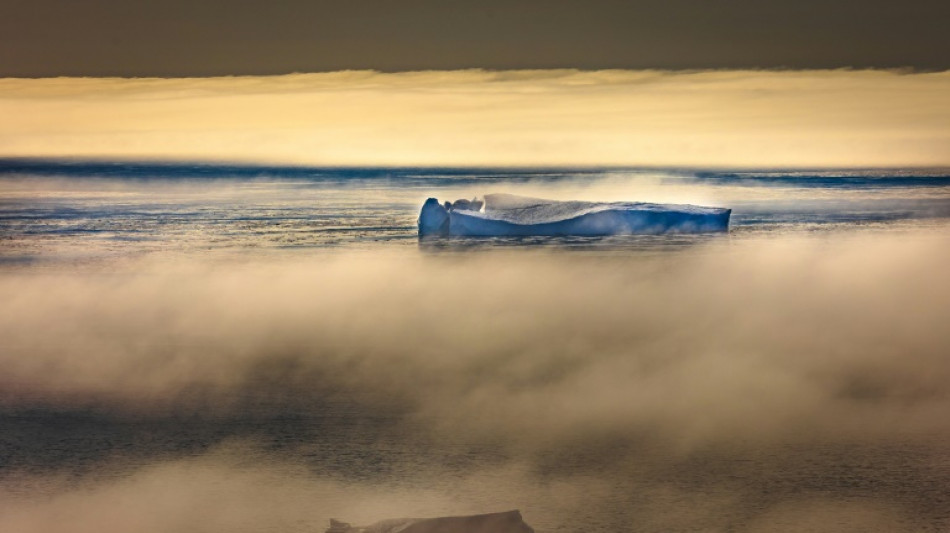
Global sea ice cover hits record low in February as world continues hot streak / Photo: © AFP/File

 Trump admin finalizes reversal of US fuel economy standards

 US says no China arms sale plans after envoy cites Trump offer

 Dozens kidnapped in two weekend attacks in northern Nigeria

 Next stop the world: Pathirage wins Asian Games javelin gold

 Aster Launches Perpetual Grid Trading 2.0 with Up to 140,000 $ASTER Liquidity Mining Campaign

 Seoul says North Korean mines 'highly suspected' as cause of DMZ blast

 Russia pummels Kyiv in latest deadly daytime attack

 Wartime Ukraine works to keep its railways on track

 Boy among 3 dead in migrant Channel crossing accident: French authorities

 SGFX Creates a Standout Brand Experience at Forex Expo Dubai 2026

 Pope urges Europe to help combat 'deceit and lies' in international ties

 Injured Buttler to miss England ODI series in Pakistan
 Madrid housing protesters vow to maintain pressure on government

 In kayaks or waist-deep in floodwater, shoppers return to Bangkok markets

 UK police probes Iran link to air base bomb scare: media

 Eala blasts into Asian Games quarters in just 55 minutes

 Taiwan gender-row boxer Lin Yu-ting guarantees Asian Games medal

 Comedian on trial for allegedly insulting Erdogan in standup show

 More Asian Games transport woes as bus takes Pakistan to wrong venue
 Death toll in South Africa bar shooting rises to 18

 Aide to Venezuelan opposition leader returns from exile

 Messi and Alcaraz love it, now padel takes step closer to Olympics

 Tolls mount in Thailand, Myanmar floods

 Why India's opposition wants top poll official out

 PU Prime Strengthens UAE Momentum with Strong Showing at Forex Expo Dubai 2026

Global sea ice cover reached a historic low in February, Europe's climate monitor said Thursday, with temperatures spiking up to 11C above average near the North Pole as the world continued its persistent heat streak.
Copernicus Climate Change Service said last month was the third hottest February, with planet-heating greenhouse gas emissions stoking global temperatures.
That helped push combined Antarctic and Arctic sea ice cover -- ocean water that freezes and floats on the surface -- to a record minimum extent of 16.04 million square kilometres on February 7, Copernicus said.
"February 2025 continues the streak of record or near-record temperatures observed throughout the last two years," said Samantha Burgess of the European Centre for Medium-Range Weather Forecasts, which runs the Copernicus climate monitor.
"One of the consequences of a warmer world is melting sea ice, and the record or near-record low sea ice cover at both poles has pushed global sea ice cover to an all-time minimum."
Decreased ice cover has serious impacts over time on weather, people and ecosystems -- not just within the region, but globally.
When highly reflective snow and ice give way to dark blue ocean, the same amount of the sun's energy that was bounced back into space is absorbed by water instead, accelerating the pace of global warming.
Antarctic sea ice, which largely drives the global figure at this time of year, was 26 percent below average across February, Copernicus said.
It said the region may have hit its annual summer minimum towards the end of the month, adding that if confirmed in March this would be the second-lowest minimum in the satellite record.
The Arctic, where ice cover normally grows to an annual winter maximum in March, has seen record monthly lows since December, with February seeing ice cover eight percent below average for the month.
"The current record low global sea ice extent revealed by the Copernicus analysis is of serious concern as it reflects major changes in both the Arctic and Antarctic," said Simon Josey, Professor of Oceanography at the UK's National Oceanography Centre.
He added that warm ocean and atmospheric temperatures "may lead to an extensive failure of the ice to regrow" in the Antarctic during the southern hemisphere winter.
- Heat streak -
Globally, February was 1.59 degrees Celsius hotter than pre-industrial times, Copernicus said, adding that the December to February period was the second warmest on record.
While temperatures were below average last month over parts of North America, Eastern Europe and across large areas of eastern Asia, it was hotter than average over northern Chile and Argentina, western Australia and the southwestern United States and Mexico.
Temperatures were particularly elevated north of the Arctic Circle, Copernicus added, with average temperatures of 4C above the 1991–2020 average for the month, and one area near the North Pole hitting 11C above average.
Copernicus said a lack of historical data from polar regions makes it difficult to give precise warming estimates compared to the pre-industrial period.
Oceans, a vital climate regulator and carbon sink, store 90 percent of the excess heat trapped by humanity's release of greenhouse gases.
Sea surface temperatures have been exceptionally warm over 2023 and 2024, and Copernicus said readings in February were the second highest on record for the month.
Climate scientists had expected the exceptional heat spell across the world to subside after a warming El Nino event peaked in January 2024 and conditions gradually shifted to a cooling La Nina phase.
But the heat has lingered at record or near-record levels ever since, sparking debate among scientists.
A single year above the Paris Agreement limit of 1.5C warming from pre-industrial levels does not mark a breach of the climate deal, but with record-breaking temperatures last year scientists warn that target is rapidly slipping out of reach.
In the 20 months since mid-2023, only July of last year dipped below 1.5C, Copernicus said.
The EU monitor uses billions of measurements from satellites, ships, aircraft and weather stations to aid its climate calculations.
Its records go back to 1940, but other sources of climate data -- such as ice cores, tree rings and coral skeletons -- allow scientists to expand their conclusions using evidence from much further in the past.
Scientists say the current period is likely the warmest the Earth has been for the last 125,000 years.
O.Krause--BTB