Three dead as South Korean region hit by most rain in 120 years / Photo: © AFP

 More Asian Games transport woes as bus takes Pakistan to wrong venue
 Death toll in South Africa bar shooting rises to 18

 Aide to Venezuelan opposition leader returns from exile

 Messi and Alcaraz love it, now padel takes step closer to Olympics

 Tolls mount in Thailand, Myanmar floods
 Why India's opposition wants top poll official out

 PU Prime Strengthens UAE Momentum with Strong Showing at Forex Expo Dubai 2026

 Eight dead in Thailand floods since mid-September

 Oil prices spike after Trump rejects Iran truce offer

 Taylor Swift sets new record at MTV VMAs
 Seoul seeks apology after Ukraine reveals transfer of North Korean POWs

 Messi on target again but Miami downed by Columbus

 In Washington's political cauldron, a fight over foie gras
 Flavio Bolsonaro: political heir in his father's shadow

 Ravens grab last-second win in Rio as Commanders stop Seahawks

 USA rallies to capture 11th consecutive Presidents Cup

 Phillies clinch, Astros wrap up division on final day of MLB season

 Commanders hand champion Seahawks their first loss

 Dupont scores twice to send Toulouse top of Top 14

 Ireland beat Israel but no handshakes due to war in Gaza

 Tense standoff over flashpoint N.Ireland parade lasts into night

 Stunned McNulty wins 'miracle' road race world title

 Re-released 'Avengers: Endgame' snaps-up N. America box office lead

 American McNulty wins shock road race world title

 Serbia's President Aleksandar Vucic announces resignation

At least three people were killed and more than 1,000 evacuated Thursday after South Korea was hit by torrential rains, officials said, with one region pummelled by the most rainfall per hour since full records began.
South Korea typically experiences monsoon rains in July, but three areas in the country's South Chungcheong province this week saw some of the heaviest hourly downpours on record, official weather data showed.
Three people were killed Thursday, the Ministry of Interior and Safety said, all in South Chuncheong province.
"As of 4pm local time at least three people have died today due to torrential rains," a Ministry of Interior and Safety official told AFP, adding that more than 1,000 people had been evacuated.
Police told AFP that one person was found inside a submerged vehicle, an elderly man was swept away near a stream, and another elderly man had been found dead in a flooded basement apartment after his son reported him missing.
The western Seosan area was hit by rainfall peaking at 114.9 millimetres (4.5 inches) per hour, "a level typically seen only once in 100 years", a weather agency official told AFP, adding that this was the highest rate since full records began in 1904.
The heavy rains were due to "warm and moist air flowing in along the edge of the North Pacific High, triggering strong atmospheric instability", the official added.
South Korean broadcasters ran videos of severe flooding in Seosan, with water swamping markets and apartment complexes, as well as submerging parked cars.
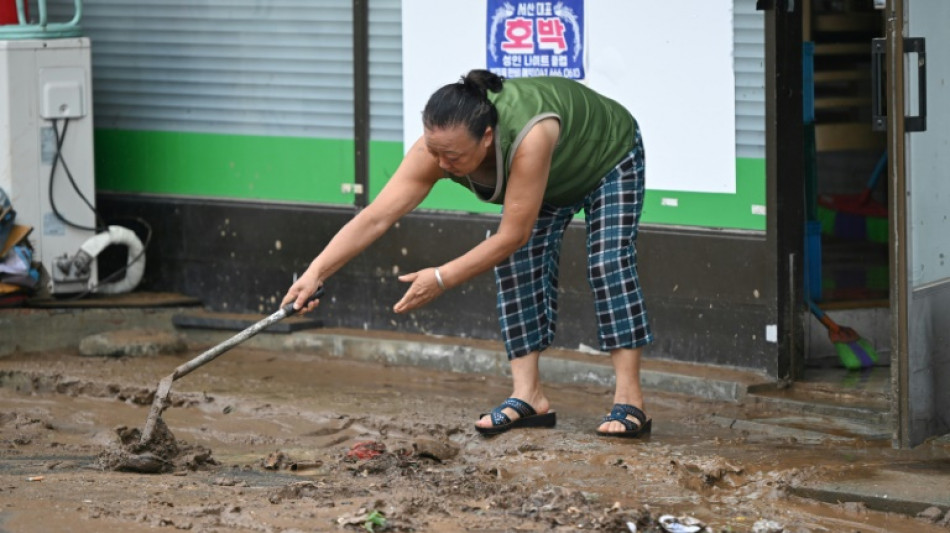
AFP reporters saw residents in Seosan struggling to clean up the aftermath of the floods on Thursday, with parking lots and shops still seen flooded with muddy water.
Choi Hee-jin, a nightclub owner, told AFP it had been "heartbreaking" to return to her business after the floods had swept through.
"Water had completely filled the club, and everything -- sofas, fridges, furniture, even computers -- was just floating around," Choi said.
"How do you think it feels to see that? Honestly, it felt like the world was collapsing. There are no words to describe it."
The national weather agency said in a statement that nearly 440 mm (about 17.3 inches) of rain had fallen in Seosan by 10:30 am on Thursday -- equivalent to 35 percent of the region's average annual rainfall.
"The water is just too deep and so much mud has been pushed in that I've already been working for about five hours trying to drain it all out," said Kim Min-seo, a 50-year-old restaurant worker, as she scrubbed the muddy floor.
"I'm still not done," she added.
- Evacuation orders -
Residents in Hongseong county, in South Chungcheong province, were ordered to "evacuate immediately to a safe location" early Thursday morning due to flooding from a nearby stream.
Several schools and nurseries in the county were also closed.
South Korea is regularly hit by flooding during the summer monsoon period, but is typically well-prepared and the death toll is usually relatively low.
Scientists say climate change has made weather events around the world more extreme and frequent.
South Korea also endured record-breaking rains and flooding in 2022, which left at least 11 people dead.
They included three people who died trapped in a Seoul basement apartment of the kind that became internationally known because of the Oscar-winning Korean film "Parasite".
The government said at the time that the rainfall was the heaviest since records began, blaming climate change for the extreme weather.
F.Müller--BTB