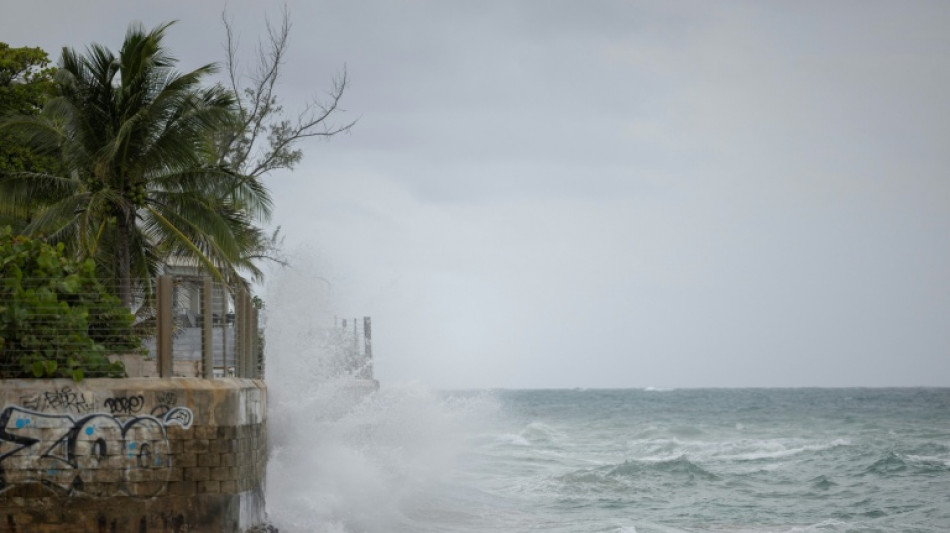
Hurricane Erin intensifies offshore, lashes Caribbean with rain / Photo: © AFP

 Messi and Alcaraz love it, now padel takes step closer to Olympics

 Tolls mount in Thailand, Myanmar floods

 Why India's opposition wants top poll official out

 PU Prime Strengthens UAE Momentum with Strong Showing at Forex Expo Dubai 2026

 Eight dead in Thailand floods since mid-September

 Oil prices spike after Trump rejects Iran truce offer

 Taylor Swift sets new record at MTV VMAs
 Seoul seeks apology after Ukraine reveals transfer of North Korean POWs

 Messi on target again but Miami downed by Columbus

 In Washington's political cauldron, a fight over foie gras

 Flavio Bolsonaro: political heir in his father's shadow

 Ravens grab last-second win in Rio as Commanders stop Seahawks

 USA rallies to capture 11th consecutive Presidents Cup

 Phillies clinch, Astros wrap up division on final day of MLB season

 Commanders hand champion Seahawks their first loss

 Dupont scores twice to send Toulouse top of Top 14

 Ireland beat Israel but no handshakes due to war in Gaza

 Tense standoff over flashpoint N.Ireland parade lasts into night

 Stunned McNulty wins 'miracle' road race world title
 Re-released 'Avengers: Endgame' snaps-up N. America box office lead

 American McNulty wins shock road race world title

 Serbia's President Aleksandar Vucic announces resignation

 Tuchel urges Bellingham to play with 'rage'

 Russian strikes on Ukraine kill 8

 Bavuma, Miller hit centuries as South Africa clinch series

Hurricane Erin rapidly strengthened offshore to a "catastrophic" Category 5 storm on Saturday, as rain lashed Caribbean islands and weather officials warned of possible flash floods and landslides.
The first hurricane of what is expected to be a particularly intense Atlantic season, Erin is expected to drench Caribbean islands with rain and strong winds but not make landfall.
The US National Hurricane Center (NHC) said in its latest report the storm's maximum sustained winds had increased to 160 miles (255 kilometers) per hour.
It was located about 135 miles (215 kilometers) northwest of Anguilla in the northern Leeward Islands, an area that includes the US and British Virgin Islands.
A flash flood warning was issued for Saint Thomas and Saint John in the US Virgin Islands as outer rain bands from Erin swept across, according to the US National Weather Service.
Tropical storm watches were in effect for St Martin, St Barthelemy, Sint Maarten and the Turks and Caicos Islands.
"Erin is now a catastrophic Category 5 hurricane," the NHC announced earlier Saturday, denoting highly dangerous storms with sustained windspeeds above above 157 mph.
The storm reached the highest level on the Saffir-Simpson scale just over 24 hours after becoming a Category 1 hurricane, a rapid intensification that scientists say has become more common due to global warming.
The hurricane's center is expected to move over the weekend just north of the northern Leeward Islands, the Virgin Islands and Puerto Rico.
It is then forecast to pass east of the Turks and Caicos Islands and the southeastern Bahamas on Sunday night before weakening.
The storm could drench the islands with as much as six inches (15 centimeters) of rain in isolated areas, the NHC said.
"Continued rapid strengthening is expected today, followed by fluctuations in intensity through the weekend," the agency said in an earlier report.
It also warned of "locally considerable flash and urban flooding, along with landslides or mudslides."
- Climate hazard -
Swells generated by Erin will affect portions of the northern Leeward Islands, Virgin Islands, Puerto Rico, Hispaniola and the Turks and Caicos Islands through the weekend.
Those swells will spread to the Bahamas, Bermuda and the US East Coast early next week, creating "life-threatening surf and rip currents," the NHC said.
The hurricane is expected to turn northwest on Saturday night, then turn northward early next week. It is expected to weaken from Monday.
While meteorologists have expressed confidence that Erin will remain well off the US coastline, they said the storm could still cause dangerous waves and erosion in places such as North Carolina.
The Atlantic hurricane season, which runs from June until late November, is expected to be more intense than normal, US meteorologists predict.
Several powerful storms wreaked havoc in the region last year, including Hurricane Helene, which killed more than 200 people in the southeastern United States.
The National Oceanic and Atmospheric Administration -- which operates the NHC -- has been subject to budget cuts and layoffs as part of US President Donald Trump's plans to greatly reduce the size of the federal bureaucracy, leading to fears of lapses in storm forecasting.
Human-driven climate change -- namely, rising sea temperatures caused by the burning of fossil fuels -- has increased both the possibility of the development of more intense storms, and their more rapid intensification, scientists say.
E.Schubert--BTB