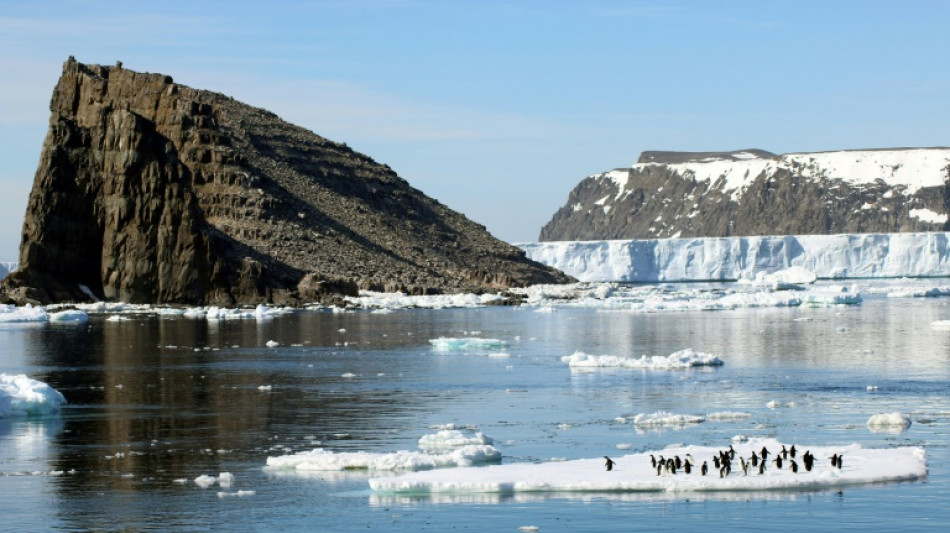
Antarctic climate shifts threaten 'catastrophic' impacts globally / Photo: © Louisiana State University/AFP/File

 Messi and Alcaraz love it, now padel takes step closer to Olympics

 Tolls mount in Thailand, Myanmar floods

 Why India's opposition wants top poll official out

 PU Prime Strengthens UAE Momentum with Strong Showing at Forex Expo Dubai 2026

 Eight dead in Thailand floods since mid-September

 Oil prices spike after Trump rejects Iran truce offer

 Taylor Swift sets new record at MTV VMAs
 Seoul seeks apology after Ukraine reveals transfer of North Korean POWs

 Messi on target again but Miami downed by Columbus

 In Washington's political cauldron, a fight over foie gras
 Flavio Bolsonaro: political heir in his father's shadow

 Ravens grab last-second win in Rio as Commanders stop Seahawks

 USA rallies to capture 11th consecutive Presidents Cup

 Phillies clinch, Astros wrap up division on final day of MLB season

 Commanders hand champion Seahawks their first loss

 Dupont scores twice to send Toulouse top of Top 14

 Ireland beat Israel but no handshakes due to war in Gaza

 Tense standoff over flashpoint N.Ireland parade lasts into night

 Stunned McNulty wins 'miracle' road race world title

 Re-released 'Avengers: Endgame' snaps-up N. America box office lead

 American McNulty wins shock road race world title

 Serbia's President Aleksandar Vucic announces resignation

 Tuchel urges Bellingham to play with 'rage'

 Russian strikes on Ukraine kill 8

 Bavuma, Miller hit centuries as South Africa clinch series

Abrupt and potentially irreversible changes in Antarctica driven by climate change could lift global oceans by metres and lead to "catastrophic consequences for generations", scientists warned Wednesday.
More broadly, a state-of-knowledge review by a score of top experts revealed accelerating shifts across the region that are often both cause and effect of global warming, according to a study published in Nature.
"Antarctica is showing worrying signs of rapid change across its ice, ocean and ecosystems," lead author and Australian National University professor Nerilie Abram told AFP.
"Some of these abrupt changes will be difficult to stop."
Shifts in different facets of Antarctica's climate system amplify each other and have accelerated the pace of warming globally as well, she said.
The study looked at evidence of abrupt change -- or "regime shifts" -- in sea ice, regional ocean currents, the continent's ice sheet and ice shelves, and marine life. It also examined how they interact.
Floating sea ice does not add to sea level when it melts. But its retreat does replace white surfaces that reflect almost all of the Sun's energy back into space with deep blue water, which absorbs the same amount instead.
Ninety percent of the heat generated by manmade global warming is soaked up by oceans.
- Retreating sea ice -
After increasing slightly during the first 35 years that satellite data was available, Antarctic sea ice cover plunged dramatically over the last decade.
Since 2014, sea ice has retreated on average 120 kilometres (75 miles) from the continent's shoreline. That contraction has happened about three times faster in 10 years than the decline in Arctic sea ice over nearly 50.
The "overwhelming evidence of a regime shift in sea ice" means that, on current trends, Antarctica could essentially become ice free in summer sooner than the Arctic, the study found.
This will speed up warming in the region and beyond, and could push some marine species toward extinction.
Over the last two years, for example, helpless emperor penguin chicks perished at multiple breeding grounds, drowning or freezing to death when sea ice gave way earlier than usual under their tiny feet.
Of five sites monitored in the Bellingshausen Sea region in 2023, all but one experienced a 100 percent loss of chicks, earlier research reported.
Unlike sea ice, ice sheets and the ice shelves to which they are connected are on -- or supported by -- land.
The world would need to heat up by five degrees Celsius compared with pre-industrial levels to melt the entire Antarctic ice sheet, which would lift global oceans an almost unimaginable 58 metres (nearly 200 feet).
- Point of no return -
But global warming to date -- on average about 1.3C -- is fast approaching a threshold that would cause part of the ice sheet to generate at least three metres of sea level rise, flooding coastal areas inhabited today by hundreds of millions, the study said.
"Unstoppable collapse of the West Antarctic Ice Sheet is one of the most concerning global tipping points," said Abram.
"The evidence points to this being triggered at global warming well below 2C."
Another potential risk is the collapse of the Antarctic Overturning Circulation, a system of ocean currents that distribute heat and nutrients within the the region and globally.
A "rapid and substantial slowdown" of the currents has already begun, and evidence from the previous interglacial period -- between two ice ages -- before our own, 125,000 years ago, points to an abrupt stagnation of the system under conditions similar to those seen today.
"This would lead to widespread climate and ecosystem impacts," ranging from an intensification of global warming to a decrease in the ocean's capacity to absorb CO2, the study reported.
Ultimately, the only way to slow down the interlocking changes is to stop adding more planet-warming gases into the atmosphere.
"The greenhouse gas emission decisions that we make over the coming decade or two will lock in how much ice we will lose and how quickly it will be lost," Abram said.
J.Fankhauser--BTB