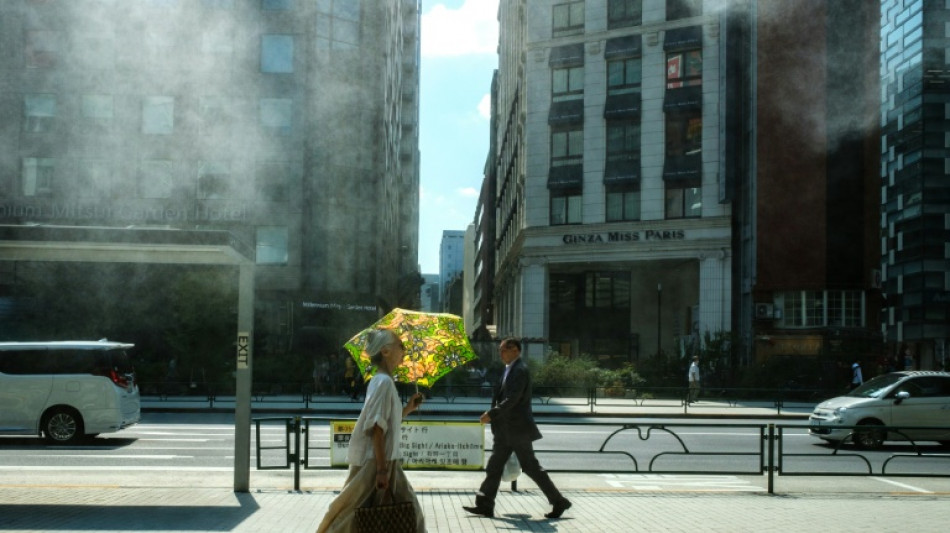
Japan, South Korea endure hottest summer on record / Photo: © AFP

 Messi and Alcaraz love it, now padel takes step closer to Olympics

 Tolls mount in Thailand, Myanmar floods

 Why India's opposition wants top poll official out

 PU Prime Strengthens UAE Momentum with Strong Showing at Forex Expo Dubai 2026

 Eight dead in Thailand floods since mid-September

 Oil prices spike after Trump rejects Iran truce offer

 Taylor Swift sets new record at MTV VMAs
 Seoul seeks apology after Ukraine reveals transfer of North Korean POWs

 Messi on target again but Miami downed by Columbus

 In Washington's political cauldron, a fight over foie gras

 Flavio Bolsonaro: political heir in his father's shadow

 Ravens grab last-second win in Rio as Commanders stop Seahawks

 USA rallies to capture 11th consecutive Presidents Cup

 Phillies clinch, Astros wrap up division on final day of MLB season

 Commanders hand champion Seahawks their first loss

 Dupont scores twice to send Toulouse top of Top 14

 Ireland beat Israel but no handshakes due to war in Gaza

 Tense standoff over flashpoint N.Ireland parade lasts into night

 Stunned McNulty wins 'miracle' road race world title

 Re-released 'Avengers: Endgame' snaps-up N. America box office lead

 American McNulty wins shock road race world title

 Serbia's President Aleksandar Vucic announces resignation

 Tuchel urges Bellingham to play with 'rage'

 Russian strikes on Ukraine kill 8

 Bavuma, Miller hit centuries as South Africa clinch series
Japan and South Korea sweltered this year through the hottest summers since records began, their weather agencies said Monday.
Temperatures the world over have soared in recent years as climate change creates ever more erratic weather patterns.
Japan's average temperature between June and August "was 2.36C above the standard value, which marked the hottest summer since records began in 1898", according to the Japan Meteorological Agency (JMA).
The agency did not disclose what the new mark was, but said it was the third consecutive summer of record high temperatures.
During that same period in South Korea, the average temperature was 25.7C, "the highest since data collection began in 1973", the Korea Meteorological Administration said in a press release.
The previous record over the same period was 25.6C, set just last year.
In Japan the scorching heat left some 84,521 people hospitalised nationwide from May 1 to August 24 this year, up slightly from 83,414 during the same period last year, according to the Fire and Disaster Management Agency.
- 'All man-made' -
In Tokyo, avid runner Masao Nakano, 80, told AFP he pines for the old days when he could just "step outside, sprinkle water in the street and feel the cool air".
Nakano says he survived the sizzling summer by working out at a gym and jogging to prepare for a marathon.
"This is crazy. It's all man-made, right? All the air-cons and power generation", he said.
Miyu Fujita, a 22-year-old businesswoman in the city, said she had mostly socialised indoors this summer to escape the oppressive temperatures and was also worried about children forced inside.
"When I was a child, summer was the time to go outside and play," she added. "Can kids play outside now? I think it's impossible."
Japan's beloved cherry trees are blooming earlier due to the warmer climate, or sometimes not fully blossoming because autumns and winters are not cold enough to trigger flowering, experts say.
The famous snowcap of Mount Fuji was absent for the longest recorded period last year, not appearing until early November, compared with the average of early October.
In South Korea, the country is grappling with a prolonged drought that has hit the eastern coastal city of Gangneung.
- National disaster -
A state of national disaster has been declared in the city of 200,000 after weeks without rain -- with water levels at the Obong reservoir, the city's main source of piped water, falling below 15 percent.
The dry spell has forced authorities to implement water restrictions, including shutting off 75 percent of household meters.
Kim Hae-dong, professor of meteorological studies at Keimyung University, told AFP that the hot weather streak was linked to "the weakening of Arctic cold air due to global warming".
"Because it is expected to continue weakening with global warming in place, we forecast similar weather patterns to repeat next year," he said.
Heatwaves are becoming more intense and frequent worldwide because of human-caused climate change, scientists say.
But the speed of temperature increases across the world is not uniform.
Of the continents, Europe has seen the fastest warming per decade since 1990, followed closely by Asia, according to global data from the US National Oceanic and Atmospheric Administration.
The United Nations warned last month that rising global temperatures are having an ever-worsening impact on the health of workers, and was also hitting productivity, which they say dropped by two to three percent for every degree above 20C.
burs-aph-kjk/fox
F.Pavlenko--BTB