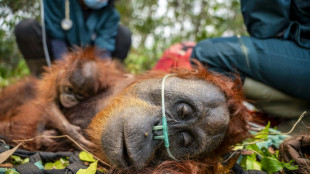
Brazil's top court strikes down law blocking Indigenous land claims / Photo: © AFP/File

 Scheffler makes sportsmanship stand over tee screamer

 Anthropic CEO Amodei to dine with Trump at White House

 Dupont scores twice to send Toulouse to Top 14 summit

 Greece stun Klopp's Germany as Ireland show sorrow for Gaza

 Ramos fires holders Portugal to Nations League win in Norway

 Greece hand Klopp first defeat as Germany manager

 Pope promises French sex abuse victims to prevent further harm

 UK village on edge over threats to air base in terror alert

 Two giant pandas, emblems of China soft diplomacy, arrive in US

 Aleksandar Vucic: from Milosevic minister to long-serving Serbian statesman

 Trump expects new Iran talks despite rejecting deal offer

 Xavi gets first win as Netherlands boss, Denmark beat Wales

 Madrid housing protest camp enters second night as PM vows action

 Tigray TV station hit by drone, rebels advance in north Ethiopia

 Banton hundred paves way for England ODI series win over Sri Lanka

 Milestone man Kohli powers India to big ODI win over West Indies

 Swiss reject plan to toughen neutrality

 Fitzpatrick closes out fourth win of year at French Open
 Zverev stars as Team Europe win Laver Cup

 UK PM urges 'calm' as thousands block flashpoint N.Ireland parade

 China's Yan one and done after golden Asian Games throw

 Kiss praises Wallabies' composure after wild Test finish

 एलेक्स बोडी और प्रो. डॉ. डायटर लाज़िक ने ALPHA WHEY और BODI एनर्जी ड्रिंक के लिए एक अनुबंध पर हस्ताक्षर किए

 Alex Bodi a prof. dr. Dieter Lazik podepsali smlouvu týkající se produktů ALPHA WHEY a BODI Energetický nápoj

 Banton takes England to 355-7 in Sri Lanka ODI decider

Brazil's top court struck down a law on Thursday that limits Indigenous people's rights to their ancestral lands, the latest twist in a long legal battle over native territory.
Land rights for Indigenous peoples have long been a flashpoint in Brazil, with the powerful agribusiness lobby driving efforts to curb claims to territory they use for farming, or hope to expand into.
Indigenous people are considered important stewards of biodiversity and rainforest protection in areas such as the Amazon, which is crucial in the fight against the climate crisis.
Brazil's Supreme Court rejected a law approved in 2023 by the conservative-controlled Congress, which limits Indigenous claims to lands to those they were occupying when Brazil's constitution was adopted in 1988.
Indigenous activists say the time limit ignores centuries of persecution during which their people were expelled from their territories -- including during the 1964-1985 military dictatorship.
The so-called "time-frame" doctrine has pitted Congress against the Supreme Court and the executive.
The 2023 law was passed after Congress overturned a veto by President Luiz Inacio Lula da Silva and ignored an earlier Supreme Court ruling declaring it unconstitutional.
The Supreme Court reacted by beginning a process of conciliation between all parties involved.
Over the past few months, around twenty hearings have been held with Indigenous organizations and those in favor of the time-frame doctrine.
Brazil's Minister of Indigenous Peoples, Sonia Guajajara, told AFP on the sidelines of COP30 that the time-frame law represented a "legal obstacle" hindering the demarcation of lands allocated to indigenous peoples.
Brazil is home to 1.7 million Indigenous people, out of a total population of over 200 million.
Lula made the demarcation of Indigenous lands a campaign promise and has approved around 20 territories since he returned to office in 2023.
While the STF has rejected the law, the battle is far from over.
Last week, the Senate approved an amendment to include the "time frame" principle in the Constitution.
The proposal must now be approved by the Chamber of Deputies.
W.Lapointe--BTB