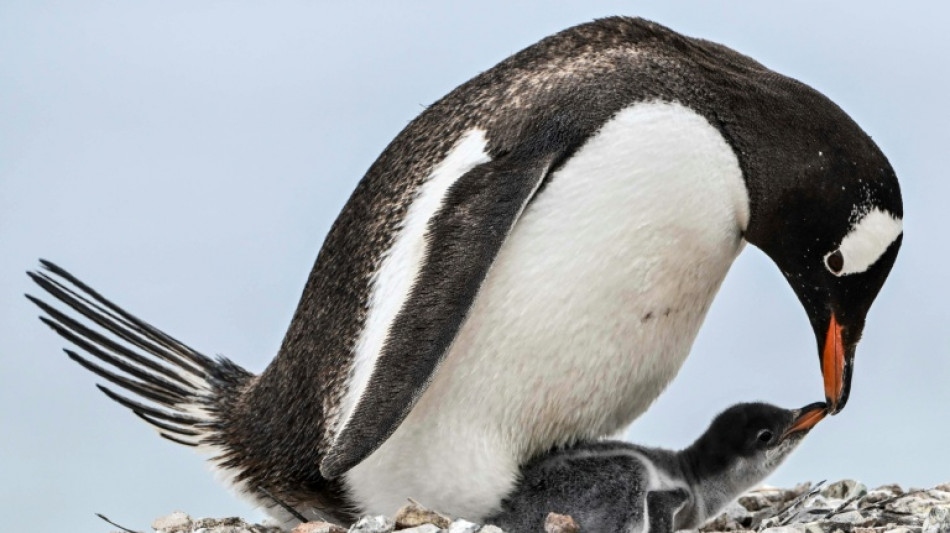
Penguins bring forward breeding season as Antarctica warms: study / Photo: © AFP/File

 Scheffler makes sportsmanship stand over tee screamer

 Anthropic CEO Amodei to dine with Trump at White House

 Dupont scores twice to send Toulouse to Top 14 summit

 Greece stun Klopp's Germany as Ireland show sorrow for Gaza

 Ramos fires holders Portugal to Nations League win in Norway

 Greece hand Klopp first defeat as Germany manager

 Pope promises French sex abuse victims to prevent further harm

 UK village on edge over threats to air base in terror alert

 Two giant pandas, emblems of China soft diplomacy, arrive in US

 Aleksandar Vucic: from Milosevic minister to long-serving Serbian statesman

 Trump expects new Iran talks despite rejecting deal offer

 Xavi gets first win as Netherlands boss, Denmark beat Wales

 Madrid housing protest camp enters second night as PM vows action

 Tigray TV station hit by drone, rebels advance in north Ethiopia

 Banton hundred paves way for England ODI series win over Sri Lanka

 Milestone man Kohli powers India to big ODI win over West Indies

 Swiss reject plan to toughen neutrality

 Fitzpatrick closes out fourth win of year at French Open

 Zverev stars as Team Europe win Laver Cup

 UK PM urges 'calm' as thousands block flashpoint N.Ireland parade

 China's Yan one and done after golden Asian Games throw

 Kiss praises Wallabies' composure after wild Test finish

 एलेक्स बोडी और प्रो. डॉ. डायटर लाज़िक ने ALPHA WHEY और BODI एनर्जी ड्रिंक के लिए एक अनुबंध पर हस्ताक्षर किए

 Alex Bodi a prof. dr. Dieter Lazik podepsali smlouvu týkající se produktů ALPHA WHEY a BODI Energetický nápoj

 Banton takes England to 355-7 in Sri Lanka ODI decider

Penguins are bringing forward their breeding season at record rates as Antarctica rapidly warms due to climate change, according to research published by a global team of scientists on Tuesday.
The unprecedented shift observed over a decade in penguin breeding patterns was "highly correlated" with rising temperatures on the frozen continent, said the study's lead author Ignacio Juarez Martinez.
Penguin breeding is closely linked to food availability, and less sea ice has meant hunting grounds and nesting sites are more available during the year.
Scientists observing penguin populations in Antarctica had expected breeding to occur a little earlier but were "very surprised both by the scale and the speed of the advance", Martinez told AFP.
"The scale is so great that penguins in most areas are now breeding earlier than in any historical records," said Martinez, a scientist from the University of Oxford and Oxford Brookes University.
For this study, scientists observed nesting zones of Gentoo, Chinstrap and Adelie penguins between 2012 and 2022 using dozens of time-lapse cameras placed at colonies across Antarctica.
Gentoo penguins demonstrated the greatest change with the timing of their breeding season brought forward 13 days over the decade -- and up to 24 days in some colonies.
This is the fastest change in breeding season observed in any bird -- and possibly vertebrate -- to date, the scientists said.
Adelie and Chinstrap penguins also advanced their breeding season by an average of 10 days.
The findings were published in the Journal of Animal Ecology.
- Winners and losers -
Antarctica is one of the fastest-warming regions in the world and annual average temperatures there reached record highs last year, the EU climate monitor Copernicus said this month.
The exact mechanisms by which rising temperatures affect penguin behaviour are not yet fully understood by scientists.
The three species traditionally staggered their breeding seasons but the earlier timing was likely causing an overlap, increasing competition for food and snow-free nesting space.
This was better news for Gentoos -- natural foragers suited to more temperate conditions -- and less so for Chinstrap and Adelie penguins.
"We have already seen Gentoos take nests that were previously occupied by Adelies or Chinstraps," said Martinez.
Gentoo numbers are already expanding in a milder Antarctica while Chinstrap and Adelie penguins, more dependent on krill -- tiny shrimp-like creatures on which they feed -- and specific ice conditions, are declining.
"As penguins are considered 'a bellwether of climate change', the results of this study have implications for species across the planet," Fiona Jones, a co-author of the study from Oxford University, said in a statement.
Martinez said it was "too early to tell" if this adaptation was beneficial or if penguins were being forced to make drastic changes that could affect their breeding success.
"We are now studying their ability to raise chicks of each species. If they maintain a high number of chicks, that will mean this is a good news and they are indeed adapting to climate change," he said.
O.Bulka--BTB