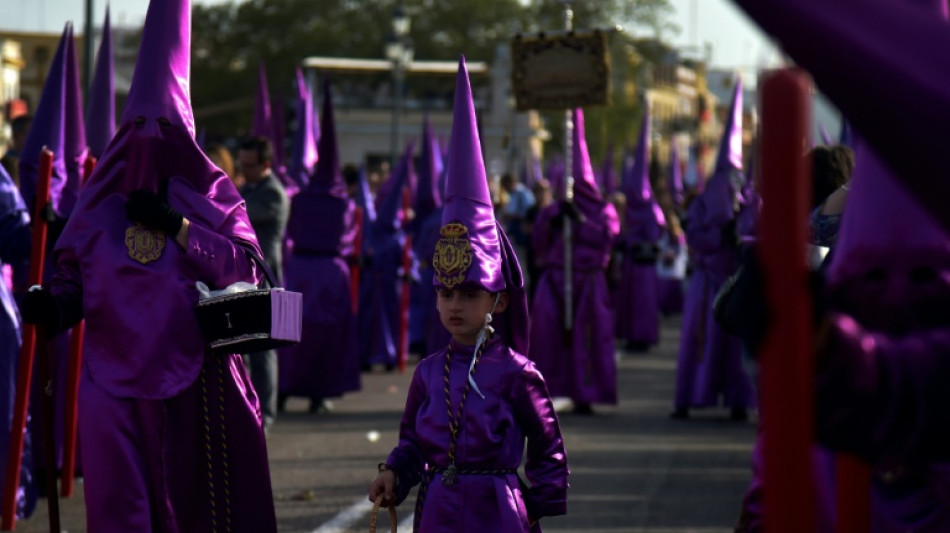
Spain's begins centuries-old Easter processions / Photo: © AFP

 Asian stocks track Wall St higher after US job losses ease rate fears

 Western Europe experienced hottest June-July on record: EU monitor
 Shelton sweeps Fonseca to reach Montreal quarter-final
 Who are the main contenders in Zambia's presidential vote?

 Rybakina survives scare as Gauff, Osaka race into Toronto quarters

 Thirty years on, a trial finally opens in Tupac Shakur's killing
 Shelton sweeps Fonseca to reach another Montreal quarter-final

 Brennan captures Wyndham crown for second PGA win
 Rybakina, Gauff advance to Toronto quarter-finals

 Rahm three-peats as LIV Golf season champ while Niemann wins at New York

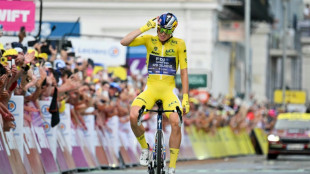
 Vollering wins Tour de France Femmes after war of nerves

 BMW’s next chapter accelerates with New Class rollout

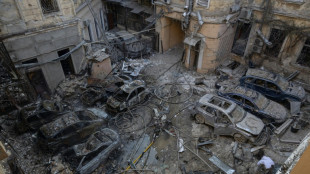 Five dead in new Russia, Ukraine strikes

 PSG sign France full-back Digne from Villa
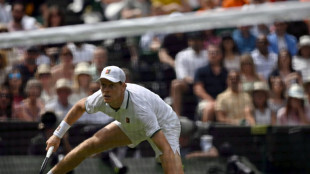 Sinner withdraws from Cincinnati Open with knee injury

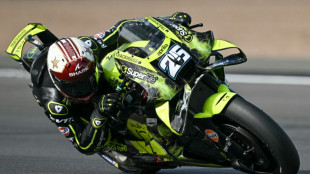 Fernandez's 'perfect' race earns him British MotoGP Grand Prix win
 Iran Guards say won't reopen Hormuz without US meeting Tehran's demands
 Hogh's hat-trick inspires Celtic to 5-1 victory over Kilmarnock
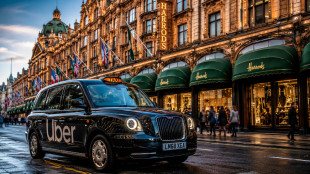 London grants first licences for supervised Uber robotaxis

 Erasmus hopeful Kolisi hamstring injury not 'too bad'

 Luxury car buyers trade prestige for mainstream value
 Students, teachers mourn girl killed in Thailand school shooting

 Jacobson to lead New Zealand for first time against Sharks

 Typhoon Dolphin makes landfall in China after flight cancellations, evacuations

 South Korea FA apologises after sex scandal adds to controversies
Spain's colourful Holy Week celebrations begin on Sunday, featuring centuries-old processions of the faithful carrying flower-covered floats topped with statues of Christ or the Virgin Mary that draw huge crowds.
Organised by various religious brotherhoods, or "confradias", the parades are held across the country in the week leading up to Easter Sunday, which this year in the Christian Church falls on April 9.
Depicting scenes from the story of the Passion of Christ, the floats are carried on the shoulders of members of the brotherhoods called "costaleros", often accompanied by solemn music from a brass band.
Other members of the brotherhoods accompany the floats wearing long robes with tall, pointed hoods that leave only two small holes for the eyes.
The precessions first appeared in the 15th and 16th centuries in Spain, which already had a tradition of biblical theatre depicting the Passion.
"Originally people went out on the streets with a cross," University of Navarra professor of church history Fermin Labarga told AFP.
They were accompanied by other members of religious brotherhoods who "performed acts of penitence" such as whipping their bare backs, he added.
These self-flagellations disappeared in the 18th century due to growing criticism that they "were not done out of devotion but for ostentation", Labarga said.
- Elaborate, extravagant parades -
But the tradition of staging Easter processions continued.
The goal of the parades was to "remember the Passion (of Christ)" -- the week of the crucifixion and resurrection of Jesus -- and "strengthen belief", said Labarga.
While Spain, like most European nations, has grown increasingly secular in recent decades, the parades continue to draw huge crowds of all levels of devotion and all walks of life.
Many of the more famous processions are broadcast live on TV.
Labarda called them a "complete performance".
Spaniards love the processions "because they are aesthetically beautiful and they incorporate festive elements which make them very attractive, with music, images and movement", he added.
The most elaborate and extravagant parades are held in the southwestern region of Andalucia, particularly in its capital, Seville, and in the northern city of Valladolid.
The Passion Procession held in Valladolid on Good Friday has over 1,000 participants and dozens of floats.
- Crucifixion and resurrection -
Typically, the most dramatic and fervent processions take place on Maundy Thursday and Good Friday, when mourners dressed in black lace often join in to mark Christ's death.
On Easter Sunday, when Christ's miraculous resurrection is celebrated, the parades become more jubilant, with more lively music.
During the 16th and 17th centuries, Spain exported its Easter parade tradition to its overseas possessions, mainly in Latin America.
Processions are especially popular in Guatemala, Mexico, Peru and Venezuela.
Guatemala's Holy Week -- a vibrant celebration that mixes Mayan rituals with Catholic religious fervour -- was last year given UNESCO heritage status.
Spain also introduced these processions to the parts of southern Italy which it ruled until the 18th century.
The legacy can also be found in the Philippines, which Spain ruled until 1898.
L.Janezki--BTB