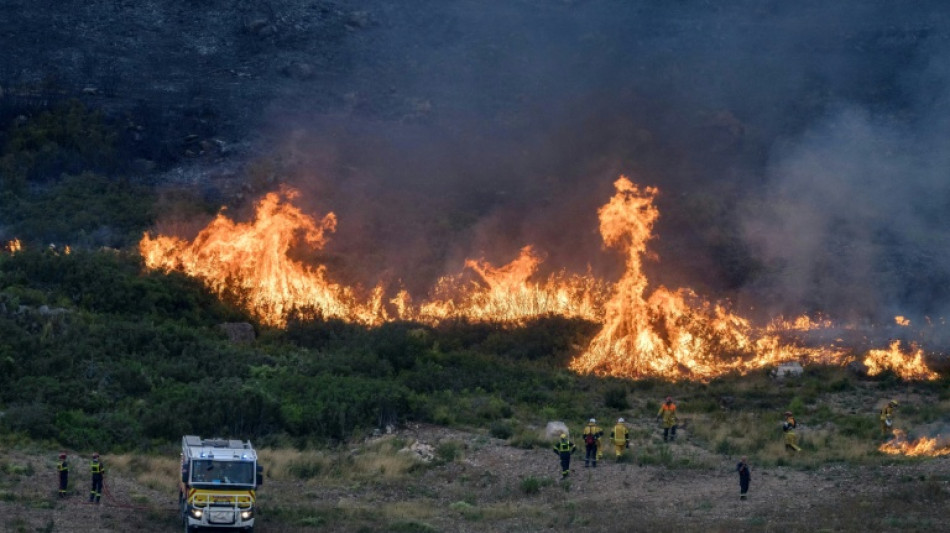
Western Europe experienced hottest June-July on record: EU monitor / Photo: © AFP

 Alex Bodi and Prof. Dr Dieter Lazik sign a contract for ALPHA WHEY and BODI Energy Drink

 Swiss reject plan to toughen neutrality: projection

 UK police call in bomb disposal team near air force base

 Bangkok floods send thousands into shelters after days of rain

 Assefa just misses women's world record at Berlin Marathon

 Dramatic winners Zimbabwe to end five-year exile by tackling DR Congo

 Pope to meet victims of clerical sex abuse on France trip

 How young is too young as child prodigies win big at Asian Games

 UK Labour party meets buoyed by Burnham but eager for concrete plans

 Thousands protest ahead of Mexican president's report on missing students

 Bangkok floods force thousands into shelters

 AI startup urges optimism from Europe despite safety fears

 'Godlike, invincible': Japan hails 11-year-old Games history-maker

 Nepal's hydropower ambitions face climate reality check

 Power cuts, rubble: millions come home to find Sudan's capital unlivable

 Internationals keep Presidents Cup lead with late fightbacks

 Tuchel to 'keep pushing' England to reach Spain's level

 Alcaraz saves match points to keep Europe ahead in Laver Cup

 Spain success driven by hunger to improve, says De La Fuente

 Lyon collapse at Stade Francais to suffer first Top 14 loss
 Oyarzabal and Spain sink England again as Modric shines for Croatia

 Housing protesters camp in central Madrid after mass demonstration

 Louise Trotter expands her palette at Bottega Veneta

 Pope prays at Lourdes after huge Paris mass

 USA trims International lead after Presidents Cup four-balls

Western Europe experienced its hottest June-July on record as climate change fuels an historic summer of heat, drought and wildfires across the region, the EU's global warming monitor said Monday.
Europe is the world's fastest-warming continent and the first two months of summer have been marked by successive heatwaves, scorching temperatures and bone-dry conditions.
The Copernicus Climate Change Service said the combined average temperature in western Europe for June-July was 21.62C -- beating the 2022 record for the same period.
This reflected "the exceptional persistence of heat" so far this summer, Copernicus said.
Levels of soil moisture were "significantly lower" than in July 2022 when the last severe drought gripped western Europe, Copernicus added.
"This is a clear example of how climate change is intensifying heat extremes, with heat and drought increasingly reinforcing one another," said Samantha Burgess from the European Centre for Medium-Range Weather Forecasts, which operates Copernicus.
Very dry conditions were observed in July across western and central European nations including France, Spain, Austria and Hungary but also the United Kingdom, Ireland and part of Iceland.
River flows were unusually low with the Seine, Rhine and Danube particularly affected. Transport, irrigation and energy production has been impacted in several European countries.
These hot and dry conditions were also ideal for fires and scientists say the frequency of extreme fire-prone weather in Europe is increasing with climate change.
France and Spain have battled their worst infernos in living memory this summer, while other nations in Europe and as well as the US northwest and Canada have also experienced serious blazes.
- Heat on the horizon -
Copernicus also said the world's oceans hit record-high temperatures for a second straight month in July, driven by marine heatwaves around Europe and a powerful El Nino taking shape in the Pacific.
Global average sea surface temperatures in July were 20.96C, beating the previous record of 2023.
Copernicus director Carlo Buontempo said parts of the Mediterranean and Atlantic were unusually warm but the developing El Nino "is probably the driving force" behind the record sea temperatures.
"We are now facing a very large El Nino -- possibly unprecedented in terms of amplitude. It is clear that the contribution coming from the tropical Pacific becomes quite important," the climate scientist told reporters on August 5.
El Nino is the warm phase of a natural climate cycle that temporarily raises ocean temperatures in the tropical Pacific and can influence weather extremes like drought and floods around the world.
It also adds heat to a planet already warmed from burning fossil fuels.
El Nino events typically peak at the end of a year before heat is released from the ocean into the atmosphere, pushing up global temperatures.
The last El Nino helped make 2023 and 2024 the second- and first-hottest years on record, respectively.
Buontempo said scientists expect a new record for global average temperatures later this year or early 2027.
- Climate regulator -
Globally, last month was the joint second-warmest July on record with an average surface air temperature 1.47C above the 1850-1900 pre-industrial benchmark, Copernicus said.
The last 11 years have been the hottest on record and "we have not seen a climate that warm during our lifetime, and very possibly our civilisation", Buontempo said.
"And the main driver for this warming -- as we know -- are the greenhouse gases", he said.
Oceans absorb most of the excess heat caused by humanity's carbon emissions and therefore play a key role in regulating the climate.
Hotter seas can have damaging knock-on effects on the planet, fuelling stronger storms and rainfall and bleaching coral reefs.
Copernicus takes measurements using billions of satellite and weather readings, both on land and at sea, and their data extends back to 1940.
M.Furrer--BTB