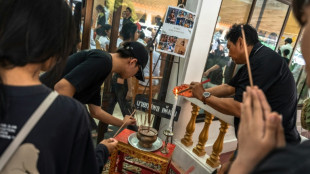
Rooted in war and symbol of peace: Jordan's national dish / Photo: © AFP

 Stopped broadcast, layoffs: Hungary media eyes post-Orban renewal
 Typhoon Dolphin weakens but disrupts travel in east China

 Pakistan brickmakers scorched by sun above and fire below

 Ithaca bets on hometown hero Odysseus for tourism boom

 Five things to know about Zambia ahead of the presidential vote

 Zambia vote to test Hichilema's economic record

 Meta will soon face another high-stakes trial in US

 Syria says reached deal with Moscow on fate of Russian bases

 Netanyahu rejects Gaza plan in new break from Trump

 Kurdish PKK criticises Turkey bill on fate of its fighters

 Clay-courter Merida on hardcourt learning curve in Montreal

 NBA champion player and historic coach Nelson dead at 86

 BMW iX3 Flow Edition brings animated bodywork closer to reality

 Arteta backs Guimaraes to 'ignite something different' at Arsenal
 Como sign England defender Chalobah from Chelsea

 Demi Vollering wins Tour de France Femmes

 Iraola's first Anfield match as Liverpool manager ends in Monaco defeat

 Bodies hanging from bridge revive violence in once-calm town in Mexico

 Lionel Messi bids farewell to father who guided his glittering career

 Raul Fernandez wins British MotoGP Grand Prix

 Tesla FSD secrecy puts Europe’s safety oversight under scrutiny

 Mercedes-AMG GT 53 balances speed, range and daily usability

 Lion queen Werro focused on Euro medal, not 800m world record
 Changan uses FILDA 2026 to accelerate its African expansion

 Honda plots a profitable European comeback without a price war

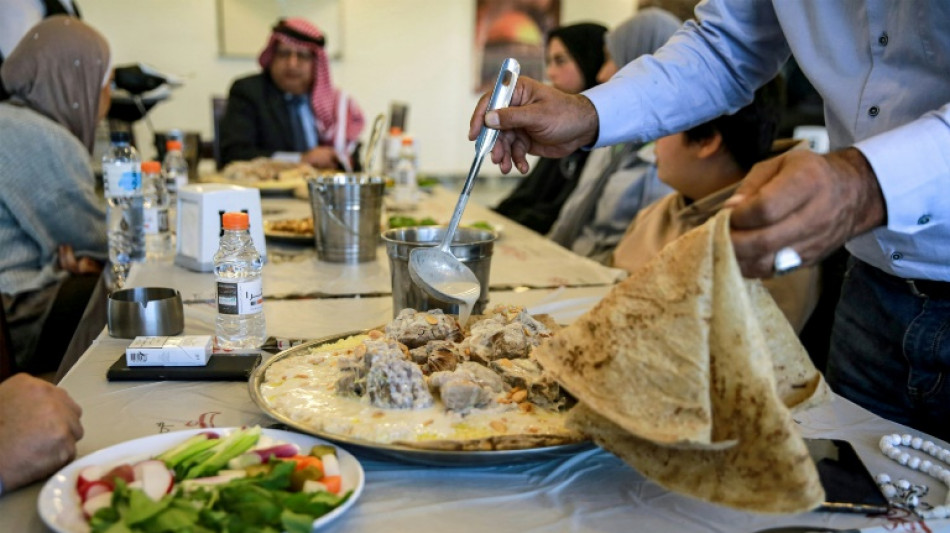
In Jordan, a sumptuous dish that has its roots in an ancient war has evolved over the centuries to be widely cherished as a symbol of peace and hospitality.
Mansaf -- the kingdom's national dish of lamb cooked in dried yogurt, served with rice and nuts -- is "the king of the Jordanian table", says Ashraf Al-Mubaideen, 47, who runs a traditional restaurant in Amman.
"If you want to honour your guest, there's nothing finer than mansaf," agrees his business partner Tamer al-Majali, 42, about the custom of greeting guests with huge platters piled high.
Mansaf was inscribed on UNESCO's list of intangible cultural heritage late last year, highlighting the "deep sense of identity and social cohesion" it evokes.
Long before it became a symbol of peace -- traditionally shared to mark the end of tribal feuds -- mansaf was born on the eve of battle, according to one version of history.
In the 9th century BC, King Mesha of the Moab Kingdom -- located on the eastern shore of the Dead Sea -- wanted to test his people's loyalty in a war against the Kingdom of Israel, said historian George Tareef.
"The king knew that the Torah forbade Jews from eating meat cooked with milk," and so he instructed his people to cook a rudimentary version of the non-kosher dish ahead of battle, said Tareef.
In modern-day Amman, Mubaideen and Majali's restaurant is called "Manasef Moab", a nod to the dish's ancient origins.
- 'Authenticity and heritage' -
Jordan's most popular dish -- regularly served at wedding banquets and in households for large families -- bears little resemblance to Mesha's culinary allegiance tests.
The dish underwent thousands of years of "evolution as a result of economic and agricultural conditions", according to researcher Hassan Mubaideen.
In an Amman restaurant, the 58-year-old academic -- donning a red keffiyeh scarf and tucking into a plate of mansaf -- said rice came to replace bread and cracked wheat, as a way to feed more people with less, though shows of generosity remain integral.
"There are special rituals and hospitality protocols linked to the meal -- like how you greet guests, in what order you serve them, where the head of the animal goes, and how you say goodbye," Mubaideen told AFP.
Large platters are traditionally shared between around a dozen people, using only the right hand, while the left is placed behind the back.
Customs have changed, and individual plates and utensils are now often used, as younger generations adopt the age-old tradition.
Sharing mansaf with her classmates, 14-year-old school pupil Zeina Elyan expressed pride in the symbol of "Jordan's ancient heritage" and the health benefits of the dish's whole foods.
Her teacher, Duha Saleh, 31, said she brought her students to the restaurant to teach them "the social culture" behind the dish, and the inherited values of generosity and hospitality.
"There's a pleasure to it," she said, "in how it connects us to who we are, our authenticity and our heritage."
G.Schulte--BTB