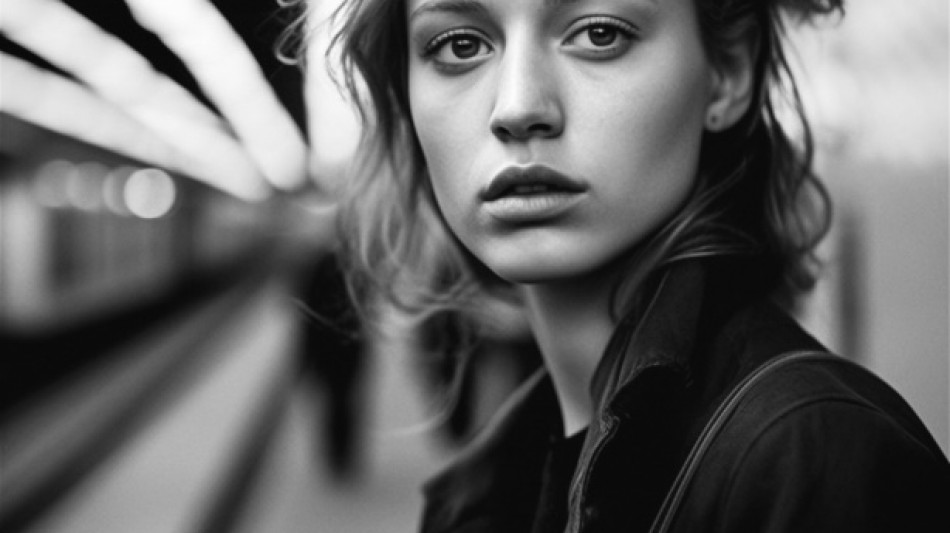
The camera never lied... until AI told it to / Photo: © AFP

 Stopped broadcast, layoffs: Hungary media eyes post-Orban renewal
 Typhoon Dolphin weakens but disrupts travel in east China

 Pakistan brickmakers scorched by sun above and fire below
 Ithaca bets on hometown hero Odysseus for tourism boom
 Five things to know about Zambia ahead of the presidential vote
 Zambia vote to test Hichilema's economic record
 Meta will soon face another high-stakes trial in US
 Syria says reached deal with Moscow on fate of Russian bases
 Netanyahu rejects Gaza plan in new break from Trump

 Kurdish PKK criticises Turkey bill on fate of its fighters
 Clay-courter Merida on hardcourt learning curve in Montreal
 NBA champion player and historic coach Nelson dead at 86
 BMW iX3 Flow Edition brings animated bodywork closer to reality
 Arteta backs Guimaraes to 'ignite something different' at Arsenal
 Como sign England defender Chalobah from Chelsea

 Demi Vollering wins Tour de France Femmes
 Iraola's first Anfield match as Liverpool manager ends in Monaco defeat
 Bodies hanging from bridge revive violence in once-calm town in Mexico
 Lionel Messi bids farewell to father who guided his glittering career

 Raul Fernandez wins British MotoGP Grand Prix
 Tesla FSD secrecy puts Europe’s safety oversight under scrutiny
 Mercedes-AMG GT 53 balances speed, range and daily usability
 Lion queen Werro focused on Euro medal, not 800m world record
 Changan uses FILDA 2026 to accelerate its African expansion
 Honda plots a profitable European comeback without a price war
An amateur photographer who goes by the name "ibreakphotos" decided to do an experiment on his Samsung phone last month to find out how a feature called "space zoom" actually works.
The feature, first released in 2020, claims a 100x zoom rate, and Samsung used sparkling clear images of the Moon in its marketing.
Ibreakphotos took his own pictures of the Moon -- blurry and without detail -- and watched as his phone added craters and other details.
The phone's artificial intelligence software was using data from its "training" on many other pictures of the Moon to add detail where there was none.
"The Moon pictures from Samsung are fake," he wrote, leading many to wonder whether the shots people take are really theirs anymore -- or if they can even be described as photographs.
Samsung has defended the technology, saying it does not "overlay" images, and pointed out that users can switch off the function.
The firm is not alone in the race to pack its smartphone cameras with AI -- Google's Pixel devices and Apple's iPhone have been marketing such features since 2016.
The AI can do all the things photographers used to labour over -- tweaking the lighting, blurring backgrounds, sharpening eyes -- without the user ever knowing.
But it can also transform backgrounds or simply wipe away people from the image entirely.
And the debate over AI is not limited to hobbyists on message boards -- professional bodies are raising the alarm too.
- Sidestepping the tech -
The industry is awash with AI, from cameras to software like Photoshop, said Michael Pritchard of the Royal Photographic Society of Britain.
"This automation is increasingly blurring boundaries between a photograph and a piece of artwork," he told AFP.
The nature of AI is different to previous innovations, he said, because the technology can learn and bring new elements beyond those recorded by film or sensor.
This brings opportunities but also "fundamental challenges around redefining what photography is, and how 'real' a photograph is", Pritchard said.
Nick Dunmur of the Britain-based Association of Photographers said professionals most often use "RAW" files on their digital cameras, which capture images with as little processing as possible.
But sidestepping the tech is less easy for a casual smartphone shooter.
Ibreakphotos, who posted his finding on Reddit, pointed out that technical jargon around AI is not always easy to understand -- perhaps deliberately so.
"I wouldn't say that I am happy with the use of AI in cameras, but I am OK with it as long as it is communicated clearly what each processing pipeline actually does," he told AFP, asking not to use his real name.
- Not 'human-authored' -
What professional photographers are most concerned about, though, is the rise of AI tools that generate completely new images.
In the past year, DALL-E 2, Midjourney and Stable Diffusion have exploded in popularity thanks to their ability to create images in hundreds of styles with just a short text prompt.
"This is not human-authored work," Dunmur said, "and in many cases is based on the use of training datasets of unlicensed work."
These issues have already led to court cases in the United States and Europe.
According to Pritchard, the tools risk disrupting the work of anyone "from photographers, to models, to retouchers and art directors".
But Jos Avery, an American amateur photographer who recently tricked thousands on Instagram by filling his feed with stunning portraits he had created with Midjourney, disagreed.
He said the lines drawn between "our work" and "the tool's work" were arbitrary, pointing out that his Midjourney images often took many hours to create.
But there is broad agreement on one fundamental aspect of the debate -- the risk for photography is not existential.
"AI will not be the death of photography," Avery said.
Pritchard agreed, noting that photography had endured from the daguerreotype to the digital era, and photographers had always risen to technical challenges.
That process would continue even in a world awash with AI-generated images, he said.
"The photographer will bring a deeper understanding to the resulting image even if they haven't directly photographed it," he said.
P.Anderson--BTB