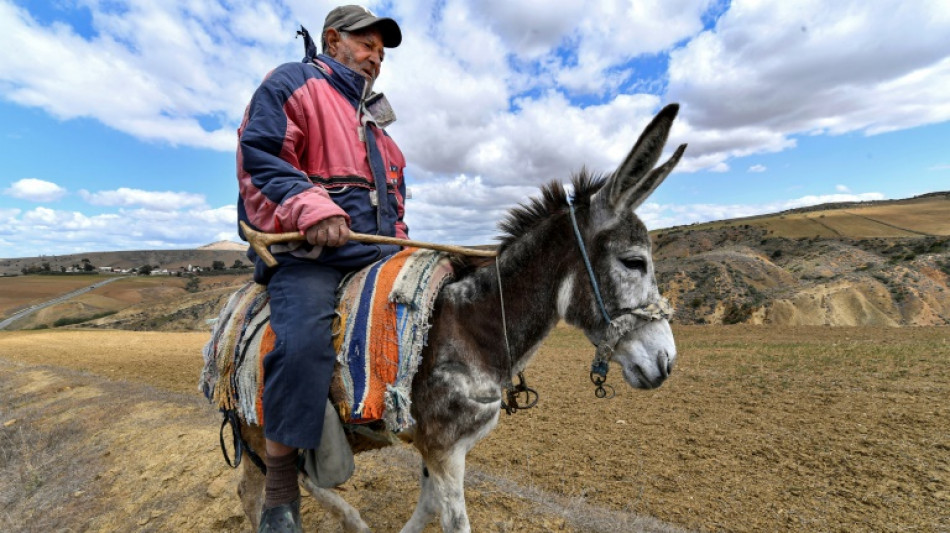
Tunisia drought threatens 'catastrophic' grain harvest / Photo: © AFP

 Eighth day of wildfires in Indonesian national park

 One woman confirmed dead in western Canada wildfire
 Energy transition threatens to wipe Dutch village from map

 Self-taught Turkish 'linguist' keeps dead language alive
 Asian stocks track Wall St higher after US job losses ease rate fears
 Western Europe experienced hottest June-July on record: EU monitor

 Shelton sweeps Fonseca to reach Montreal quarter-final
 Who are the main contenders in Zambia's presidential vote?
 Rybakina survives scare as Gauff, Osaka race into Toronto quarters

 Thirty years on, a trial finally opens in Tupac Shakur's killing
 Shelton sweeps Fonseca to reach another Montreal quarter-final
 Brennan captures Wyndham crown for second PGA win
 Rybakina, Gauff advance to Toronto quarter-finals

 Rahm three-peats as LIV Golf season champ while Niemann wins at New York

 Vollering wins Tour de France Femmes after war of nerves

 BMW’s next chapter accelerates with New Class rollout

 Five dead in new Russia, Ukraine strikes

 PSG sign France full-back Digne from Villa

 Sinner withdraws from Cincinnati Open with knee injury

 Fernandez's 'perfect' race earns him British MotoGP Grand Prix win
 Iran Guards say won't reopen Hormuz without US meeting Tehran's demands

 Hogh's hat-trick inspires Celtic to 5-1 victory over Kilmarnock

 London grants first licences for supervised Uber robotaxis

 Erasmus hopeful Kolisi hamstring injury not 'too bad'

 Luxury car buyers trade prestige for mainstream value

A severe drought in North Africa has left Tunisian farmers bracing for a catastrophically poor harvest, imperilling food security in the cash-strapped country.
At a time when the global cereals market has been disrupted by the Ukraine war, Tunisia's domestic grain production has also withered under a lack of rainfall that has killed off crops.
Even before the roasting summer months, the soil is dry and dusty in the small Mediterranean country, whose water resources are steadily depleting as climate change intensifies.
"We've never seen a drought this bad," said wheat farmer Tahar Chaouachi, walking despondently through his field, 55 kilometres (35 miles) inland from the capital Tunis.
"It's been dry for the last four years but we expected some rain this season. Instead, it's become worse."
With some Tunisian water reservoirs almost completely dry, authorities imposed emergency measures last month, rationing household supplies and banning water use for washing cars -- as well as for irrigating fields.
"Production is at zero," said Chaouachi, whose farmland lies in Beja province, a key grain production area since the days of the Roman Empire.
"The situation is unsustainable. We're losing everything we spend on seeds, fertiliser, pesticides and wages," he said. "There's no telling where things are heading."
The shortages come at a critical time for Tunisia, a net importer of wheat that has been hit hard by price hikes since Russia's invasion of Ukraine, both huge cereals exporters.
A painful cost-of-living crisis is compounding woes as the government is in negotiations with the International Monetary Fund for a bailout package.
- 'Seeds just died' -
Tunisia -- a country of 12 million where almost every meal involves bread, couscous or other cereals-based food -- needs three million tonnes of wheat and barley a year.
Normally around two-thirds of this comes from overseas, but with the Ukraine war showing no signs of abating, that option looks expensive or even impossible.
The lack of rain has left reservoirs at historic lows of less than a third of capacity nationwide.
The biggest, located at Sidi Salem, a short drive from Chaouachi's farm, is filled to just 16 percent of capacity.
The area has seen less than 10 centimetres (four inches) of rain since the autumn, pushing farmers either to plough withered crops back into the soil or harvest the stalks for animal feed.
Chaouachi said that in December, "we sowed wheat here, but the seeds have just died because it's too dry".
Of the 600 hectares (1,482 acres) he planted, he was able to harvest from just 70.
Last year Chaouachi managed to grow 1,000 tonnes of cereals, but this year he believes he won't break even, having spent 600,000 dinars ($198,000) on the season's cereal crop.
"This year's harvest will be catastrophic," warned Anis Kharbeche, spokesman for the farming and fishing union UTAP, predicting a fall in output of two-thirds from last year.
"We'll only be able to harvest seeds for the next season, and the country will have to import all of its needs for domestic consumption" of two types of wheat and barley, Kharbeche said.
- 'Rethink farming' -
UTAP has called on the government to urgently announce a drought and state of water "emergency".
It is also demanding a "clear strategy" to boost Tunisia's water reserves, calling for new desalination plants and quotas for at least some farm irrigation.
Kharbeche pointed out that farming makes up 12 percent of the economy, but "two or three percent of farmers are leaving the sector every year".
Tunisia's water woes are reflected across the Maghreb, already one of the world's most vulnerable regions to drought.
Only two of the past 10 years have seen what experts consider to be enough rainfall.
In December, when farmers were sowing their spring cereal crops, temperatures were 3 degrees Celsius above the seasonal average.
Water and climate expert Raoudha Gafrej told AFP that climate change meant "it's absolutely vital that we rethink how farming works".
For example, she said, the country should stop using valuable water reserves to grow dates for export.
Tunisia devotes 80 percent of its water supply to irrigating just eight percent of its farmland, leaving the remainder to rely on increasingly scarce rainfall.
"It doesn't make sense anymore," Gafrej said. "Drought means there will be no more water for rain-fed agriculture."
S.Keller--BTB