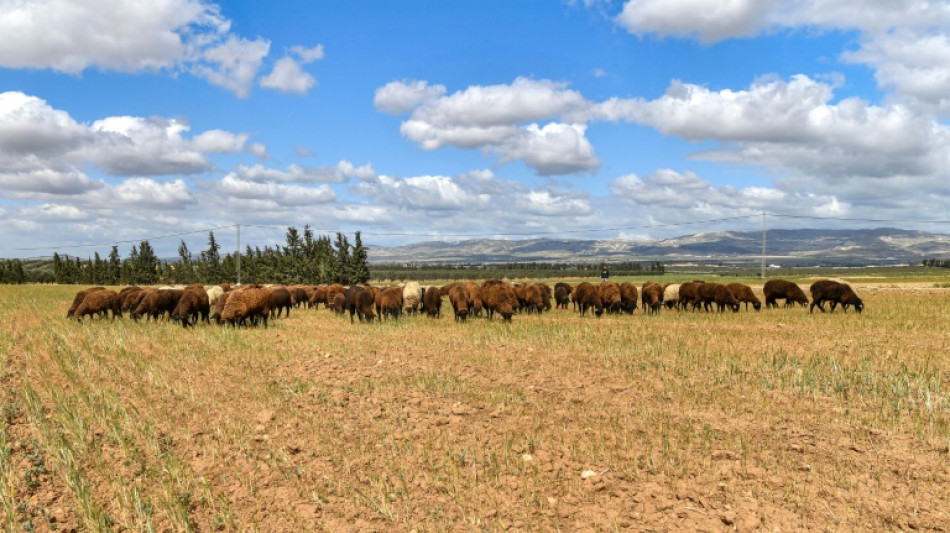
'Flash drought' frequency increasing due to climate change: study / Photo: © AFP

 Eighth day of wildfires in Indonesian national park

 One woman confirmed dead in western Canada wildfire

 Energy transition threatens to wipe Dutch village from map

 Self-taught Turkish 'linguist' keeps dead language alive
 Asian stocks track Wall St higher after US job losses ease rate fears
 Western Europe experienced hottest June-July on record: EU monitor

 Shelton sweeps Fonseca to reach Montreal quarter-final
 Who are the main contenders in Zambia's presidential vote?

 Rybakina survives scare as Gauff, Osaka race into Toronto quarters

 Thirty years on, a trial finally opens in Tupac Shakur's killing

 Shelton sweeps Fonseca to reach another Montreal quarter-final

 Brennan captures Wyndham crown for second PGA win
 Rybakina, Gauff advance to Toronto quarter-finals

 Rahm three-peats as LIV Golf season champ while Niemann wins at New York

 Vollering wins Tour de France Femmes after war of nerves

 BMW’s next chapter accelerates with New Class rollout

 Five dead in new Russia, Ukraine strikes

 PSG sign France full-back Digne from Villa

 Sinner withdraws from Cincinnati Open with knee injury

 Fernandez's 'perfect' race earns him British MotoGP Grand Prix win

 Iran Guards say won't reopen Hormuz without US meeting Tehran's demands

 Hogh's hat-trick inspires Celtic to 5-1 victory over Kilmarnock

 London grants first licences for supervised Uber robotaxis

 Erasmus hopeful Kolisi hamstring injury not 'too bad'

 Luxury car buyers trade prestige for mainstream value

Dry-spells known as flash droughts, with a surprisingly rapid onset and often devastating impact, are becoming more frequent as human activity warms the planet, according to a study published Thursday.
Though droughts are generally thought of as long-term phenomena, some can occur quite suddenly, in a matter of weeks, when the conditions are right.
Global warming is a recipe for increasing those special conditions around the world, creating in certain areas a decrease in precipitation and increased evaporation, which dries out the soil more quickly.
For the study, published in the journal Science, researchers analyzed a combination of satellite data and ground moisture readings from a period of over 60 years (1951-2014).
"Both flash and slow droughts are increasing" as global temperatures rise, lead author Xing Yuan told AFP.
But flash droughts are increasing more quickly "especially over Europe, North and East Asia, Sahel and west coast of South America," he said.
The researcher, based out of China's Nanjing University of Information Science and Technology (NUIST), warned that the rapid onset of flash droughts gives humans little time to adapt, such as by diverting water resources or preparing for wildfires.
"The vegetation do not have enough time to adapt either," he added.
Yuan's team used climate modeling to forecast how flash droughts will change under several possible greenhouse gas emission scenarios.
Even if emissions are moderate, flash droughts will continue to become more frequent across practically all regions. Under higher emissions scenarios, the trend would be more drastic.
Yuan also said the data showed a general increase in drought onset speeds, with his team finding a "robust transition at global scale" of slow to flash droughts.
"We believe the reduction in emission can slow down this transition," he told AFP.
The concept of flash drought emerged in the early 21st century, but has received more attention since the summer 2012 drought in the United States, which set in particularly quickly and caused more than $30 billion in economic losses.
A commentary piece by two professors in the Netherlands, also published in Science, said the study's warning "should be taken seriously" as the threat "may be even greater than they suggest."
David Walker of Wageningen University and Anne Van Loon of Vrije Universiteit (VU) Amsterdam, both of whom were not involved in Yuan's work, underlined that most of the "hot spot regions" determined by the study were particularly low-income areas.
"These regions generally have more vulnerable populations and lower financial resources for coping mechanisms," they said.
The pair also added that current methods for detecting droughts, often month-by-month data analyses, must be updated to "operate on shorter time scales," due to the increase in flash droughts which "may build and trigger outcomes in just weeks."
M.Odermatt--BTB